Why this chapter matters. This chapter gave 4 questions in the 6 papers from CDS I 2024 to CDS II 2026: one in CDS I 2024, one in CDS II 2024 and two in CDS I 2026. That is two questions in every three papers. Not one of them was a calculation. Two were on how heat travels (which everyday case is convection; the quickest way to cool hot rice), one asked for the triple point of water, and one asked which of four substances conducts heat worst. So learn sections 7 to 10 (conduction, convection, radiation, cooling) and the triple point in section 4 first. Latent heat and the ice-and-water sums in sections 3 and 6 have not been asked in these six papers, but they are standard and take little time.
What you will be able to do
- Name each change of state and say why the temperature stays constant while it happens.
- Use Q = mL together with Q = mc\,\Delta T in ice-and-water calculations.
- Explain how pressure and dissolved salt change the melting point and the boiling point, and how evaporation cools.
- Tell conduction, convection and radiation apart, give everyday examples of each, and rank common materials by thermal conductivity.
- Say what the triple point of a substance is, and give its value for water.
Before you start you should know: heat, temperature, specific heat capacity and "heat lost = heat gained" (Chapter K1-8), and atmospheric pressure (Chapter K1-2).
1. The changes of state
Matter is commonly found in three states: solid, liquid and gas. Heating or cooling can change one state into another.
| Change | Name | Example |
|---|---|---|
| Solid to liquid | Melting (fusion) | Ice to water |
| Liquid to solid | Freezing (solidification) | Water to ice |
| Liquid to gas | Vaporisation (by boiling or by evaporation) | Water to steam |
| Gas to liquid | Condensation | Steam to water; dew on grass |
| Solid directly to gas | Sublimation | Camphor, naphthalene balls, dry ice (solid carbon dioxide) |
The fixed temperature at which a solid melts is its melting point. The fixed temperature at which a liquid boils is its boiling point. For pure water at normal atmospheric pressure these are 0 °C and 100 °C. Metals melt at much higher temperatures: iron at about 1500 °C.
2. The temperature does not rise during a change of state
Heat a block of ice steadily and watch a thermometer. The readings go like this.
| Stage | What is happening | Temperature |
|---|---|---|
| 1 | Ice below 0 °C warms up | Rises to 0 °C |
| 2 | Ice melts | Stays at 0 °C until all the ice has melted |
| 3 | Water warms up | Rises from 0 °C to 100 °C |
| 4 | Water boils | Stays at 100 °C until all the water has become steam |
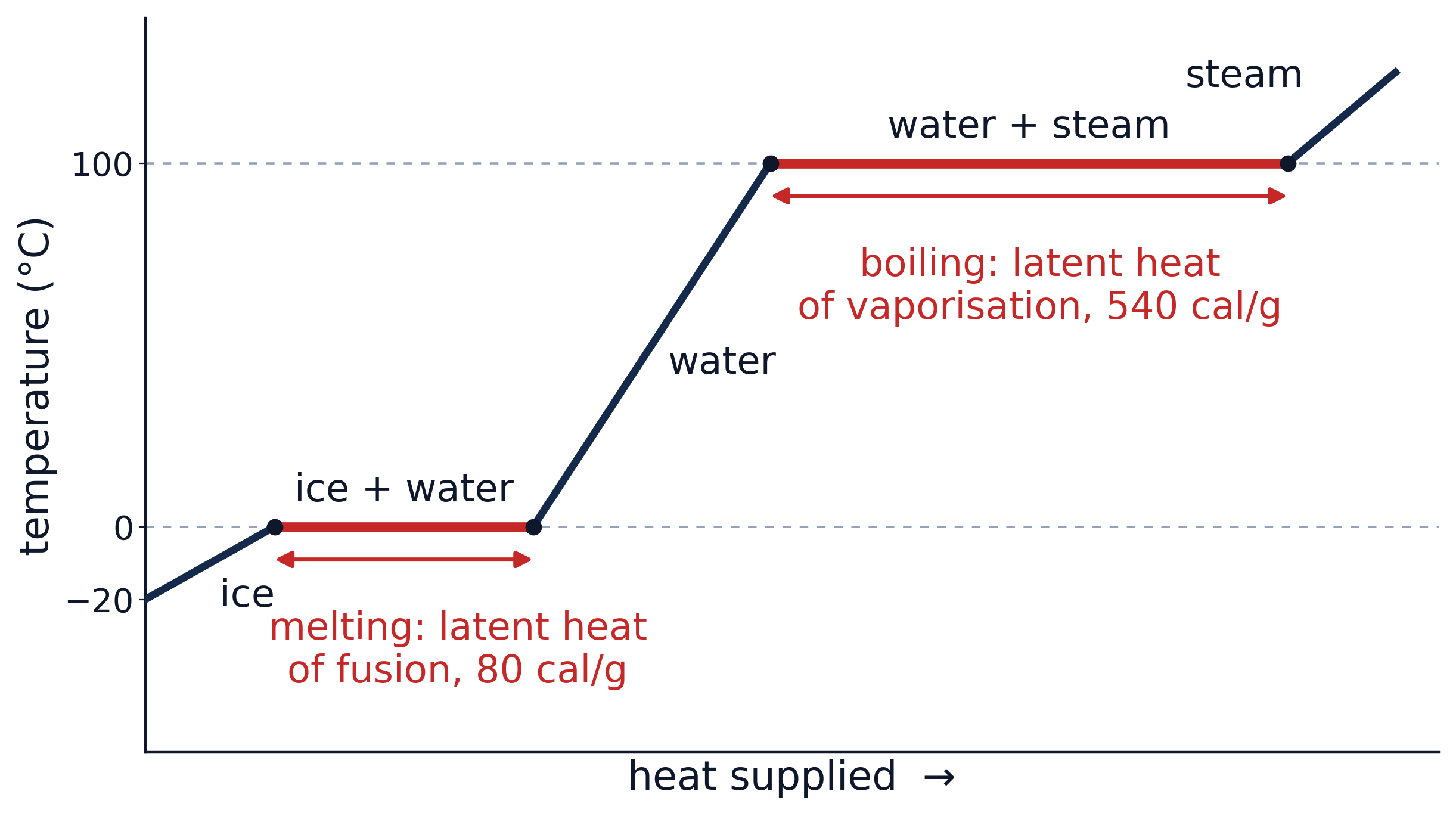
In stages 2 and 4 heat is going in all the time, yet the temperature does not rise. The heat is used to pull the molecules apart against the forces that hold them together. It does not make them move faster, so the temperature does not change.
3. Latent heat
The heat taken in or given out during a change of state, with no change in temperature, is called latent heat. "Latent" means hidden: the thermometer does not show it.
The specific latent heat L of a substance is the heat needed to change the state of unit mass of it without any change in temperature.
Q = mL
| Quantity | Value for water | In calories |
|---|---|---|
| Specific latent heat of fusion of ice (ice at 0 °C to water at 0 °C) | About 3.34 \times 10^5 J/kg | About 80 cal/g |
| Specific latent heat of vaporisation of water (water at 100 °C to steam at 100 °C) | About 22.6 \times 10^5 J/kg | About 540 cal/g |
| SI unit of specific latent heat | J/kg (joule per kilogram) |
The same heat is given out when steam condenses or water freezes.
Both values for water are high. Three results follow:
- Steam at 100 °C burns the skin more severely than boiling water at 100 °C. Each gram of steam gives out 540 calories as it condenses on the skin, and only then does it start to cool like hot water.
- Ice at 0 °C cools a drink better than the same mass of water at 0 °C. Each gram of ice takes 80 calories from the drink just to melt.
- Lakes and snowfields take a long time to freeze and a long time to melt. This steadies the temperature around them.
Example. The heat needed to melt 2 kg of ice at 0 °C is Q = mL = 2 \times 3.34 \times 10^5 = 6.68 \times 10^5 J. The temperature of the water formed is still 0 °C.
4. What changes the melting point and the boiling point; the triple point
| Change | Effect | Where you see it |
|---|---|---|
| More pressure on a liquid | Boiling point rises | In a pressure cooker water boils at about 120 °C, so food cooks faster |
| Less pressure on a liquid | Boiling point falls | On a high mountain the air pressure is low and water boils below 100 °C. Food takes longer to cook at a high-altitude post |
| More pressure on ice | Melting point falls slightly | Two pieces of ice pressed together join into one: the ice melts where it is pressed and freezes again when the pressure is taken off (regelation) |
| Salt or another substance dissolved in water | Freezing point falls, boiling point rises | Ice mixed with salt (a freezing mixture) goes well below 0 °C and is used to make ice cream. Salt is spread on icy roads |
The triple point. Take a substance and mark, on a graph of pressure against temperature, where it is a solid, a liquid and a gas. Three boundary lines appear: the melting (fusion) curve, the boiling (vaporisation) curve and the sublimation curve. The three lines meet at one point. This is the triple point: the one temperature and pressure at which the solid, the liquid and the vapour of the substance exist together in equilibrium.
| Substance | Temperature at the triple point | Pressure at the triple point |
|---|---|---|
| Water | 273.16 K, which is 0.01 °C | About 611 Pa. This is about 0.006 of an atmosphere, or about 4.6 mm of mercury |
| Carbon dioxide | 216.55 K, which is about −56.6 °C | About 5.1 atmospheres |
- 273.16 K is not the ice point. Ice melts at 273.15 K (0 °C) at normal atmospheric pressure. The triple point is one hundredth of a degree higher, at a very low pressure.
- Below its triple-point pressure a substance cannot be a liquid: the solid changes straight to vapour. Normal air pressure, 1 atmosphere, is below the 5.1 atmospheres of carbon dioxide. That is why dry ice sublimes and never forms a puddle.
- A substance has many melting points and boiling points, one for each pressure, but only one triple point. That is why it is used as a fixed point for thermometers.
CDS I 2026 asked for the triple point of water. Take care with the pressure. The NCERT Class 11 Physics book prints it as 6.11 × 10⁻³ Pa, and the option in the paper used the same figure. The measured value is about 611 Pa, that is 6.11 \times 10^{2} Pa. In the exam, pick the option that pairs 273.16 K with the digits 6.11.
5. Boiling and evaporation
Both change a liquid into vapour, but they are not the same.
| Boiling | Evaporation | |
|---|---|---|
| Temperature | Only at the boiling point | At every temperature |
| Where in the liquid | Throughout the liquid (a bulk process) | Only at the surface (a surface process) |
| Speed | Fast | Slow |
| Bubbles | Yes | No |
| Effect on the liquid | Temperature stays constant | The liquid left behind becomes cooler |
What boiling is. The vapour of a liquid has a pressure of its own, called the vapour pressure, and it rises as the liquid gets hotter. A liquid boils at the temperature at which its vapour pressure becomes equal to the atmospheric pressure on it. Bubbles of vapour can then form inside the liquid and rise. So the bubbles in boiling water are water vapour, not air. This definition also explains section 4: lower the outside pressure and the liquid reaches it at a lower temperature.
Evaporation is faster when
- the temperature is higher,
- the surface area is larger (clothes are spread out to dry),
- the wind is stronger,
- the air is drier (less humidity). On a humid day sweat does not dry and we feel sticky.
Evaporation cools. The fastest molecules leave the surface, taking latent heat with them, and the rest of the liquid becomes cooler.
- Sweat cools the body as it evaporates.
- Water in an earthen pot (matka) stays cool: it seeps through the pores and evaporates from the outside.
- Spirit or petrol on the hand feels cold.
- A desert cooler works well in dry heat and poorly in humid weather.
- A dog pants, so that water evaporates from its tongue.
6. Ice-and-water calculations
In these questions calories are easier. Use: specific heat of water 1 cal/g °C, specific heat of ice 0.5 cal/g °C, latent heat of fusion of ice 80 cal/g, latent heat of vaporisation of water 540 cal/g.
Work in steps, one for each stage of section 2, and then use heat lost = heat gained.
Example. 10 g of ice at 0 °C is put into 50 g of water at 40 °C. Find the final temperature, if no heat escapes.
Let the final temperature be T.
- Heat lost by the warm water: 50 \times 1 \times (40 - T).
- Heat gained by the ice: 10 \times 80 to melt, then 10 \times 1 \times T to warm the melted water.
So 2000 - 50T = 800 + 10T, which gives 60T = 1200 and T = 20 °C.
If you forget the 800 calories for melting, you get 33.3 °C, which is the usual wrong option.
7. Conduction
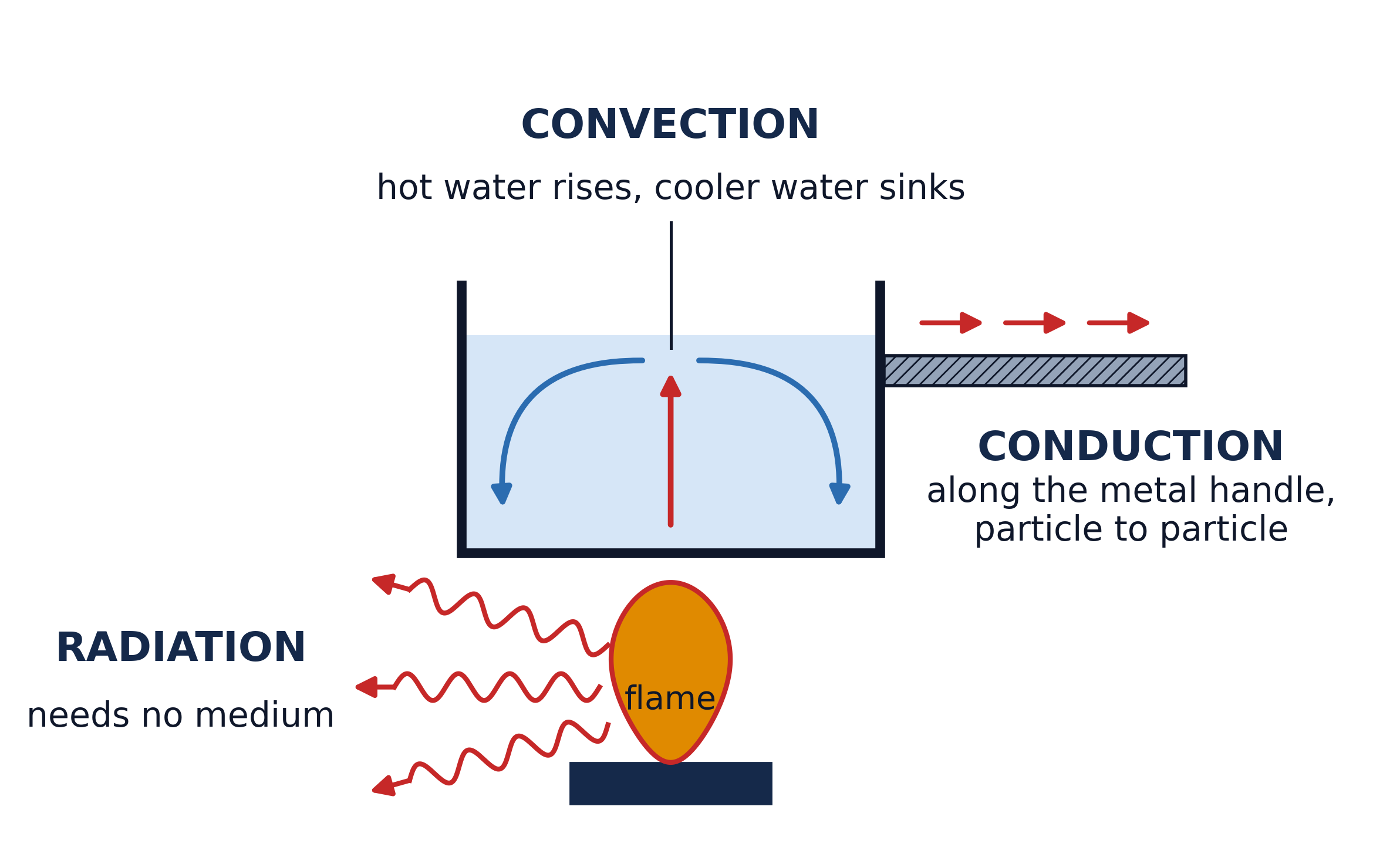
Heat travels in three ways.
In conduction, heat passes from one particle to the next while the particles themselves stay in their places. It is the main way heat travels in solids.
| Examples | |
|---|---|
| Good conductors | Metals: silver (the best), copper, aluminium, iron. Mercury, though a liquid, is a metal and conducts well |
| Poor conductors (insulators) | Wood, glass, plastic, rubber, wool, cork, still air, water |
What follows from this:
- Cooking pots are made of metal, and their handles of wood or plastic.
- A metal chair feels colder than a wooden one in the same room. Both are at the same temperature, but the metal carries heat away from the hand faster.
- Woollen clothes, a quilt and a bird's fluffed feathers keep warmth in because they hold still air, which is a poor conductor. Two thin blankets are warmer than one thick blanket of the same total thickness, because of the layer of air between them.
- An ice box has double walls with an insulating layer between them.
Thermal conductivity. How well a material conducts heat is measured by its coefficient of thermal conductivity, k. Take a slab of area A and thickness L whose two faces are kept at temperatures T_1 and T_2. The heat that flows through it each second is
H = \frac{kA\,(T_1 - T_2)}{L}
So more heat flows through a larger area, a thinner slab, a bigger difference in temperature and a material with a larger k. The SI unit of k is W m⁻¹ K⁻¹ (the same as J s⁻¹ m⁻¹ K⁻¹).
| Group | Material | k in W m⁻¹ K⁻¹ (about) |
|---|---|---|
| Metals | Silver | 406 |
| Copper | 385 | |
| Aluminium | 205 | |
| Steel | 50 | |
| Mercury | 8 | |
| Non-metal solids and liquids | Ice | 1.6 |
| Glass, concrete, water | 0.8 | |
| Wood | 0.12 | |
| Glass wool, felt | 0.04 | |
| Gases | Hydrogen | 0.14 |
| Air | 0.024 |
The values are from the NCERT Class 11 Physics book. Other tables give a little less for water, about 0.6. Learn the pattern, not the numbers: metals are in the hundreds, non-metal solids and liquids are near 1 or below, and gases are the lowest group. CDS I 2026 asked which of hydrogen, water, copper and aluminium has the least thermal conductivity. Hydrogen is a gas, so it is the answer, even though it conducts better than air does.
8. Convection
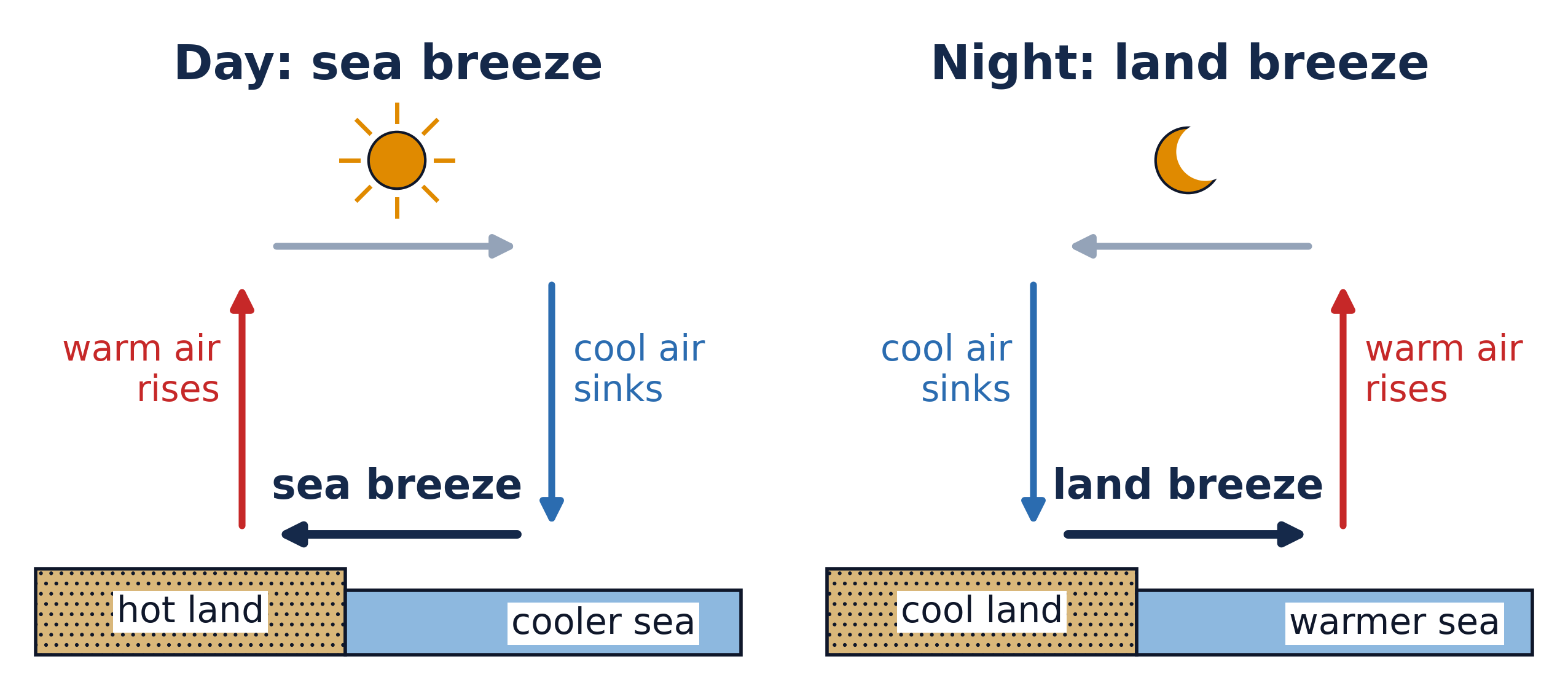
In convection, the heated matter itself moves and carries the heat with it. It happens only in liquids and gases. The heated part expands, becomes less dense and rises. Cooler, denser matter moves in to take its place. This sets up a convection current.
- The heating coil of an electric kettle is at the bottom; the freezing unit of a refrigerator and the air conditioner in a room are near the top.
- Sea breeze and land breeze. Land heats and cools faster than the sea. By day the air over the hot land rises and cool air blows in from the sea (sea breeze). At night the land is cooler, and the breeze blows from the land to the sea (land breeze).
- Ventilators are placed near the ceiling, where the warm air collects.
- Winds and ocean currents are convection on a large scale.
9. Radiation
Radiation needs no medium. Heat travels as electromagnetic waves, mainly infrared waves, in straight lines and at the speed of light. This is how the Sun's heat crosses empty space to reach the Earth, and how you feel the warmth of a fire from the side.
Infrared waves are often called heat waves. The reason is that the water molecules present in most materials readily absorb infrared waves and move faster, so the material warms up.
A microwave oven also heats by radiation. Its waves are microwaves, not infrared, and the water molecules in the food absorb them. It is not conduction and not convection. CDS II 2024 used it as a wrong option in a question on convection.
Every body gives out radiation, and a hotter body gives out more.
| Surface | As an absorber | As an emitter (radiator) | As a reflector |
|---|---|---|---|
| Dull black | Good | Good | Poor |
| White or shiny | Poor | Poor | Good |
- White or light clothes are worn in summer and dark clothes in winter.
- The base of a cooking pot is often left black, to take in heat well.
- A solar cooker is painted black inside and has a mirror to reflect more sunlight into it.
- The walls of a thermos flask are silvered, to send radiation back.
| Conduction | Convection | Radiation | |
|---|---|---|---|
| Medium needed? | Yes | Yes | No; it can cross a vacuum |
| Mainly in | Solids | Liquids and gases | Empty space and transparent materials |
| Do the particles of the medium travel? | No | Yes | No medium is involved |
| Speed | Slow | Faster | The speed of light |
10. Newton's law of cooling
A hot body left in cooler surroundings loses heat. Newton's law of cooling says that the rate at which it loses heat is proportional to the difference between its temperature and the temperature of the surroundings, as long as this difference is not large.
So a cup of tea at 90 °C in a room at 25 °C cools quickly at first and more and more slowly as it comes near 25 °C. The law is about a warm body cooling in its surroundings. It does not describe melting or boiling, where the temperature is not changing.
Cooling something quickly. CDS I 2024 asked for the quickest way to cool a bowl of freshly cooked rice. Put the three ways of heat transfer to work together:
- Stand the bowl in water. Water touches the whole bowl, conducts heat away many times faster than still air does (compare 0.8 with 0.024 in the table of section 7), and has a high specific heat, so it takes in a lot of heat and warms only a little.
- Run a fan at full speed. Moving air carries the warm air away from the surface (forced convection), keeps the difference in temperature large, and speeds up evaporation from the wet rice, which cools it further.
So "bowl in water, fan at full speed" beats a bowl left on the table, a bowl in water with no fan, and a cool room with a slow fan.
What the papers have asked
These are all the questions on this chapter in the 6 papers from CDS I 2024 to CDS II 2026, in our own words. The answers are our own working.
| Paper | The idea asked | The answer in one line |
|---|---|---|
| CDS I 2024 | The quickest way to cool a bowl of freshly cooked rice, from four choices | Stand the bowl in water and run a fan at full speed: conduction into water, plus forced convection and evaporation |
| CDS II 2024 | Which is an example of convection: food in a microwave oven, water boiling in a pot on a gas stove, the warmth of the Sun, or a brass rod heated at one end? | Water boiling in a pot. The microwave oven and the Sun are radiation; the rod is conduction |
| CDS I 2026 | The temperature and pressure of the triple point of water | 273.16 K, with the pressure figure 6.11 (see section 4 for the power of ten) |
| CDS I 2026 | Which of hydrogen, water, copper and aluminium has the least thermal conductivity? | Hydrogen, because it is a gas |
All four are "which one of the following" questions on ideas. None needed a formula. The neighbouring ideas that a paper can pick next are in the same sections: a good absorber is a good emitter, why a pressure cooker cooks faster, boiling against evaporation, sea and land breezes, and Newton's law of cooling.
Worked examples
Example 1. How much heat is needed to change 200 g of ice at 0 °C into water at 30 °C? (Latent heat of fusion of ice = 80 cal/g; specific heat of water = 1 cal/g °C)
(a) 6000 cal (b) 16 000 cal (c) 22 000 cal (d) 22 600 cal
Solution. Two steps. To melt: 200 \times 80 = 16{,}000 cal. To warm the water from 0 °C to 30 °C: 200 \times 1 \times 30 = 6000 cal. Total 22,000 cal. Option (a) leaves out the melting and option (b) leaves out the warming. Answer (c).
Example 2. Consider the following statements:
- While a liquid is boiling, its temperature keeps rising as long as it is heated.
- Water boils at a temperature higher than 100 °C inside a pressure cooker.
Which of the statements given above is/are correct?
(a) 1 only (b) 2 only (c) Both 1 and 2 (d) Neither 1 nor 2
Solution. During boiling the heat supplied is used as latent heat, and the temperature stays constant. Statement 1 is wrong. In a pressure cooker the steam cannot escape, the pressure rises, and a higher pressure raises the boiling point. Statement 2 is correct. Answer (b).
Example 3. Steam at 100 °C causes a worse burn than the same mass of boiling water at 100 °C because
(a) steam is at a higher temperature than boiling water (b) steam gives out its latent heat of vaporisation when it condenses on the skin (c) steam is lighter than water (d) steam has a higher specific heat than water
Solution. Both are at 100 °C, so (a) is false. When steam touches the cooler skin it condenses and gives out about 540 cal for every gram, and then the hot water formed gives out more heat as it cools. Boiling water gives only this second part. Answer (b).
Example 4. Match List I with List II.
| List I (what happens) | List II (way heat travels) |
|---|---|
| A. The handle of a steel spoon left in hot dal becomes hot | 1. Radiation |
| B. A sea breeze blows towards the land on a hot afternoon | 2. Conduction |
| C. You feel warm when you stand in the winter sun | 3. Convection |
(a) A-2, B-3, C-1 (b) A-3, B-2, C-1 (c) A-2, B-1, C-3 (d) A-1, B-3, C-2
Solution. Heat passes along the solid spoon from particle to particle: conduction (A-2). Air over the hot land rises and sea air moves in: convection (B-3). The Sun's heat crosses empty space: radiation (C-1). Option (c) swaps the last two; remember that only radiation can cross a vacuum. Answer (a).
Example 5. Which one of the following will NOT make a wet uniform dry faster?
(a) Spreading it out fully (b) Hanging it in a breeze (c) A rise in the humidity of the air (d) A rise in the temperature of the air
Solution. Evaporation is faster with a larger surface, with wind and with a higher temperature. It is slower when the air already holds a lot of water vapour, that is, when the humidity is high. This is why clothes dry slowly in the rainy season. Answer (c).
Example 6. Why are two thin blankets warmer than one thick blanket of the same total thickness?
(a) Two blankets are heavier (b) The layer of air trapped between them is a poor conductor of heat (c) Two blankets reflect more radiation (d) Wool gives out heat
Solution. A blanket does not give out heat. It only slows the loss of body heat. Still air is a very poor conductor, and the layer of air held between the two blankets adds to the insulation. Answer (b).
Mistakes that cost marks
- Leaving out the latent heat step. Ice must first melt (80 cal/g) before the water from it can warm up. Write one line for each stage.
- Saying the temperature rises during melting or boiling. It stays constant until the change of state is complete.
- Mixing up the effect of pressure. More pressure raises the boiling point (pressure cooker). Less pressure lowers it (mountains).
- Saying a blanket or woollen clothes "give heat". They are insulators. They only stop the body's own heat from escaping.
- Calling every case of heating "conduction". Ask what carries the heat. Particles passing it on while staying in place: conduction. The hot fluid itself moving: convection. Waves, with no medium needed: radiation.
Quick check
Do these without help. Answers are at the end.
- What is the name for the change of a solid directly into a gas? Give one example.
- How much heat is needed to melt 50 g of ice at 0 °C? (Latent heat of fusion = 80 cal/g)
- Why does food cook more slowly at a mountain post?
- By which way does heat travel from the Sun to the Earth, and why not by the other two?
- Why is the freezing unit of a refrigerator placed near the top?
Read and watch more, free
| What | Where | Language |
|---|---|---|
| Textbook | NCERT textbooks, the book menu: Class 11 Physics Part II, Chapter 10 Thermal Properties of Matter (change of state, the triple point, latent heat, conduction and the table of conductivities, convection, radiation, Newton's law of cooling) | English, Hindi |
| Easy first read | NCERT textbooks, the book menu: Class 7 Science Curiosity, Chapter 7 Heat Transfer in Nature | English, Hindi |
| Self-study lesson | NIOS Secondary course, Science and Technology (212), Lesson 14 Thermal Energy; and NIOS Senior Secondary Physics (312), the lesson on heat transfer. Both are on the NIOS website under online course material | English, Hindi |
| The real papers | UPSC previous question papers (CDS, General Knowledge; the physics block is ten questions) | English, Hindi |
| Video, revision in one class | The Journey Extraordinary: GS Revision Package for the 2026 sittings (the physics class, with six years of past questions; about ten hours, so use the part on this chapter) | Hinglish |
| Video, topic classes | CDS Wallah: CDS Exam Full Playlist, CDS 1 2026 (the physics classes; three to six hours each) | Hinglish |
| Video, past questions | Chandigarh Career Group: CDS General Studies PYQ (the channel also has a list of CDS physics past questions) | Hinglish |
The NCERT and NIOS books are named in words because the book pages move; open the book list and choose the class and subject. The videos were chosen from their titles, length and views; they have not yet been watched by a teacher.
Answers to the quick check
- Sublimation. Camphor, naphthalene balls or dry ice.
- 50 \times 80 = 4000 cal.
- The air pressure is lower, so water boils below 100 °C and the food is in cooler water.
- By radiation. Conduction and convection need a medium, and most of the space between the Sun and the Earth is empty.
- Cold air is denser and sinks. A freezing unit at the top cools the whole space by convection.
Next chapter: Sound waves.