Why this chapter matters. This chapter gave 2 questions in the 6 papers from CDS I 2024 to CDS II 2026: one in CDS I 2024 and one in CDS II 2026. That is one question in every three papers, worth 0.83 marks. So this is a short chapter to learn well in one sitting, not one to spend days on. (The magnetic field of an electric current, with its direction rules, is asked far more often. Those questions are counted in Chapter K1-15, and this chapter is the base for them.) One question asked which substance is not ferromagnetic. The other gave four statements about magnetic field lines and asked for the one that is not correct. Learn the table of magnetic materials in section 1 and the six properties of field lines in section 3 first.
What you will be able to do
- Tell natural from artificial magnets, and magnetic from non-magnetic materials.
- State the properties of a magnet and of magnetic field lines, and spot a false statement about them.
- Describe the Earth's magnetic field: where its poles are, and what declination and dip mean.
- Say why soft iron is used for electromagnets and steel for permanent magnets.
Before you start you should know: what a force is, and that a force can act at a distance (Chapter K1-4).
1. Natural and artificial magnets
A magnet is a body that attracts iron and, when free to turn, sets itself in a north-south direction.
Natural magnets. The first magnets known were pieces of a black iron ore called magnetite, an oxide of iron (Fe₃O₄). A piece of it that acts as a magnet is called a lodestone, which means "leading stone", because sailors used it to find direction. Natural magnets are weak and of irregular shape.
Artificial magnets. These are made by people, from iron, steel or special alloys, in whatever shape is useful: bar magnet, horseshoe (U-shaped) magnet, magnetic needle, ring magnet. They are much stronger than lodestone.
| Natural magnet | Artificial magnet | |
|---|---|---|
| Example | Lodestone (magnetite) | Bar magnet, horseshoe magnet, compass needle, electromagnet |
| Strength | Weak | Can be made very strong |
| Shape | Irregular | Any shape needed |
Two ways to make a magnet.
- Stroking. Rub one pole of a magnet along a steel needle, many times, always in the same direction. The needle becomes a magnet.
- Electric current. Put a steel bar inside a coil of wire (a solenoid) and pass a direct current through the coil. This is the method used in industry. A coil with a soft-iron core that is a magnet only while the current flows is an electromagnet (Chapter K1-15).
Which materials does a magnet attract?
| Class (the Class 12 name) | How it behaves near a strong magnet | Examples |
|---|---|---|
| Ferromagnetic | Strongly attracted. These are the "magnetic materials" of everyday speech | Iron, cobalt, nickel, and many of their alloys such as steel |
| Paramagnetic | Very weakly attracted; you do not notice it with an ordinary magnet | Aluminium, sodium, calcium, oxygen |
| Diamagnetic | Very weakly repelled | Copper, silver, gold, bismuth, lead, water, common salt |
So for an ordinary magnet the rule is simple: it picks up iron, cobalt, nickel and things that contain them. It does not pick up plastic, wood, glass, paper, carbon, copper, brass or aluminium. CDS I 2024 asked which of four substances is not ferromagnetic.
A ferromagnetic material loses this strong magnetism when it is heated above a fixed temperature, called its Curie temperature. Above it the material is only paramagnetic. For iron the Curie temperature is about 770 °C (1043 K).
Four finer points, at the level the CDS paper can reach.
- Being a metal is not enough. Silver, gold and copper are diamagnetic. Aluminium is paramagnetic. None of them is picked up by a magnet.
- Containing iron is not enough. Many salts of iron, such as ferric chloride (FeCl₃), are only paramagnetic. Many common kinds of stainless steel are not picked up by a magnet either.
- Diamagnetism is present in every material, but it is very weak. It shows only where the stronger paramagnetism or ferromagnetism is absent.
- A superconductor pushes the magnetic field out of its inside completely. It behaves as a perfect diamagnet. This is called the Meissner effect.
2. Properties of a magnet
| Property | What it means |
|---|---|
| Attractive property | A magnet attracts iron, cobalt and nickel. The pull is strongest near the two ends, called the poles, and weakest at the middle. Dip a bar magnet in iron filings: they cling to the ends |
| Directive property | A magnet hung freely by a thread comes to rest pointing roughly north-south. The end that points north is the north-seeking pole or north pole (N); the other is the south pole (S). The compass depends on this |
| Like poles repel, unlike poles attract | N repels N, S repels S, N attracts S |
| Poles exist in pairs | A single pole has never been found. Break a bar magnet in two and each half is a complete magnet with its own N and S poles. Break it again and the same happens |
| Magnetic induction | A piece of iron near a magnet becomes a magnet itself for the time being, with the opposite pole facing the magnet. That is why it is attracted. "Induction comes before attraction" |
The sure test of a magnet is repulsion. Suppose one end of a bar attracts the N pole of a compass. The bar may be a magnet (its S pole is facing the compass), or it may be a plain piece of iron. You cannot tell. But if an end of the bar repels one pole of the compass, the bar must be a magnet, because only two like poles repel.
The magnetic force acts without contact. A magnet pulls a pin across a gap, through air, paper, glass or a vacuum. Friction needs contact; magnetic, electric and gravitational forces do not.
Losing magnetism. A magnet is weakened by heating it strongly, by hammering it, or by dropping it again and again. Bar magnets are stored in pairs with unlike poles side by side and a piece of soft iron, called a keeper, across each end.
Soft iron and steel.
| Material | Behaviour | Used for |
|---|---|---|
| Soft iron | Easily magnetised, and loses its magnetism as soon as the cause is removed | Cores of electromagnets, electric bells and transformers |
| Steel (and alloys such as alnico) | Harder to magnetise, but keeps its magnetism | Permanent magnets, compass needles |
3. The magnetic field and its lines
The space around a magnet in which its force can be felt is its magnetic field. The field has both a size and a direction, so it is a vector quantity. Its SI unit is the tesla (T). A smaller, older unit is the gauss: 1 gauss = 10^{-4} T.
The direction of the field at a point is the direction in which the north pole of a small compass placed there would point.
We picture a field with magnetic field lines. Sprinkle iron filings on a card over a bar magnet and tap the card: the filings arrange themselves along these lines.
Properties of magnetic field lines (learn all six).
- Outside the magnet they run from the north pole to the south pole.
- Inside the magnet they run from the south pole to the north pole. So each line is a closed, continuous curve. It has no beginning and no end.
- The direction of the field at any point is along the tangent to the line there.
- The lines are closer together where the field is stronger. They are most crowded near the poles.
- Two field lines never cross. If they did, a compass at the crossing point would have to point in two directions at once, which is impossible.
- In a uniform field the lines are parallel and equally spaced.
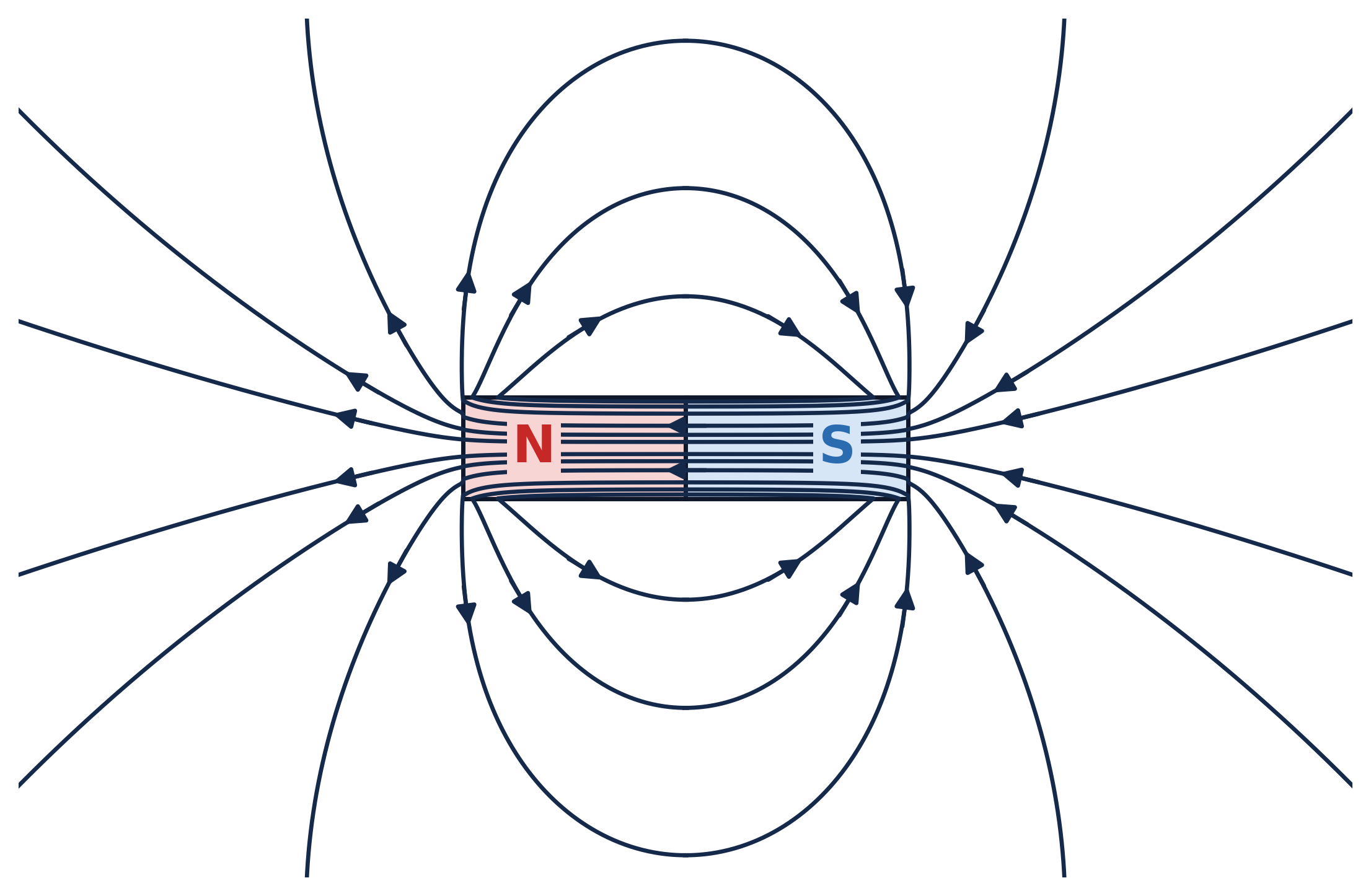
CDS II 2026 gave four statements about field lines and asked for the one that is not correct. Hold on to three points for such a question. Field lines never cross, inside a magnet or outside it. They are closed curves. They are parallel only where the field is uniform, so "always parallel" is false.
Compare with electric field lines, which start on positive charges and end on negative charges. Magnetic field lines are closed because there are no separate magnetic poles for them to start or end on.
4. The Earth as a magnet
A compass needle anywhere on the Earth settles in a fixed direction, and a bar of iron left lying north-south for years becomes weakly magnetised. Both show that the Earth itself has a magnetic field. The field is roughly like that of a huge bar magnet at the centre of the Earth, though no such magnet exists.
| Fact | Detail |
|---|---|
| Cause | Electric currents in the moving molten iron and nickel of the Earth's outer core. This is called the dynamo effect. It is not a block of permanent magnet: the core is far too hot |
| Strength at the surface | Very weak: of the order of 10^{-5} T, a fraction of one gauss |
| Tilt | The magnetic axis does not coincide with the axis of rotation. It is tilted by about 11° |
| Magnetic poles | The two places where the field is vertical. They are near the geographic poles but not at them, and they shift slowly over the years |
| Which pole is which | The north pole of a compass points north. Unlike poles attract, so the Earth's magnetic pole in the north behaves like the south pole of a magnet. The imaginary bar magnet has its S pole towards geographic north |
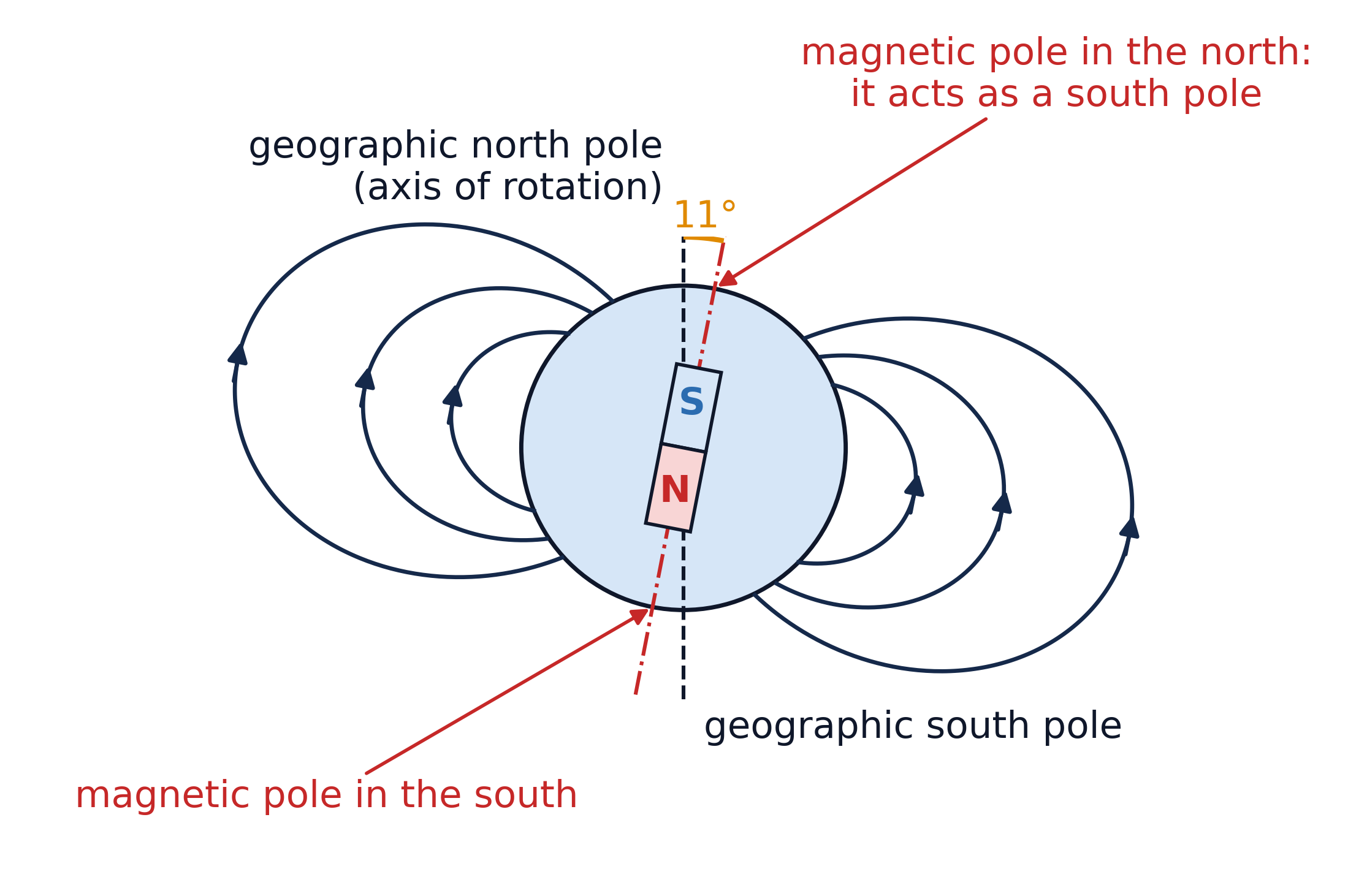
Two angles describe the field at any place.
| Quantity | Meaning | Values |
|---|---|---|
| Magnetic declination | The angle between geographic north (true north) and the direction a compass shows (magnetic north) | Different from place to place; small over most of India. A navigator must add or subtract it to get true north from the compass |
| Angle of dip (inclination) | The angle the Earth's field makes with the horizontal. A magnetised needle free to swing up and down (a dip needle) shows it | 0° at the magnetic equator, where the field is horizontal; 90° at the magnetic poles, where the field is vertical |
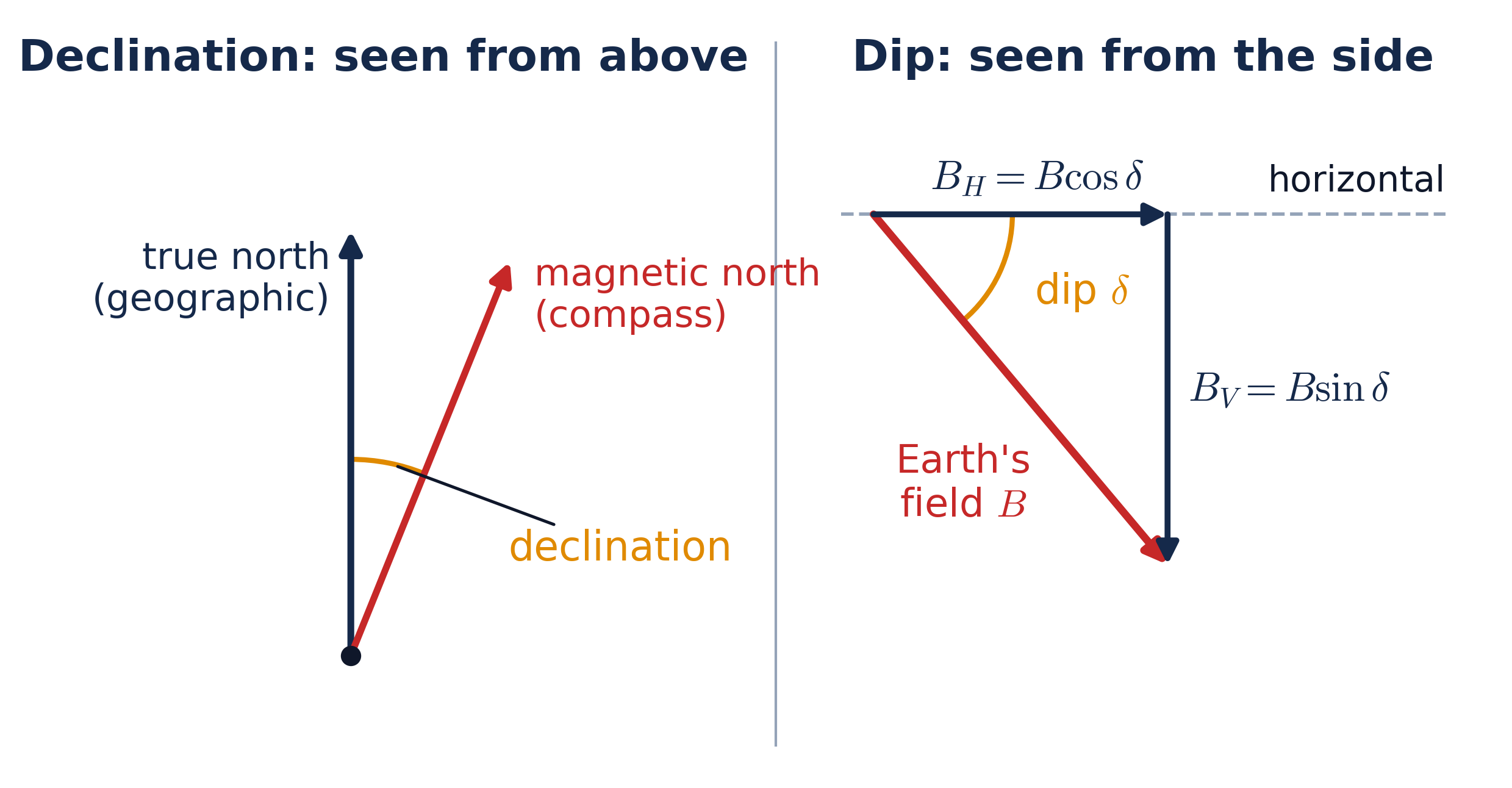
A third quantity is the horizontal component of the Earth's field. If the total field is B and the dip is \delta, then the horizontal part is B_H = B\cos\delta and the vertical part is B_V = B\sin\delta, so \tan\delta = \dfrac{B_V}{B_H}. An ordinary compass needle turns in a horizontal plane, so it responds only to B_H. At a magnetic pole B_H is zero and a compass is useless there.
What the Earth's field does for us.
- Navigation. The magnetic compass and the mariner's compass work because of it. Many migrating birds are also believed to sense it.
- A shield. The Sun sends out a stream of fast charged particles called the solar wind. The Earth's field turns most of them aside.
- Aurora. Some of these particles are guided along the field lines towards the two magnetic poles. There they strike the gases of the upper atmosphere and make them glow in colours. This is the aurora: aurora borealis (northern lights) in the north, aurora australis (southern lights) in the south. It is seen mainly at high latitudes.
What the papers have asked
These are all the questions on this chapter in the 6 papers from CDS I 2024 to CDS II 2026, in our own words.
| Paper | The idea asked | The answer in one line |
|---|---|---|
| CDS I 2024 | Which of four substances is not ferromagnetic: iron, cobalt, silver or a salt of iron | Iron and cobalt are ferromagnetic. Silver is diamagnetic, so silver is the plain answer. The salt, ferric chloride, is paramagnetic, so strictly it is not ferromagnetic either. We have not seen the official key |
| CDS II 2026 | Which of four statements about magnetic field lines is not correct | Field lines never cross, inside a magnet or outside it. As printed, the option "they are always parallel" is also false: they are parallel only in a uniform field. The two true options were "south to north inside the magnet" and "more crowded lines mean a stronger field" |
| CDS I 2025, CDS II 2025, CDS II 2026 (counted in Chapter K1-15) | The rule for the direction of the field round a straight wire, the rule for an induced current, the force on a moving charge, the field of two wires with opposite currents | All of these use the idea of field lines taught here, with a current in place of the magnet |
What this shows:
| Point | What to do about it |
|---|---|
| Both questions were plain facts from a textbook table or list | Sections 1 and 3 are enough for them. Each should take under 20 seconds |
| Both questions were loosely set: two options could be defended | Do not freeze. Pick the option that the standard textbook list contradicts most directly (silver is not in "iron, cobalt, nickel"; "field lines never cross" is a named property) |
| No question in these six papers was on declination, dip or the aurora | Read section 4 once and know the two angles. It is also useful for the geography questions on the Earth |
Worked examples
Example 1 (a single fact). A bar magnet is cut into two equal pieces across its length. Which one of the following is correct?
(a) One piece has only a north pole and the other only a south pole (b) Each piece is a magnet with a north and a south pole (c) Both pieces lose their magnetism (d) Only the longer piece stays a magnet
Solution. Poles always come in pairs. Each piece becomes a complete magnet with two poles. Option (a) is the tempting one, but a single magnetic pole has never been obtained. Answer (b).
Example 2 (statements). Consider the following statements about magnetic field lines of a bar magnet:
- They are closed curves.
- Outside the magnet they run from the south pole to the north pole.
- They are closest together near the poles.
Which of the statements given above are correct?
(a) 1 and 2 only (b) 2 and 3 only (c) 1 and 3 only (d) 1, 2 and 3
Solution. Statement 1 is correct. Statement 3 is correct: the field is strongest at the poles, and crowded lines mean a strong field. Statement 2 has the direction reversed: outside the magnet the lines go from north to south; it is inside that they go from south to north. Answer (c).
Example 3 (two ideas). You are given two identical-looking steel bars. One is a magnet and the other is not. You have nothing else, not even a thread. How can you tell which is the magnet?
Solution. Use the fact that a magnet is strong at its poles and has almost no pull at its middle. Touch the end of bar A to the middle of bar B. If A is the magnet, its pole attracts B strongly. If B is the magnet, its middle hardly attracts A at all. Then try the other way round to confirm. Simply bringing the two ends together tells you nothing, because they attract in both cases.
Example 4 (a short calculation). At a certain place the Earth's total magnetic field is 4 \times 10^{-5} T and the angle of dip is 60°. What is the horizontal component of the field?
(a) 2 \times 10^{-5} T (b) 3.5 \times 10^{-5} T (c) 4 \times 10^{-5} T (d) 8 \times 10^{-5} T
Solution. B_H = B\cos\delta = 4 \times 10^{-5} \times \cos 60^\circ = 4 \times 10^{-5} \times 0.5 = 2 \times 10^{-5} T. Option (b) uses \sin 60^\circ and gives the vertical component. Answer (a).
Example 5 (matching lists). Match each term with its meaning.
| List I | List II |
|---|---|
| A. Declination | 1. Temperature above which iron stops being strongly magnetic |
| B. Dip | 2. Angle between true north and magnetic north |
| C. Curie temperature | 3. Soft-iron piece placed across the ends of stored magnets |
| D. Keeper | 4. Angle between the Earth's field and the horizontal |
(a) A-2, B-4, C-1, D-3 (b) A-4, B-2, C-1, D-3 (c) A-2, B-4, C-3, D-1 (d) A-1, B-4, C-2, D-3
Solution. Declination is measured in the horizontal plane, between true north and magnetic north (2). Dip is measured in the vertical plane, between the field and the horizontal (4). The Curie temperature is where ferromagnetism is lost (1). A keeper protects stored magnets (3). Option (b) exchanges declination and dip. Answer (a).
Example 6 (how many are correct). Consider the following statements:
- A diamagnetic material is weakly repelled by a strong magnet.
- Ferric chloride is ferromagnetic because it contains iron.
- Iron heated above its Curie temperature is no longer ferromagnetic.
How many of the above statements are correct?
(a) Only one (b) Only two (c) All three (d) None
Solution. Statement 1 is the definition of a diamagnetic material. Statement 3 is the meaning of the Curie temperature. Statement 2 is wrong: a compound of iron need not be ferromagnetic, and ferric chloride is only paramagnetic. In this form of question one wrong judgement loses the mark, so test each statement separately before you count. Answer (b).
Mistakes that cost marks
- "Field lines start at N and end at S." That is only the part outside the magnet. The lines continue inside from S to N and are closed curves.
- Mixing up declination and dip. Declination: true north against magnetic north, in the horizontal plane. Dip: field against the horizontal, in the vertical plane; 0° at the magnetic equator and 90° at the magnetic poles.
- Thinking attraction proves a body is a magnet. A magnet attracts plain iron too. Only repulsion proves it.
- Saying a magnet attracts all metals. It attracts iron, cobalt and nickel. It does not pick up copper, aluminium, brass, gold or silver.
Quick check
Do these without help. Answers are at the end.
- Name the three common elements that a magnet attracts strongly.
- What is the angle of dip at the Earth's magnetic poles?
- Why can two magnetic field lines never cross?
- Which is used for the core of an electromagnet, soft iron or steel, and why?
- The north pole of a compass needle points towards the geographic north. What kind of magnetic pole does the Earth have there?
Read and watch more, free
NCERT and NIOS books are free on their own websites. The NIOS lesson is named in words, without a link.
| What | Where | Language |
|---|---|---|
| Textbook, magnets and the compass | NCERT textbooks, the book menu: Class 6 Science Curiosity, Chapter 4 "Exploring Magnets" | English, Hindi |
| Textbook, field lines | NCERT textbooks, the book menu: Class 10 Science, Chapter 12 "Magnetic Effects of Electric Current" (the first sections) | English, Hindi |
| Textbook, full treatment | NCERT textbooks, the book menu: Class 12 Physics Part I, Chapter 5 "Magnetism and Matter" (the bar magnet, the Earth's field, dia-, para- and ferromagnetism) | English, Hindi |
| Self-study lesson | NIOS Secondary course, Science and Technology (212), Lesson 17 "Magnetic Effect of Current", on the NIOS website under online course material | English, Hindi |
| The real papers | UPSC previous question papers (General Knowledge booklets of every CDS sitting) | English, Hindi |
| Video, physics in one class | The Journey Extraordinary: CDS GS Revision Package (the physics class with six years of past questions; it is over ten hours long, so find this chapter's part) | Hinglish |
| Video, topic by topic | CDS Wallah: CDS Exam Full Playlist (the physics videos) | Hinglish |
| Video, past questions | Reveal GK: CDS past questions by subject and topic (the physics parts) | Hinglish |
The videos were chosen from their titles, length and views; they have not yet been watched by a teacher.
Answers to the quick check
- Iron, cobalt and nickel.
- 90°. The field is vertical there.
- At a crossing point the field would have two directions at once, and a compass there would have to point two ways. That is impossible.
- Soft iron. It is magnetised easily and loses its magnetism as soon as the current stops, so the electromagnet can be switched on and off.
- A magnetic south pole, because unlike poles attract.
Next chapter: Charge, current, Ohm's law, circuits.