Why this chapter matters. This chapter gave 3 questions in the 6 papers from CDS I 2024 to CDS II 2026: two in CDS I 2025 and one in CDS II 2026. That is one question in every two papers, worth 0.83 marks each time. All three were on the buoyant force and floating. One asked the condition for floating, one was a ten-second calculation of the buoyant force, and one asked whether a body floats deeper on the Moon. So learn sections 5 and 6 first: "upthrust equals the weight of the liquid displaced" and "a floating body displaces its own weight". The first four sections are the base those two rules stand on, and they also serve the chemistry questions on states of matter.
What you will be able to do
- Describe the three states of matter and name the changes between them.
- Tell mass from weight, and density from relative density, with the correct unit for each.
- Use the principle of Archimedes to find the upward force on a body in a liquid.
- Decide whether a body floats or sinks, and how much of a floating body stays under the surface.
Before you start you should know: the SI units of length, mass and time (the metre, the kilogram and the second) and how to work with powers of ten such as 2 \times 10^{-4}. No earlier chapter is needed.
1. The three states of matter
Matter is anything that has mass and takes up space. It is made of very small particles that are always moving. How closely the particles are packed decides the state.
| Solid | Liquid | Gas | |
|---|---|---|---|
| Shape | Fixed | Takes the shape of the vessel | Fills the whole vessel |
| Volume | Fixed | Fixed | Not fixed |
| Can it be compressed? | Almost not | Almost not | Easily |
| Particles | Closely packed, they only vibrate | Close, but free to slide past each other | Far apart, moving fast in all directions |
| Example | Iron, ice | Water, diesel | Air, steam |
Liquids and gases can flow, so both are called fluids. A fourth state, plasma, is a gas so hot that its atoms have broken into charged particles. The Sun and the stars are made of plasma.
The names of the changes of state are worth knowing exactly.
| Change | Name | Example |
|---|---|---|
| Solid to liquid | Melting (fusion) | Ice to water |
| Liquid to solid | Freezing | Water to ice |
| Liquid to gas | Vaporisation (boiling or evaporation) | Water to steam |
| Gas to liquid | Condensation | Drops on a cold glass |
| Solid to gas directly | Sublimation | Camphor, naphthalene balls, dry ice |
Boiling and evaporation are not the same. Evaporation happens only at the surface of a liquid, and at any temperature. Wet clothes dry at 25 °C. Boiling happens through the whole body of the liquid, with bubbles of vapour forming inside it, and only at one fixed temperature for a given pressure. So evaporation is called a surface phenomenon and boiling a bulk phenomenon.
Diffusion is the mixing of the particles of two substances on their own, without stirring. The smell of cooking reaches the next room by diffusion. It is fastest in gases and slowest in solids.
2. Three properties of matter worth knowing
| Property | What it means | Facts to remember |
|---|---|---|
| Surface tension | The surface of a liquid behaves like a stretched skin and tries to take the smallest area | Small drops are round. An insect can walk on water. Soap and detergent lower the surface tension of water, so the water spreads and wets cloth better. Surface tension falls when the temperature rises. |
| Viscosity | The friction inside a flowing liquid | Honey is more viscous than water. A liquid becomes less viscous when it is heated. |
| Elasticity | A body returns to its shape when the deforming force is removed | Stress = force ÷ area, in N/m². Strain = change in length ÷ original length. Strain is a ratio, so it has no unit. |
In everyday speech rubber is "more elastic". In physics steel is more elastic than rubber, because a much larger stress is needed to produce the same strain in steel.
3. Mass, weight and volume
A soldier's pack has the same amount of matter in Delhi, on a high mountain post and on the Moon. But it does not pull down on his shoulders equally in the three places. The amount of matter is the mass. The pull of gravity on it is the weight.
| Mass | Weight | |
|---|---|---|
| What it is | The quantity of matter in a body | The force with which the Earth (or a planet) pulls the body |
| Formula | W = mg | |
| SI unit | kilogram (kg) | newton (N) |
| Kind of quantity | Scalar (size only) | Vector (it points towards the centre of the Earth) |
| Does it change from place to place? | No | Yes, because g changes |
| Measured with | A beam balance | A spring balance |
Here g is the acceleration due to gravity, about 9.8\ \text{m/s}^2 near the Earth's surface. The CDS papers usually tell you to take g = 10\ \text{m/s}^2. A body of mass 5 kg then weighs 5 \times 10 = 50 N. On the Moon, g is about one-sixth of its value on the Earth, so the same body weighs about one-sixth as much. Its mass is still 5 kg.
Volume is the space a body takes up. The SI unit is the cubic metre. The units used most often are:
| Unit | Equal to |
|---|---|
| 1 litre (L) | 1000\ \text{cm}^3 = 10^{-3}\ \text{m}^3 |
| 1 millilitre (mL) | 1\ \text{cm}^3 |
| 1\ \text{m}^3 | 1000 L |
4. Density and relative density
A bucket of sand is heavier than the same bucket full of sawdust. Sand has more mass packed into each unit of volume. This is density:
\rho = \frac{m}{V}
The SI unit is \text{kg/m}^3. In the laboratory \text{g/cm}^3 is used, and 1\ \text{g/cm}^3 = 1000\ \text{kg/m}^3.
Relative density (the older name is specific gravity) compares a substance with water:
\text{relative density} = \frac{\text{density of the substance}}{\text{density of water}}
It is a ratio of two densities, so it has no unit. The relative density of mercury is 13.6. This means mercury is 13.6 times as dense as water.
| Substance | Density in kg/m³ | Relative density |
|---|---|---|
| Air (at sea level, 0 °C) | about 1.29 | |
| Ice | about 917 | 0.917 |
| Water (at 4 °C) | 1000 | 1 |
| Sea water | about 1030 | 1.03 |
| Aluminium | 2700 | 2.7 |
| Iron | about 7800 | 7.8 |
| Mercury | 13,600 | 13.6 |
| Gold | 19,300 | 19.3 |
Two facts about water are favourites of examiners. Water is densest at 4 °C, which is 277 K. And ice is less dense than water, which is why ice floats.
Mixtures. When two liquids are mixed and the total volume does not change, the density of the mixture is total mass ÷ total volume. Two results follow:
| How they are mixed | Density of the mixture |
|---|---|
| Equal volumes | \dfrac{\rho_1 + \rho_2}{2} |
| Equal masses | \dfrac{2\rho_1\rho_2}{\rho_1 + \rho_2} |
5. Buoyancy and the principle of Archimedes
Push an empty, closed bottle under water and you feel the water pushing it up. Every liquid and every gas pushes up on a body placed in it. This upward force is called the buoyant force or upthrust. Buoyancy is a force, not a pressure, and it always acts upward.
The principle of Archimedes. When a body is fully or partly immersed in a fluid, the fluid pushes it up with a force equal to the weight of the fluid that the body displaces.
\text{upthrust} = \rho_{\text{fluid}} \times V_{\text{displaced}} \times g
Notice what is in the formula: the density of the fluid and the volume of fluid pushed aside. The mass of the body is not in it. A steel ball and a wooden ball of the same size, both held fully under water, feel the same upthrust.
The quick route in water. With \rho = 1000\ \text{kg/m}^3 and g = 10\ \text{m/s}^2, the upthrust in newtons is 10^4 \times V, with V in cubic metres. A body of volume 3 \times 10^{-4}\ \text{m}^3 fully under water feels 10^4 \times 3 \times 10^{-4} = 3 N. CDS I 2025 set exactly this kind of sum and also gave the mass of the body. The mass was not needed. It was there to tempt you into working out the weight.
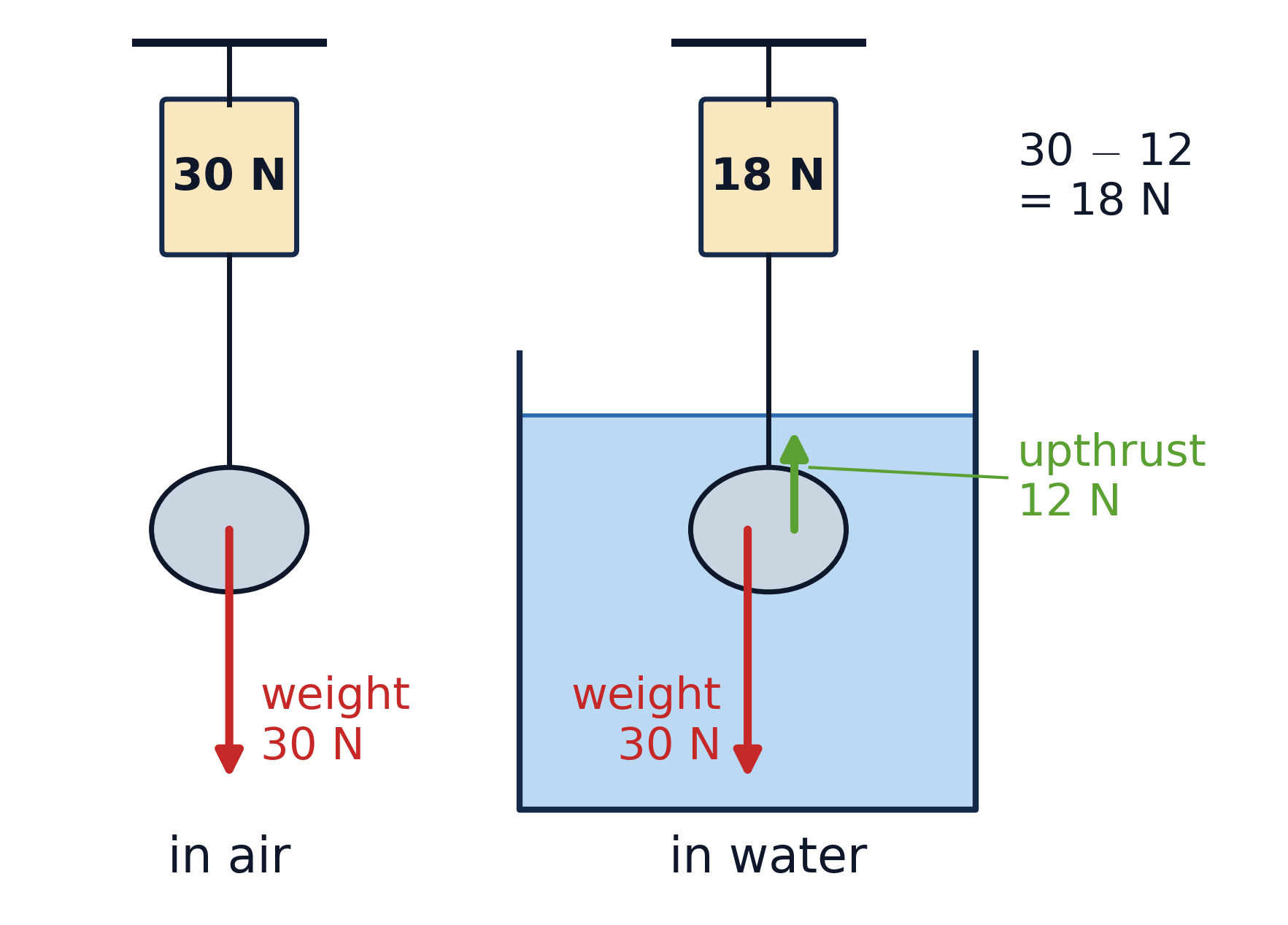
Because of the upthrust, a body seems lighter in a liquid:
\text{apparent weight} = \text{weight in air} - \text{upthrust}
The principle also gives a quick way to find relative density. A body fully under water displaces its own volume of water, so
\text{relative density of a solid} = \frac{\text{weight in air}}{\text{loss of weight in water}}
For example, a stone weighs 30 N in air and 18 N in water. The loss is 12 N, so its relative density is 30 \div 12 = 2.5.
6. Floating and sinking
Compare the weight of the body with the largest upthrust it can get, which is the upthrust when it is fully under the liquid.
| Density of the body compared with the liquid | What happens |
|---|---|
| Greater | It sinks |
| Equal | It stays wherever it is placed inside the liquid |
| Less | It rises and floats, partly above the surface |
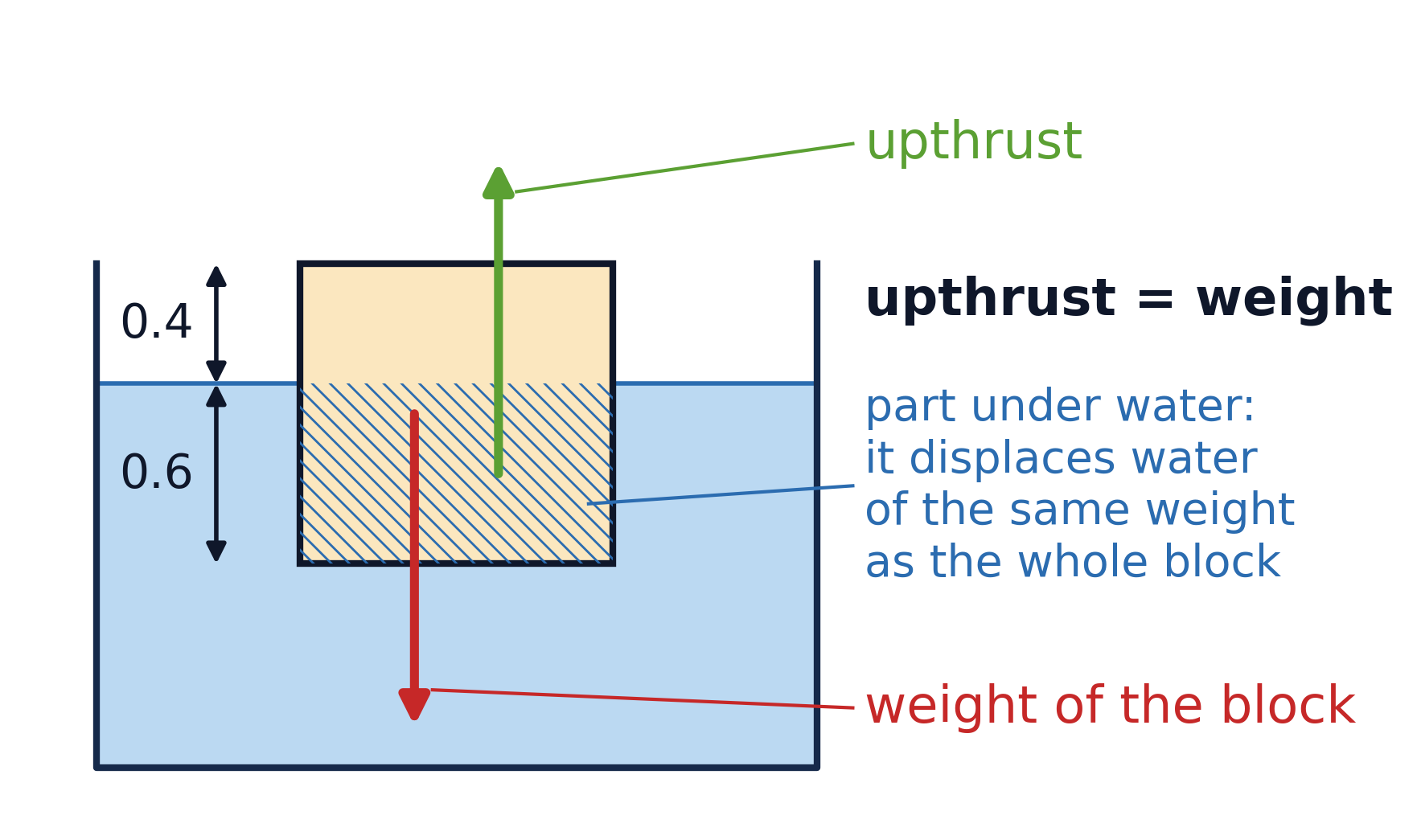
The law of floatation. A floating body displaces its own weight of liquid. From this,
\text{fraction of the body under the surface} = \frac{\text{density of the body}}{\text{density of the liquid}}
Ice has relative density 0.917, so about nine-tenths of an iceberg is under fresh water and only one-tenth shows.
Does weaker gravity change how a body floats? No. Look at the formula above: g is not in it. For a floating body, weight = upthrust, so \rho_{\text{body}} V g = \rho_{\text{liquid}} V_{\text{under}} g, and g cancels from both sides. On the Moon the weight of the body falls to one-sixth, and the weight of the water it displaces also falls to one-sixth. The balance is the same, so the same fraction of the body is under water. CDS II 2026 asked this. What does change is the size of the two forces: each is one-sixth of its value on the Earth.
Why a steel ship floats. A solid nail is steel all through, so its density is about 7800 kg/m³ and it sinks. A ship is a hollow steel shell full of air. Its average density, total mass ÷ total volume, is less than that of water, so it floats.
More facts of the same kind:
- A ship floats a little higher in the sea than in a river, because sea water is denser. The upthrust is the same in both, equal to the ship's weight. Only the volume under water changes.
- A submarine takes water into its ballast tanks to dive and blows it out with compressed air to rise. It changes its average density.
- A hydrometer is a weighted glass tube that floats upright. It sinks less in a denser liquid, so the reading on its stem gives the relative density. A lactometer is a hydrometer for milk.
- A hot-air balloon rises because the hot air inside is less dense than the cold air outside. Archimedes' principle works for gases too.
7. When is a floating body stable?
This is a Class 11 idea. The six CDS papers studied did not ask it, but it joins floating to the stable and unstable equilibrium of Chapter K1-5, which CDS II 2026 did ask. Three points are needed.
| Point | Meaning |
|---|---|
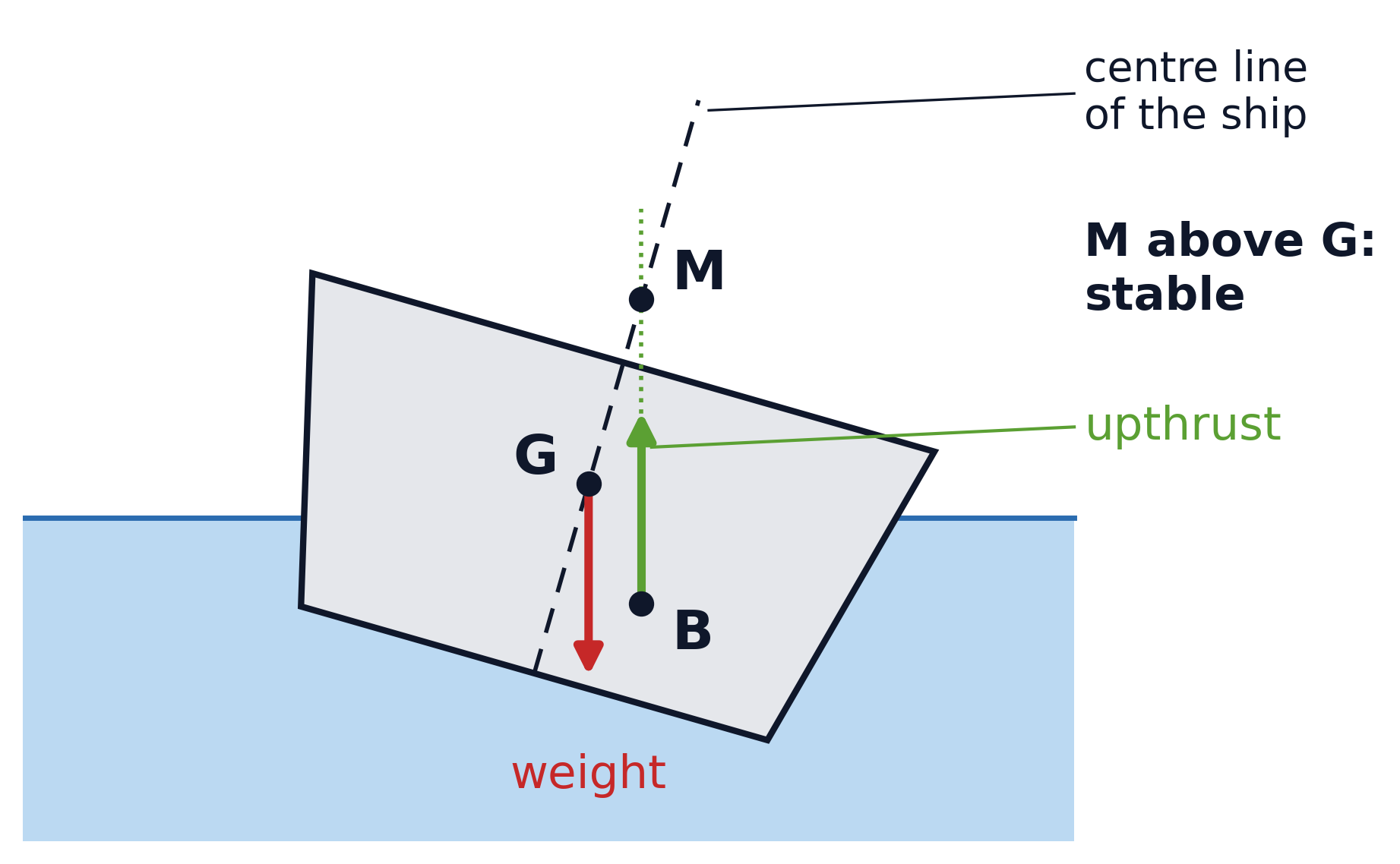
| Centre of gravity (G) | The point where the weight of the body acts |
| Centre of buoyancy (B) | The centre of gravity of the displaced liquid. The upthrust acts here. |
| Metacentre (M) | When the body tilts a little, the vertical line through the new centre of buoyancy cuts the body's original centre line at M |
A floating body is stable if the metacentre is above the centre of gravity. Then, when the ship rolls, weight and upthrust together turn it back upright. If G is above M the body turns over. This is why heavy cargo is loaded low in a ship: it lowers G.
What the papers have asked
These are all the questions on this chapter in the 6 papers from CDS I 2024 to CDS II 2026, in our own words.
| Paper | The idea asked | The answer in one line |
|---|---|---|
| CDS I 2025 | The condition on the buoyant force for a body to float in a liquid | The buoyant force equals the weight of the body |
| CDS I 2025 | The buoyant force on a metal sphere of given mass and volume held fully under water | Density of water × volume of the sphere × g. The mass is not used |
| CDS II 2026 | A body floats in water on the Earth and on the Moon. Compare the fractions of its volume under water | They are equal. Fraction = density of body ÷ density of water, and g cancels |
What this shows:
| Point | What to do about it |
|---|---|
| All three questions came from sections 5 and 6 | Know the two rules and the two formulas there without thinking |
| Two were single ideas and one was a one-line calculation | Each should take under 30 seconds. Bank the time for the polity and history blocks |
| No question came from states of matter, surface tension or elasticity in these six papers | Read sections 1 and 2 once. Do not spend an evening on them |
| The calculation carried an extra number (the mass) | Before you calculate, ask which of the given numbers the formula needs |
Worked examples
Example 1 (a single fact). Which one of the following is measured in newtons?
(a) Mass (b) Density (c) Weight (d) Relative density
Solution. Weight is a force, so its unit is the newton. Mass is the tempting option, because in daily life we say "my weight is 60 kg". In physics 60 kg is the mass, and the weight is about 600 N. Answer (c).
Example 2 (a short calculation). A metal cube of side 10 cm has a mass of 2.7 kg. What is its density?
(a) 0.27 kg/m³ (b) 27 kg/m³ (c) 270 kg/m³ (d) 2700 kg/m³
Solution. The side is 0.1 m, so the volume is 0.1^3 = 0.001\ \text{m}^3. Then \rho = 2.7 \div 0.001 = 2700\ \text{kg/m}^3. The wrong options come from leaving the side in centimetres or from misplacing the decimal point. Answer (d).
Example 3 (Archimedes). A block of volume 0.004\ \text{m}^3 weighs 100 N in air. What does it appear to weigh when fully immersed in water? (Density of water = 1000 kg/m³, g = 10\ \text{m/s}^2.)
(a) 40 N (b) 60 N (c) 96 N (d) 140 N
Solution. Upthrust = 1000 \times 0.004 \times 10 = 40 N. Apparent weight = 100 - 40 = 60 N. Option (a) is the upthrust itself, not the apparent weight. Answer (b).
Example 4 (floating). A piece of ice of density 917 kg/m³ floats in sea water of density 1030 kg/m³. About what fraction of the ice is below the surface?
(a) 0.11 (b) 0.50 (c) 0.89 (d) 0.92
Solution. Fraction under the surface = 917 \div 1030 \approx 0.89. Option (d), 0.917, is the answer for fresh water. In denser sea water the ice floats a little higher. Answer (c).
Example 5 (consider the following statements).
- The upthrust on a body fully immersed in a liquid depends on the volume of the body.
- The upthrust on a body fully immersed in a liquid depends on the density of the body.
Which of the statements given above is/are correct?
(a) 1 only (b) 2 only (c) Both 1 and 2 (d) Neither 1 nor 2
Solution. Upthrust = \rho_{\text{fluid}} V g. The volume of the body decides how much liquid is pushed aside, so statement 1 is correct. The density in the formula is that of the liquid, not of the body, so statement 2 is wrong. The density of the body decides only whether it sinks or floats. Answer (a).
Example 6 (reasoning). An ice cube floats in a glass of water. When the ice has melted completely, the level of water in the glass
(a) rises (b) falls (c) stays the same (d) rises first and then falls
Solution. The floating ice displaces water equal to its own weight. When it melts it becomes water of exactly that weight, which fills exactly the space the ice had pushed aside. So the level does not change. "Rises" is tempting because part of the ice was above the surface. Answer (c).
Example 7 (a number you do not need). A solid ball of mass 3 kg and volume 5 \times 10^{-4}\ \text{m}^3 is held completely under water. What is the buoyant force on it? (Density of water = 1000 kg/m³, g = 10\ \text{m/s}^2.)
(a) 0.5 N (b) 5 N (c) 25 N (d) 30 N
Solution. Upthrust = \rho_{\text{water}} V g = 1000 \times 5 \times 10^{-4} \times 10 = 5 N. The mass of the ball is not in the formula. Option (d), 30 N, is the weight of the ball. Option (c), 25 N, is the apparent weight, 30 - 5. Option (a) forgets to multiply by g. The ball is heavier than the upthrust, so it would sink if released, but that was not asked. Answer (b).
Example 8 (how many of the above). Consider the following statements:
- A body floating at rest in a liquid has a buoyant force on it equal to its weight.
- If the same body floats in a denser liquid, the buoyant force on it is greater.
- If the same body and liquid are taken to a place where g is smaller, a smaller fraction of the body is under the surface.
How many of the above statements are correct?
(a) Only one (b) Only two (c) All three (d) None
Solution. Statement 1 is the condition for floating: correct. Statement 2 is wrong: the body still floats, so the buoyant force still equals its weight. In the denser liquid it only displaces a smaller volume. Statement 3 is wrong: the fraction under the surface is density of body ÷ density of liquid, and g is not in it. In this form you must be sure of every statement, because one doubtful statement loses the mark. Answer (a).
Mistakes that cost marks
- Giving weight in kilograms. Mass is in kilograms and weight is in newtons. If a question gives "a body of weight 50 N", divide by g to get the mass before you find density.
- Using the density of the body in the upthrust formula. Upthrust uses the density of the liquid. The body's density is used only to decide floating or sinking.
- Saying the upthrust on a ship is greater in the sea. A floating ship always has upthrust equal to its own weight. In the sea it only needs to displace a smaller volume, so it rides higher.
- Giving relative density a unit. It is a pure number. A relative density of 2.5 means a density of 2500 kg/m³, or 2.5 g/cm³.
- Thinking a body floats deeper, or higher, where gravity is weaker. The fraction under the surface depends only on the two densities. Weight and upthrust both change with g, by the same factor.
Quick check
Do these without help. Answers are at the end.
- Name the change of state when naphthalene balls slowly disappear in a cupboard.
- A body has mass 8 kg. What is its weight where g = 10\ \text{m/s}^2?
- A liquid has relative density 0.8. What is the mass of 5 litres of it?
- A stone weighs 45 N in air and 30 N when fully immersed in water. What is its relative density?
- A block of wood of density 600 kg/m³ floats in water. What fraction of its volume is above the surface?
Read and watch more, free
The present NCERT Class 9 Science book no longer has a chapter on floating, so the best free texts are the Class 8 book for a first read and the Class 11 book for the full treatment. NCERT and NIOS books are free on their own websites. The NIOS lesson is named in words, without a link.
| What | Where | Language |
|---|---|---|
| Textbook, first read | NCERT textbooks, the book menu: Class 8 Science Curiosity, Chapter 5 (weight; floating and sinking) and Chapter 9 (density) | English, Hindi |
| Textbook, full treatment | NCERT textbooks, the book menu: Class 11 Physics Part II, Chapter 9 "Mechanical Properties of Fluids" (pressure, buoyancy, surface tension, viscosity) and Chapter 8 "Mechanical Properties of Solids" (stress and strain) | English, Hindi |
| Self-study lesson | NIOS Secondary course, Science and Technology (212), Lesson 11 "Gravitation" (buoyancy, the principle of Archimedes, density), on the NIOS website under online course material | English, Hindi |
| The real papers | UPSC previous question papers (General Knowledge booklets of every CDS sitting) | English, Hindi |
| Video, physics in one class | The Journey Extraordinary: CDS GS Revision Package (the physics class with six years of past questions; it is over ten hours long, so find this chapter's part) | Hinglish |
| Video, topic by topic | CDS Wallah: CDS Exam Full Playlist (the physics videos) | Hinglish |
| Video, past questions | Reveal GK: CDS past questions by subject and topic (the physics parts) | Hinglish |
The videos were chosen from their titles, length and views; they have not yet been watched by a teacher.
Answers to the quick check
- Sublimation: the solid changes directly into vapour.
- W = mg = 8 \times 10 = 80 N.
- Density = 0.8 \times 1000 = 800\ \text{kg/m}^3. Five litres is 0.005\ \text{m}^3. Mass = 800 \times 0.005 = 4 kg.
- Loss of weight = 45 - 30 = 15 N. Relative density = 45 \div 15 = 3.
- Fraction under water = 600 \div 1000 = 0.6, so the fraction above is 0.4, which is two-fifths.
Next chapter: Pressure and the barometer.