Why this chapter matters. This chapter gave 3 questions in the 6 papers from CDS I 2024 to CDS II 2026, one in each of the three papers from CDS I 2025 to CDS I 2026. All three were short calculations: a displacement from two velocities and a time, an average speed over two equal half-distances, and the time of fall of a body thrown horizontally. Each can be done in under a minute if the right formula comes to mind at once, and each had an option waiting for the student who picked the wrong one. Learn first the three equations of motion and the two short cuts that go with them, average velocity \tfrac{u+v}{2} and average speed \tfrac{2v_1v_2}{v_1+v_2}. Then learn the one idea of section 8: the fall of a projectile does not depend on its sideways speed.
What you will be able to do
- Tell distance from displacement and speed from velocity, and find an average speed or an average velocity.
- Use the three equations of motion for a body with uniform acceleration, including a body falling, thrown up or thrown horizontally.
- Read a distance-time graph and a velocity-time graph.
- Explain why a body moving in a circle at constant speed is still accelerating.
Before you start you should know: how to solve a simple equation, and how to find the slope of a straight-line graph. No earlier chapter is needed.
1. Distance and displacement
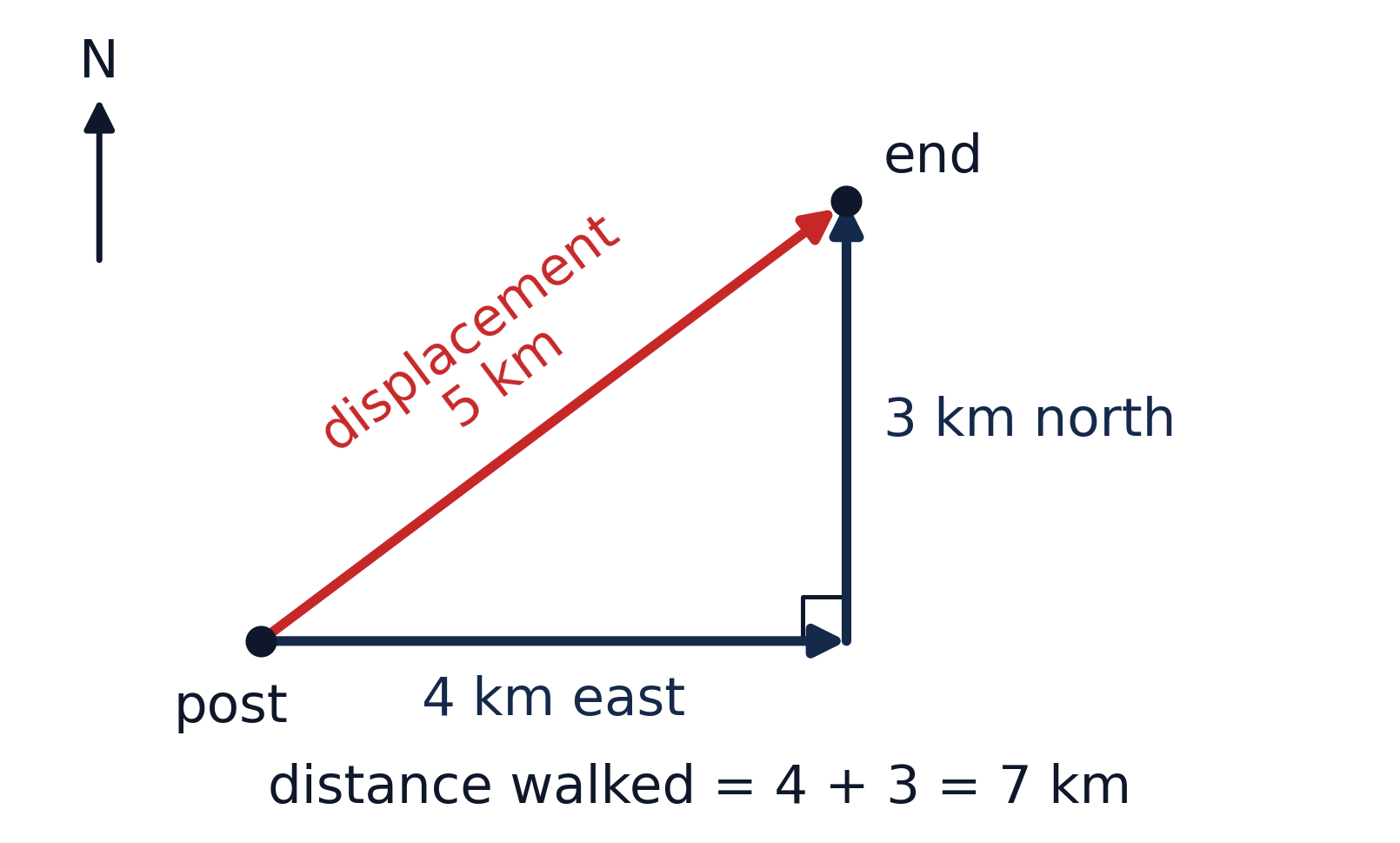
A patrol leaves its post, walks 4 km east and then 3 km north. It has walked 7 km. But it is only 5 km from the post in a straight line. These are two different quantities.
| Distance | Displacement | |
|---|---|---|
| What it is | The length of the path actually travelled | The straight line from the starting point to the end point, with its direction |
| Kind of quantity | Scalar (size only) | Vector (size and direction) |
| Can it be zero after a journey? | No | Yes, if the body returns to where it started |
| Which is larger? | Never smaller than the displacement | Never larger than the distance |
For the patrol, the distance is 4 + 3 = 7 km and the displacement is \sqrt{4^2 + 3^2} = 5 km, pointing north of east. The two are equal only when a body moves along a straight line without turning back.
2. Speed and velocity
| Speed | Velocity | |
|---|---|---|
| Meaning | Distance covered in unit time | Displacement in unit time |
| Kind of quantity | Scalar | Vector |
| Average value | \dfrac{\text{total distance}}{\text{total time}} | \dfrac{\text{total displacement}}{\text{total time}} |
| SI unit | m/s | m/s |
Changing units. 1\ \text{km/h} = \dfrac{1000\ \text{m}}{3600\ \text{s}} = \dfrac{5}{18} m/s. So multiply km/h by \tfrac{5}{18} to get m/s, and multiply m/s by \tfrac{18}{5} to get km/h. For example, 72 km/h is 72 \times \tfrac{5}{18} = 20 m/s.
The round trip. A truck drives 60 km to a depot and comes back by the same road, taking 3 hours in all. Its average speed is 120 \div 3 = 40 km/h. Its average velocity is zero, because its displacement is zero.
Two speeds over equal distances. If a body covers the first half of a distance at speed v_1 and the second half at v_2, its average speed is not the simple average. It is
\text{average speed} = \frac{2 v_1 v_2}{v_1 + v_2}
because the body spends a longer time at the lower speed. CDS II 2025 asked for this formula in symbols, with the simple average \tfrac{v_1+v_2}{2} as the tempting option. If you forget it, build it in three lines: let each half be d; the times are d/v_1 and d/v_2; divide the total distance 2d by the total time.
The simple average \tfrac{v_1+v_2}{2} is right in a different case: when the body moves at v_1 and v_2 for equal times, not equal distances.
A body has uniform velocity when it covers equal displacements in equal times, however small the times. That means a steady speed along a straight line. Otherwise the motion is non-uniform.
3. Acceleration
Acceleration is the rate at which velocity changes:
a = \frac{v - u}{t}
Here u is the initial velocity, v the final velocity and t the time taken. The SI unit is \text{m/s}^2, and acceleration is a vector.
| Case | Acceleration |
|---|---|
| Velocity increasing | Positive |
| Velocity decreasing | Negative. This is called retardation or deceleration |
| Uniform velocity (steady speed in a straight line) | Zero |
| Steady speed round a curve | Not zero, because the direction of the velocity is changing (section 7) |
A body can have zero velocity and still be accelerating. A ball thrown up stops for an instant at the top, yet gravity is still pulling it down at that instant.
4. The three equations of motion
These are true only when the acceleration is uniform (constant) and the motion is along a straight line.
| Equation | Use it when the question does not involve | |
|---|---|---|
| 1 | v = u + at | the distance s |
| 2 | s = ut + \tfrac{1}{2}at^2 | the final velocity v |
| 3 | v^2 = u^2 + 2as | the time t |
Four more results come from them.
| Result | Formula |
|---|---|
| Average velocity under uniform acceleration | \dfrac{u + v}{2} |
| Displacement when the acceleration is not given | s = \dfrac{u + v}{2} \times t |
| Distance covered in the nth second | u + \dfrac{a}{2}(2n - 1) |
| Stopping distance of a vehicle that brakes from speed u with retardation a | \dfrac{u^2}{2a} |
The second row is the quickest route when a question gives the two velocities and the time and asks for the displacement. A body that goes uniformly from 6 m/s to 14 m/s in 4 s has an average velocity of 10 m/s, so it covers 10 \times 4 = 40 m. There is no need to find the acceleration first. CDS I 2025 set a sum of this kind.
Equation 2 shows that the distance covered depends on the initial velocity u as well as on the acceleration. The last formula shows that doubling the speed makes the stopping distance four times as long, a fact every driver of a military vehicle should know.
Signs. Choose one direction as positive and keep to it. For a braking vehicle, a is negative. "Starts from rest" means u = 0. "Comes to rest" means v = 0.
5. Graphs of motion
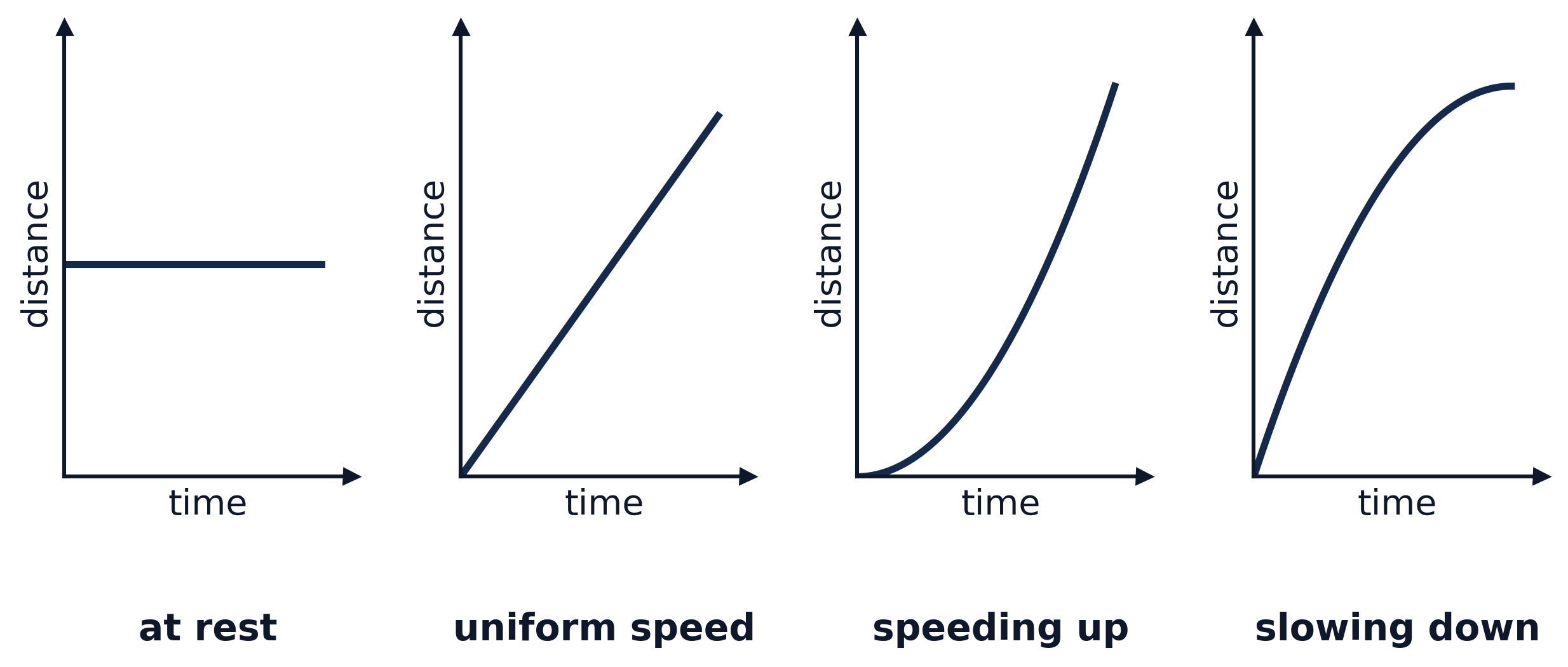
Learn the shapes from the two tables and the figure under each.
Distance-time graph (time along the horizontal axis). Its slope is the speed.
| Shape of the line | What the body is doing |
|---|---|
| Straight line parallel to the time axis | At rest |
| Straight line sloping upward | Moving with uniform speed. A steeper line means a greater speed |
| Curve that becomes steeper | Speeding up |
| Curve that becomes flatter | Slowing down |
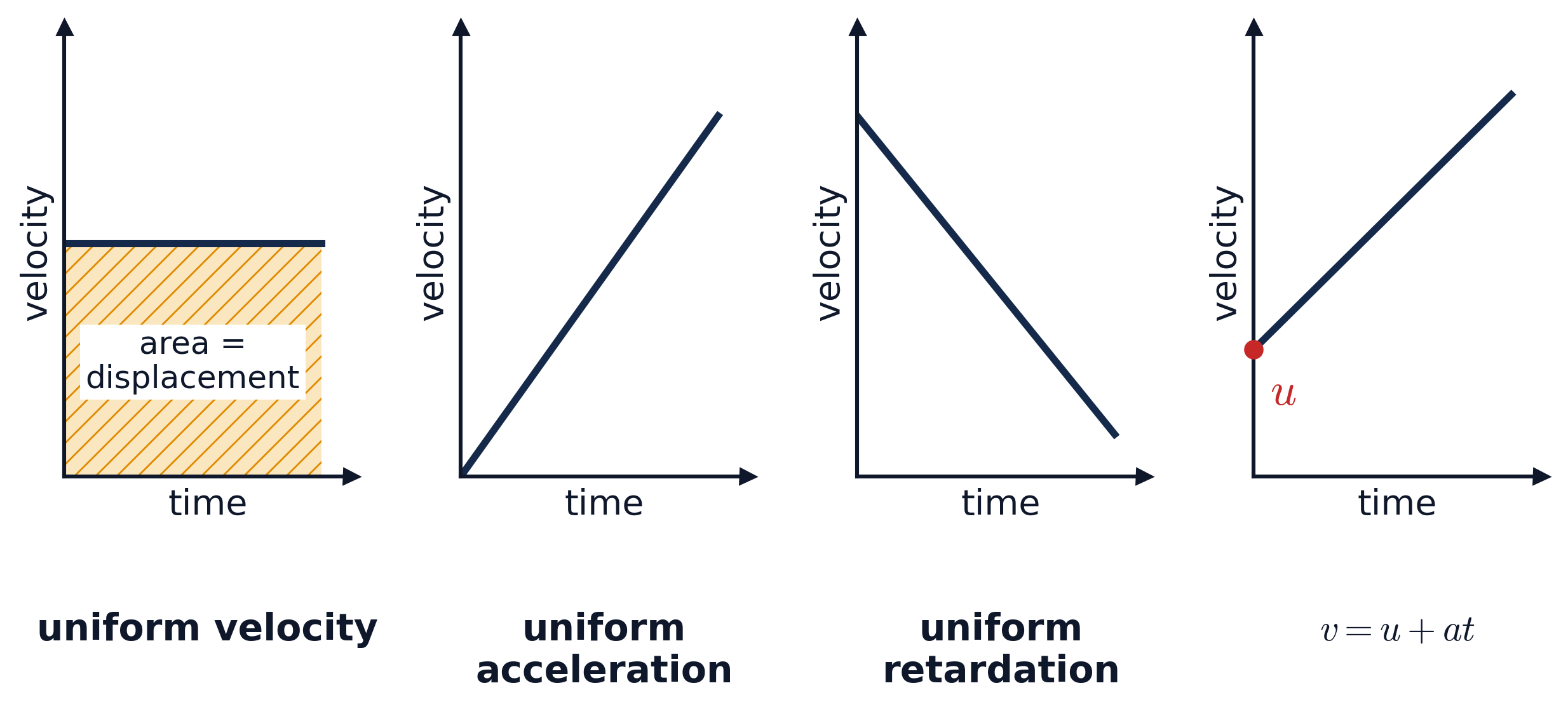
Velocity-time graph. Its slope is the acceleration. The area between the line and the time axis is the displacement.
| Shape of the line | What the body is doing |
|---|---|
| Straight line parallel to the time axis | Uniform velocity, zero acceleration |
| Straight line sloping upward | Uniform acceleration |
| Straight line sloping downward | Uniform retardation |
| Straight line sloping upward that starts above zero on the velocity axis | The equation v = u + at with u not zero |
The speed-time graph of a skydiver is a good test of reading. The speed rises quickly at first. The resistance of the air grows as the speed grows, so the line becomes flatter and at last level: the skydiver is falling at a steady speed. When the parachute opens the speed drops sharply to a new, much lower steady value.
6. Falling bodies and bodies thrown upward
A body falling freely near the Earth has a uniform acceleration g downward, about 9.8\ \text{m/s}^2 (the CDS papers usually say take g = 10\ \text{m/s}^2). It is the same for all bodies when air resistance is left out. So the three equations apply with a = g for a falling body and a = -g for a body moving upward.
| Situation | Result |
|---|---|
| Dropped from rest, after time t | Speed v = gt; distance fallen h = \tfrac{1}{2}gt^2 |
| Dropped from height h | Speed on reaching the ground v = \sqrt{2gh} |
| Thrown up with speed u | Time to reach the top = \dfrac{u}{g}; greatest height = \dfrac{u^2}{2g} |
| Thrown up and caught at the same level | Time up = time down. It returns with the same speed u |
At the highest point the velocity is zero for an instant, but the acceleration is still g downward.
7. Motion in a circle
A car goes round a circular track at a steady 40 km/h. Its speed is constant. Its velocity is not, because the direction of motion changes at every point. A changing velocity means an acceleration. So uniform circular motion is accelerated motion.
This acceleration points towards the centre of the circle and is called centripetal acceleration. For speed v on a circle of radius r,
a = \frac{v^2}{r}
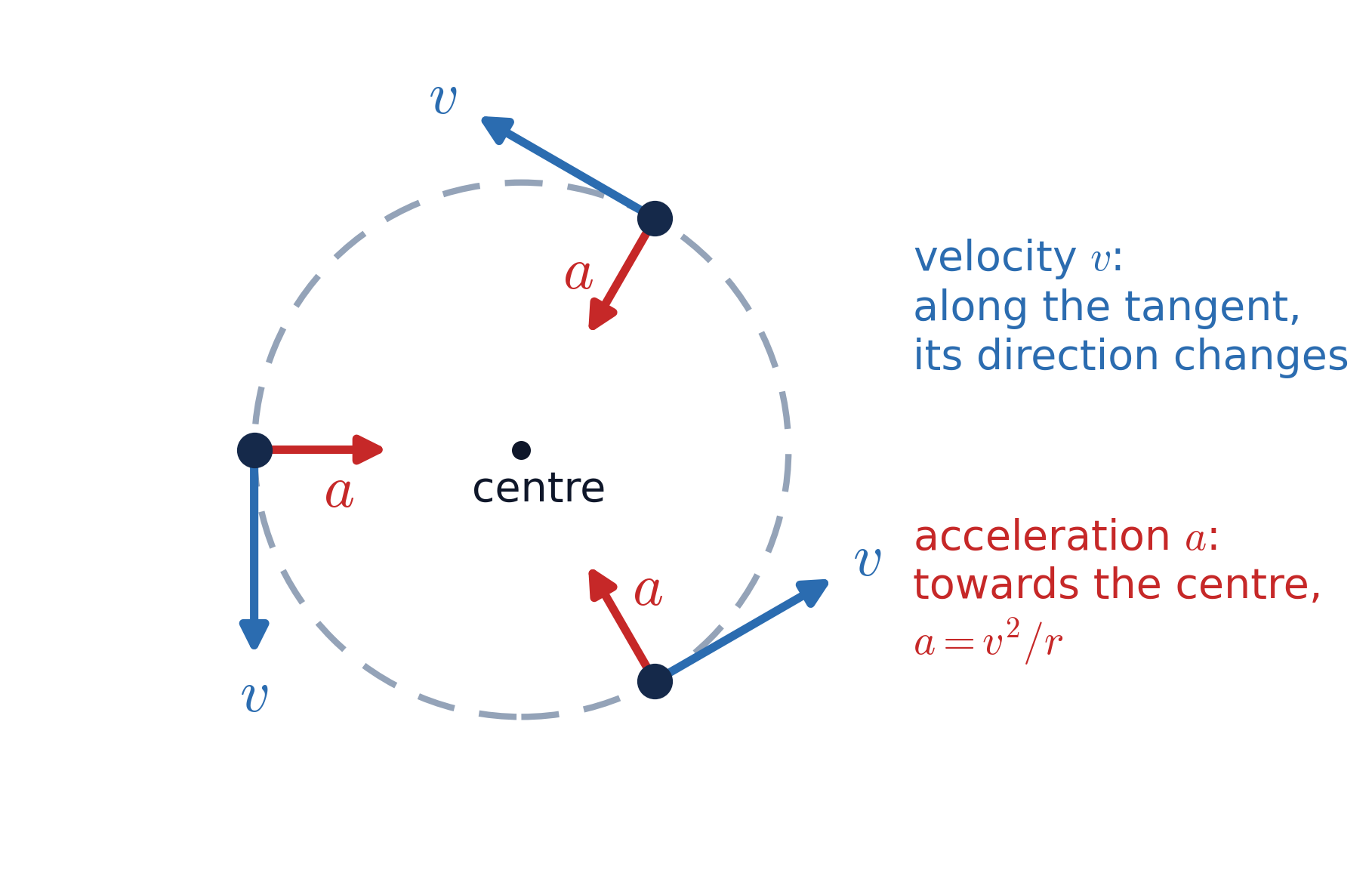
At the same speed, a gentle curve (large r) needs a smaller acceleration than a sharp curve (small r). The acceleration changes only the direction of the velocity. It does not make the body faster or slower.
8. A body thrown horizontally, and other projectiles
A body that is thrown and then moves under gravity alone is called a projectile. A shell from a gun, a ball thrown to a fielder and a packet dropped from a moving aircraft are projectiles. Air resistance is left out.
The key idea is that the motion can be split into two parts that do not affect each other.
| Direction | Force | Motion |
|---|---|---|
| Horizontal | None | Uniform velocity. The horizontal speed never changes |
| Vertical | Gravity | Uniform acceleration g downward, exactly as for a body falling straight down |
The path that results is a curve called a parabola.
Thrown horizontally from a height h with speed u. The body starts with no vertical velocity, so vertically it is simply a body dropped from rest.
| Quantity | Formula | What to notice |
|---|---|---|
| Time to reach the ground | t = \sqrt{\dfrac{2h}{g}} | It depends only on the height. The speed of the throw is not in it |
| Horizontal distance covered | u \times t | The horizontal speed is used here, and only here |
| Vertical speed on reaching the ground | gt | The same as for a body dropped from the same height |
So a bullet fired horizontally from a rifle and a bullet dropped from the same height at the same instant reach the ground together. The fired bullet lands far away, but it does not stay in the air any longer.
CDS I 2026 asked for the time of fall of a body launched horizontally from a given height. The launch speed was printed in the question, and it was not needed. For a height of 80 m, for example, t = \sqrt{2 \times 80 \div 10} = 4 s whatever the launch speed. With g = 10\ \text{m/s}^2 the rule is quick: t = \sqrt{h/5}.
Thrown at an angle \theta above the horizontal with speed u, landing at the same level. These Class 11 results are worth one reading.
| Quantity | Formula |
|---|---|
| Time of flight | \dfrac{2u\sin\theta}{g} |
| Greatest height | \dfrac{u^2\sin^2\theta}{2g} |
| Horizontal range | \dfrac{u^2\sin 2\theta}{g} |
| Angle for the greatest range | 45^\circ, and the range is then \dfrac{u^2}{g} |
Three facts follow. At the highest point the vertical velocity is zero, but the horizontal velocity is still there, so the body is not at rest. The acceleration is g downward at every point of the path, including the top. And two angles that add up to 90^\circ, such as 30^\circ and 60^\circ, give the same range.
What the papers have asked
These are all the questions on this chapter in the 6 papers from CDS I 2024 to CDS II 2026, in our own words.
| Paper | The idea asked | The answer in one line |
|---|---|---|
| CDS I 2025 | A vehicle's velocity rises uniformly from one given value to another in a given time. Find the displacement | Average velocity × time, s = \tfrac{u+v}{2} \times t. No need to find the acceleration |
| CDS II 2025 | A car covers half a distance at speed v_1 and the other half at v_2. Find the average speed | \tfrac{2v_1v_2}{v_1+v_2}, not the simple average |
| CDS I 2026 | A body is launched horizontally from a given height at a given speed. Find the time to reach the ground | t = \sqrt{2h/g}. The launch speed is not used |
What this shows:
| Point | What to do about it |
|---|---|
| All three were calculations of one or two lines | Practise until each takes under a minute |
| Two of the three carried a tempting wrong route: the simple average of two speeds, and the use of the horizontal speed in the time of fall | Before you calculate, ask which quantities the formula really needs |
| No graph question and no circular-motion question in these six papers | Read sections 5 and 7 once. Whirling a stone in a circle did appear in CDS II 2025, as a question on work (Chapter K1-7) |
| The paper has no figures in this block | Every question is in words, so draw your own small sketch for a projectile |
Worked examples
Example 1 (the round trip). An athlete runs once round a 400 m track in 50 s and stops where she started. Her average speed and average velocity are
(a) 8 m/s and 8 m/s (b) 8 m/s and 0 (c) 0 and 8 m/s (d) 0 and 0
Solution. Distance = 400 m, so average speed = 400 \div 50 = 8 m/s. She ends where she began, so the displacement is zero and the average velocity is zero. Option (a) forgets that velocity uses displacement. Answer (b).
Example 2 (equations of motion). A jeep starts from rest and accelerates uniformly at 2\ \text{m/s}^2 for 10 s. How far does it travel in this time?
(a) 20 m (b) 100 m (c) 200 m (d) 400 m
Solution. u = 0, so s = ut + \tfrac{1}{2}at^2 = 0 + \tfrac{1}{2} \times 2 \times 10^2 = 100 m. Option (a), 20, is the final speed in m/s from v = u + at. Option (c) forgets the half. Answer (b).
Example 3 (braking). A truck moving at 72 km/h is brought to rest in 50 m by its brakes. What is its acceleration, taken as uniform?
(a) -4\ \text{m/s}^2 (b) -2\ \text{m/s}^2 (c) -0.4\ \text{m/s}^2 (d) -51.8\ \text{m/s}^2
Solution. First change the unit: 72 km/h = 20 m/s. Then v^2 = u^2 + 2as gives 0 = 20^2 + 2a \times 50, so a = -400 \div 100 = -4\ \text{m/s}^2. Option (d) comes from using 72 without changing it to m/s. Answer (a).
Example 4 (matching lists). Match List I with List II.
| List I (graph) | List II (motion) |
|---|---|
| A. Distance-time graph, straight line parallel to the time axis | 1. Uniform acceleration |
| B. Distance-time graph, straight line sloping upward | 2. Body at rest |
| C. Velocity-time graph, straight line sloping upward | 3. Uniform speed |
(a) A-2, B-3, C-1 (b) A-3, B-2, C-1 (c) A-2, B-1, C-3 (d) A-1, B-3, C-2
Solution. If the distance does not change with time, the body is at rest: A-2. A distance that grows steadily means uniform speed: B-3. A velocity that grows steadily means uniform acceleration: C-1. Option (c) is the trap: a sloping straight line means uniform speed on a distance-time graph but uniform acceleration on a velocity-time graph. Answer (a).
Example 5 (thrown upward). A ball is thrown vertically upward at 30 m/s. Taking g = 10\ \text{m/s}^2, the greatest height it reaches and the time it takes to reach it are
(a) 45 m and 3 s (b) 90 m and 3 s (c) 45 m and 6 s (d) 90 m and 6 s
Solution. At the top v = 0. Time = u \div g = 30 \div 10 = 3 s. Height = u^2 \div 2g = 900 \div 20 = 45 m. Six seconds is the time for the whole flight, up and down. Answer (a).
Example 6 (consider the following statements). A stone tied to a string is whirled in a horizontal circle at a constant speed.
- The velocity of the stone is constant.
- The acceleration of the stone points towards the centre of the circle.
Which of the statements given above is/are correct?
(a) 1 only (b) 2 only (c) Both 1 and 2 (d) Neither 1 nor 2
Solution. The speed is constant but the direction of motion keeps changing, so the velocity is not constant: statement 1 is wrong. The acceleration in uniform circular motion is centripetal, towards the centre: statement 2 is correct. Answer (b).
Example 7 (thrown horizontally). A stone is thrown horizontally at 15 m/s from the top of a cliff 20 m high. Taking g = 10\ \text{m/s}^2, the time it takes to reach the ground and the horizontal distance it covers are
(a) 2 s and 30 m (b) 2 s and 20 m (c) 4 s and 60 m (d) 1.5 s and 20 m
Solution. Vertically the stone starts from rest and falls 20 m: t = \sqrt{2h/g} = \sqrt{40 \div 10} = 2 s. Horizontally it keeps its 15 m/s for those 2 s: 15 \times 2 = 30 m. Option (c) forgets the square root. Option (d) wrongly divides a distance by the horizontal speed to get the time. Answer (a).
Example 8 (how many of the above). A ball is thrown at an angle to the horizontal and lands at the same level. Air resistance is ignored. Consider the following statements:
- The horizontal part of its velocity stays the same throughout the flight.
- At the highest point the ball is at rest for an instant.
- At the highest point the acceleration of the ball is zero.
How many of the above statements are correct?
(a) Only one (b) Only two (c) All three (d) None
Solution. No force acts sideways, so the horizontal velocity does not change: statement 1 is correct. At the top only the vertical part of the velocity is zero. The ball is still moving sideways, so it is not at rest: statement 2 is wrong. Gravity acts all the time, so the acceleration is g downward at the top too: statement 3 is wrong. Statement 2 would be true for a ball thrown straight up, which is why it tempts. Answer (a).
Mistakes that cost marks
- Using distance where displacement is needed. Average velocity uses displacement. For any journey that ends where it began, the average velocity is zero.
- Not changing km/h to m/s. If the acceleration is in \text{m/s}^2 or the distance in metres, change the speed first: multiply by \tfrac{5}{18}.
- Averaging two speeds. For equal distances at 40 km/h and 60 km/h the average speed is 48 km/h, not 50 km/h.
- Saying the acceleration is zero at the top of the flight. The velocity is zero there. The acceleration is still g, downward.
- Using the horizontal speed to find the time of fall. A body thrown horizontally falls exactly like a dropped body. The time comes from the height alone. The horizontal speed is used only for the horizontal distance.
Quick check
Do these without help. Answers are at the end.
- Change 90 km/h into m/s.
- A cyclist rides 3 km north and then 4 km east. What are the distance and the size of the displacement?
- A car moving at 10 m/s accelerates at 2\ \text{m/s}^2 for 5 s. What is its final velocity?
- A stone is dropped from rest. How far does it fall in 2 s? (Take g = 10\ \text{m/s}^2.)
- What does the area under a velocity-time graph give?
Read and watch more, free
NCERT and NIOS books are free on their own websites. The NIOS lesson is named in words, without a link.
| What | Where | Language |
|---|---|---|
| Textbook, first read | NCERT textbooks, the book menu: Class 9 Science Exploration, Chapter 4 "Describing Motion Around Us" | English, Hindi |
| Textbook, full treatment | NCERT textbooks, the book menu: Class 11 Physics Part I, Chapter 2 "Motion in a Straight Line" and Chapter 3 "Motion in a Plane" (projectiles and circular motion) | English, Hindi |
| Self-study lesson | NIOS Secondary course, Science and Technology (212), Lesson 9 (motion and its description), on the NIOS website under online course material | English, Hindi |
| The real papers | UPSC previous question papers (General Knowledge booklets of every CDS sitting) | English, Hindi |
| Video, physics in one class | The Journey Extraordinary: CDS GS Revision Package (the physics class with six years of past questions; it is over ten hours long, so find this chapter's part) | Hinglish |
| Video, topic by topic | CDS Wallah: CDS Exam Full Playlist (the physics videos) | Hinglish |
| Video, past questions | Reveal GK: CDS past questions by subject and topic (the physics parts) | Hinglish |
The videos were chosen from their titles, length and views; they have not yet been watched by a teacher.
Answers to the quick check
- 90 \times \tfrac{5}{18} = 25 m/s.
- Distance = 3 + 4 = 7 km. Displacement = \sqrt{3^2 + 4^2} = 5 km.
- v = u + at = 10 + 2 \times 5 = 20 m/s.
- h = \tfrac{1}{2}gt^2 = \tfrac{1}{2} \times 10 \times 2^2 = 20 m.
- The displacement of the body (the distance travelled, if it does not turn back).
Next chapter: Newton's laws, force and momentum.