Why this chapter matters. This chapter gave 3 questions in the 6 papers from CDS I 2024 to CDS II 2026, one in each of the last three papers. Two tested exact wording: when is momentum conserved, and which sentence states the second law. The third was a calculation of a final speed from a force, a mass and a time, with the speeds in km/h. So the laws must be known word for word, and the second law in both its forms, F = ma and force = rate of change of momentum. This chapter is also the base for the next three: balance of forces, gravitation, and work and energy.
What you will be able to do
- State Newton's three laws and give an everyday example of each.
- Calculate force, acceleration, momentum and impulse, with the correct units.
- Use the conservation of momentum for a recoil and for a simple collision.
- Explain why increasing the time of impact reduces the force, and compare static, sliding and rolling friction.
Before you start you should know: velocity, acceleration and the three equations of motion (Chapter K1-3), and mass and weight (Chapter K1-1).
1. Force
A force is a push or a pull. It can start a body moving, stop it, change its speed, change its direction or change its shape. Force is a vector, and its SI unit is the newton (N).
| Kind | Meaning | Examples |
|---|---|---|
| Contact force | Acts only when two bodies touch | Friction, the push of a hand, the tension in a rope, the resistance of air, the upward push of a floor |
| Non-contact force | Acts across a distance | Gravity, magnetic force, electrostatic force |
Balanced and unbalanced forces. If the forces on a body add up to zero, they are balanced, and the body's velocity does not change. It stays at rest, or it keeps moving at a steady speed in a straight line. Only an unbalanced (net) force changes the velocity.
The four fundamental forces. Every force in nature comes from one of these.
| Fundamental force | Where it is seen |
|---|---|
| Gravitational force | Between all masses. It is the weakest of the four |
| Electromagnetic force | Between charges and between magnets. Friction, tension and the push of a floor all come from it |
| Strong nuclear force | Holds protons and neutrons together in the nucleus. It is the strongest of the four |
| Weak nuclear force | Acts in some kinds of radioactive decay |
2. The first law and inertia
Newton's first law. A body stays at rest, or keeps moving with uniform velocity in a straight line, unless an unbalanced force acts on it.
The property of a body to resist any change in its state of rest or of motion is called inertia. So the first law is also called the law of inertia. Mass is the measure of inertia: a loaded truck is harder to start and harder to stop than an empty one.
| What we see | Why |
|---|---|
| Standing passengers fall backward when a bus starts suddenly | Their feet move with the bus; the upper body tends to stay at rest |
| Passengers are thrown forward when a bus brakes | The body tends to keep moving forward. A seat belt supplies the force that stops it |
| Dust leaves a carpet that is beaten with a stick | The carpet moves; the dust tends to stay at rest |
| A coin on a card drops into the glass when the card is flicked away | The coin tends to stay at rest while the card moves from under it |
The first law also tells us that no force is needed to keep a body moving at constant velocity. A force is needed only to change the velocity. On the road we must keep the engine running only because friction and air resistance act against the vehicle.
3. Momentum
A cricket ball and a tennis ball moving at the same speed do not hurt the hand equally. A slow lorry is harder to stop than a fast bicycle. Both mass and velocity matter. Their product is the momentum of the body:
p = mv
Momentum is a vector in the direction of the velocity. Its SI unit is kg m/s.
When a ball bounces straight back from the ground at the same speed, its speed and its kinetic energy are unchanged, but its momentum changes suddenly, because its direction has reversed. If the momentum was +mv before, it is -mv after, and the change has size 2mv.
4. The second law
Newton's second law. The rate of change of momentum of a body is proportional to the unbalanced force on it, and takes place in the direction of that force.
F = \frac{\text{change in momentum}}{\text{time}} = \frac{mv - mu}{t}
For a body of constant mass, \dfrac{v - u}{t} is the acceleration, so
F = ma
| Point | What to remember |
|---|---|
| The newton | 1 N is the force that gives a mass of 1 kg an acceleration of 1\ \text{m/s}^2. So 1\ \text{N} = 1\ \text{kg m/s}^2 |
| The dyne (older CGS unit) | 1\ \text{dyne} = 1\ \text{g cm/s}^2 = 10^{-5} N |
| What mass is in F = ma | The constant of proportionality between force and acceleration |
| Direction | The acceleration is always in the direction of the net force |
| Weight | The force of gravity on a body: W = mg |
| Zero net force | a = 0, so the velocity is constant. This is the first law again |
Be careful with the wording. Force is proportional to the acceleration, and to the rate of change of momentum. It is not proportional to the momentum itself. CDS I 2026 asked which of four sentences states the second law. Each wrong sentence changed one word: angular momentum, displacement or acceleration in place of momentum. Only "the rate of change of momentum" is right.
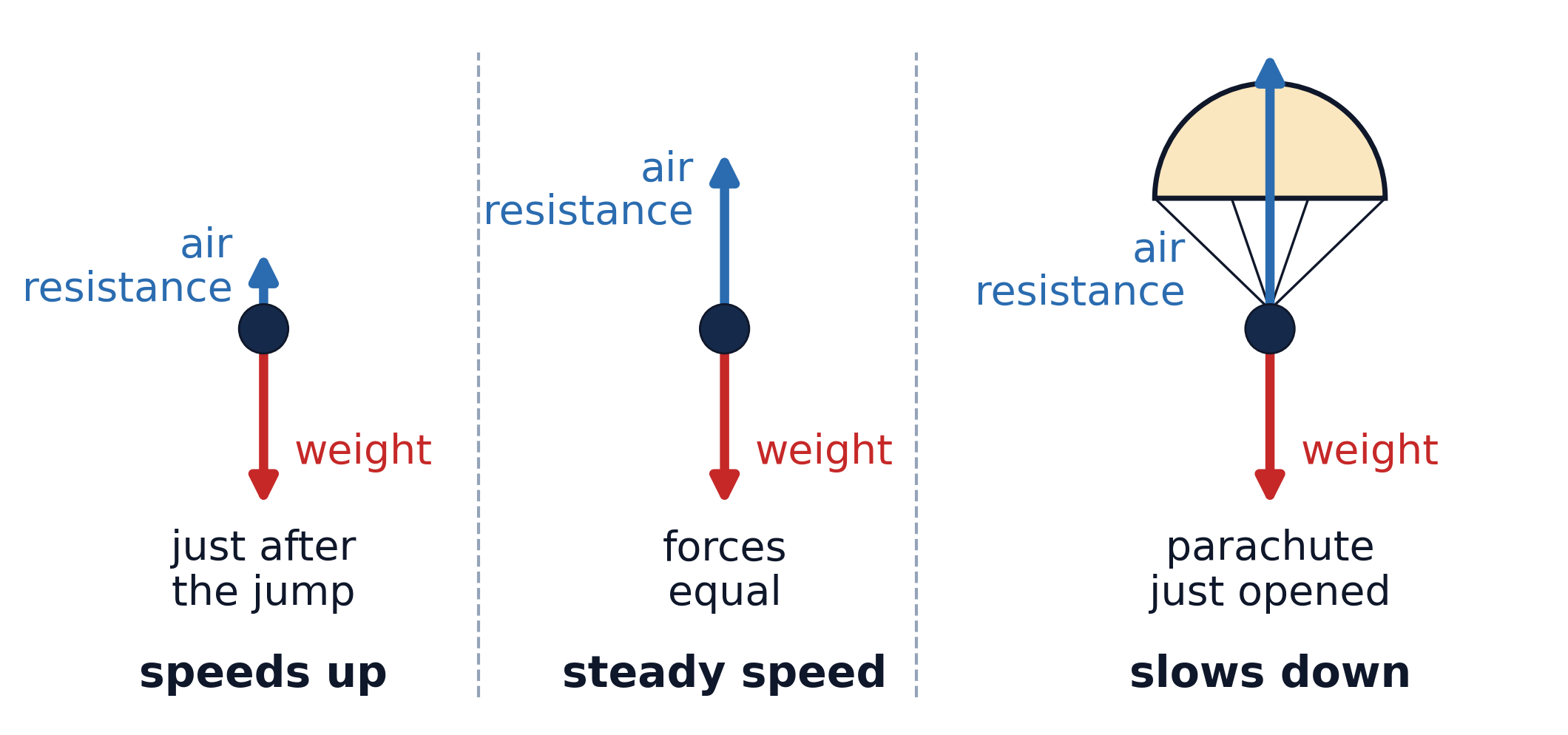
A body falling at a steady speed. A skydiver has two forces on him: his weight downward and the resistance of the air upward. Air resistance grows with speed. When it becomes equal to the weight, the net force is zero and he falls at a constant speed. When the parachute opens, the weight stays the same, but the air resistance becomes much larger, so he slows down to a new, lower steady speed.
5. Impulse: why time matters
Rearranging the second law:
F \times t = mv - mu
The product of a force and the time for which it acts is called the impulse. It equals the change in momentum. Its unit is the newton second (N s), which is the same as kg m/s.
For a given change in momentum, a longer time means a smaller force. This single idea answers many questions.
| What is done | How it helps |
|---|---|
| A fielder draws his hands back while catching a fast ball | The ball takes longer to stop, so the force on the hands is smaller |
| A paratrooper bends his knees and rolls on landing | The time of stopping is longer, so the force on his legs is smaller |
| A jumper lands on soft sand, not on a hard floor | The sand gives way and increases the time of impact |
| Glass is packed in straw; vehicles have airbags | The time of any impact is increased |
In each case the change in momentum is the same. Only the time, and therefore the force, is different.
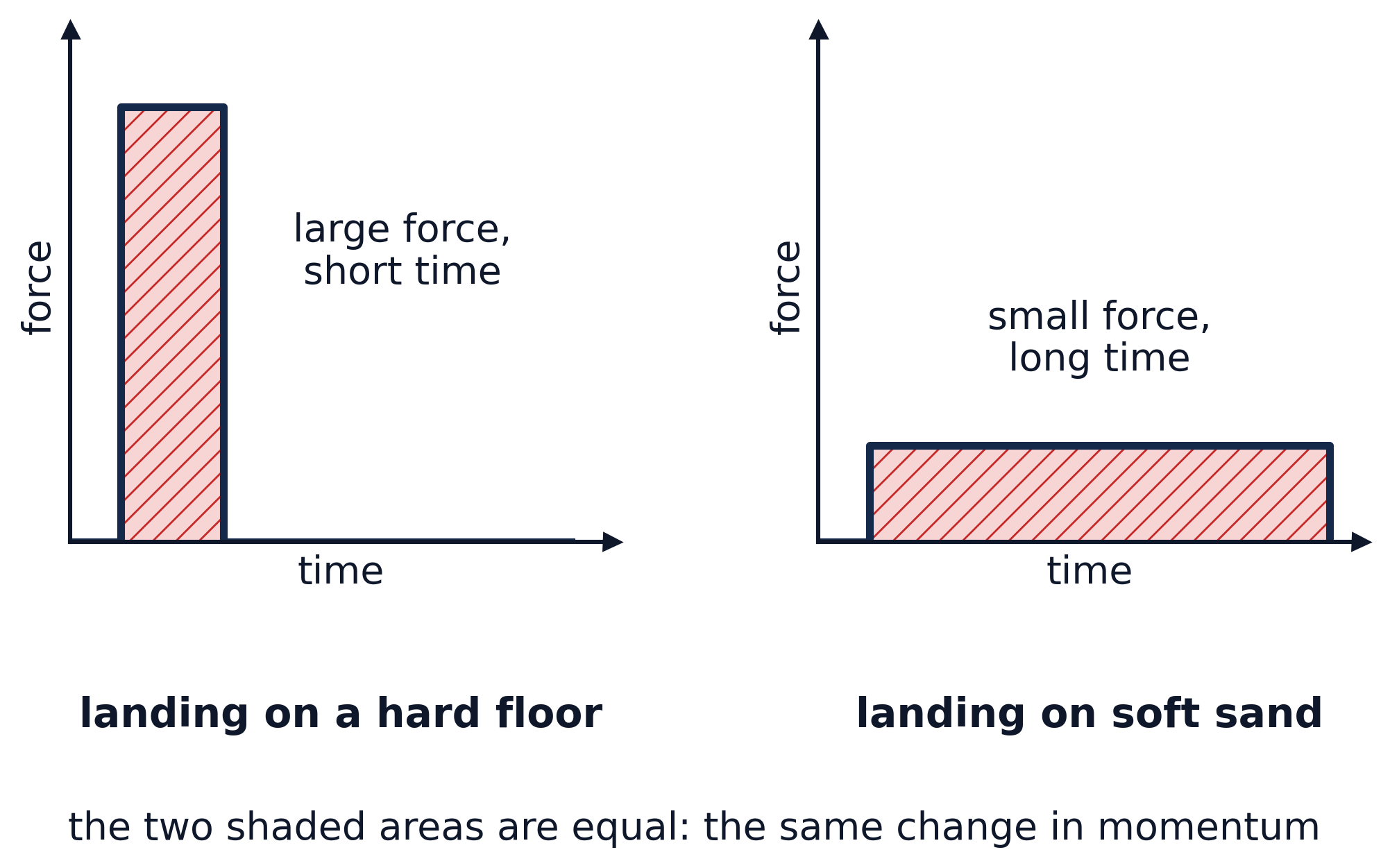
On a force-time graph, the area under the line is the impulse, so it gives the change in momentum.
The quick route for a final speed. A steady force F acting for a time t along the line of motion changes the velocity by
v - u = \frac{Ft}{m}
The velocity rises if the force is along the motion and falls if it is against it. This gain or loss comes out in m/s. If the speeds in the question are in km/h, change the gain to km/h (multiply by \tfrac{18}{5}) before you add it. CDS II 2026 set a sum of this kind, and one of its options was the answer you get by adding m/s to km/h. Example 7 below works one through.
6. The third law
Newton's third law. To every action there is an equal and opposite reaction.
If body A pushes body B, then B pushes A with a force of the same size in the opposite direction, at the same moment.
- The two forces act on two different bodies. So they never cancel each other.
- It is true for contact forces and for non-contact forces alike.
| Example | Action | Reaction |
|---|---|---|
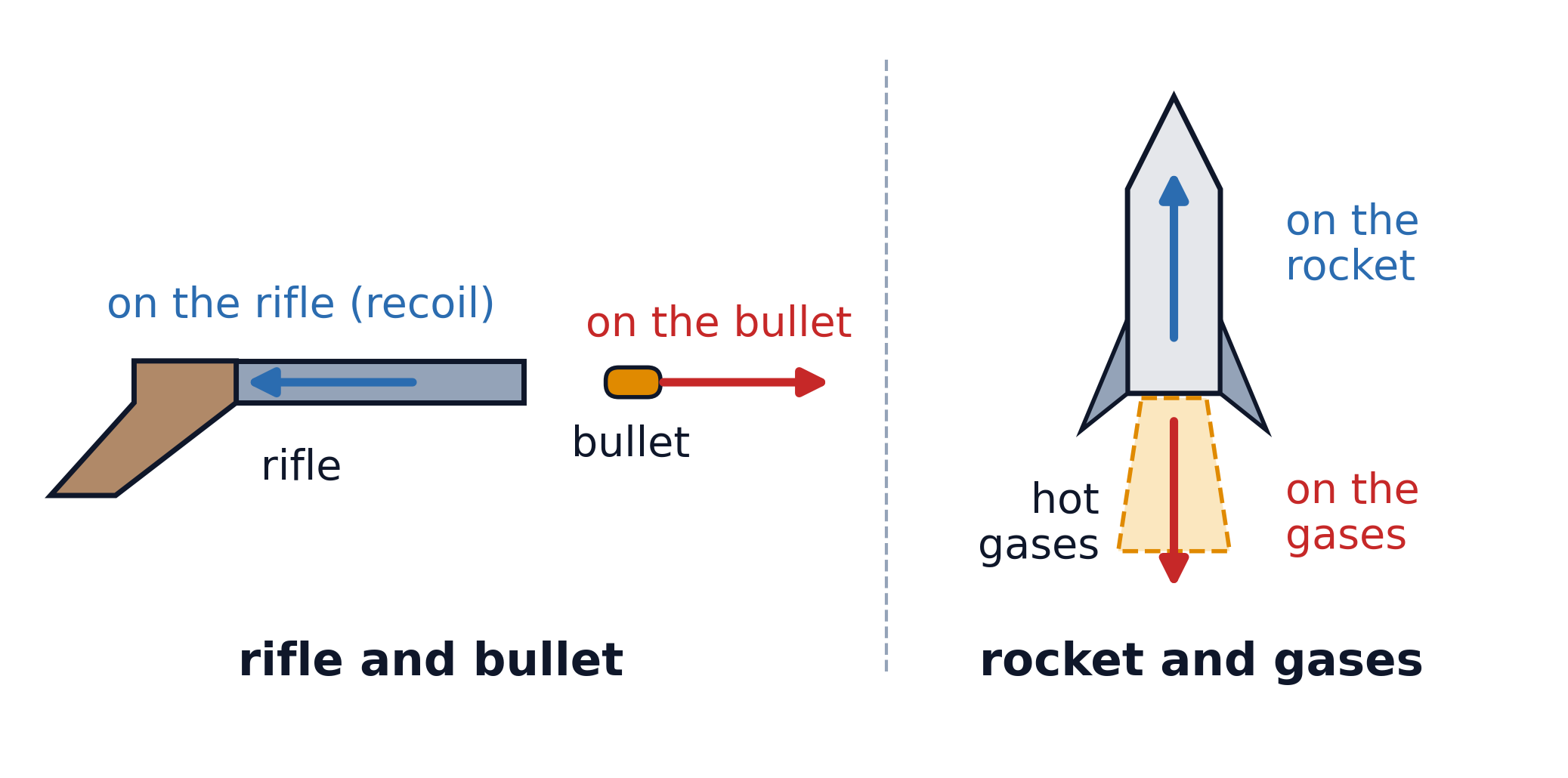
| A rifle is fired | The rifle pushes the bullet forward | The bullet pushes the rifle back. This is the recoil felt on the shoulder |
| A rocket or a jet engine | The engine pushes hot gases backward | The gases push the rocket forward. No air is needed, so a rocket works in space |
| Walking | The foot pushes the ground backward | The ground pushes the foot forward |
| Jumping from a small boat to the bank | The feet push the boat backward | The boat pushes the person forward, and the boat moves away |
7. Conservation of momentum
The law. If no external force acts on a system of bodies, the total momentum of the system stays the same.
It follows from the second and third laws together. During a collision or an explosion the bodies push each other with equal and opposite forces for the same time, so one gains exactly the momentum the other loses.
| Situation | What the law gives |
|---|---|
| A gun of mass M fires a bullet of mass m at speed v | Total momentum was zero and stays zero, so the gun recoils with speed V = \dfrac{mv}{M}. The gun is much heavier, so it moves back slowly |
| A body of mass m_1 moving at u hits a body of mass m_2 at rest, and they stick together | Common speed = \dfrac{m_1 u}{m_1 + m_2} |
| Two identical balls, one at rest, collide head-on and elastically | They exchange velocities: the moving ball stops and the other moves off with the first ball's velocity |
| A shell at rest bursts into two pieces | The pieces fly apart in opposite directions with equal amounts of momentum; the lighter piece is faster |
Forces that act inside a system, for example a chemical reaction or an explosion inside a body, cannot change the total momentum of the system. So they cannot change the velocity of its centre of mass.
For a single particle the law is simply the second law read backward: if the net force on the particle is zero, its rate of change of momentum is zero, so its momentum stays constant. CDS II 2025 asked for this condition. One of its options was "the net torque is zero". That is the condition for a different quantity, angular momentum, to be conserved. Torque is the turning effect of a force (Chapter K1-5). For linear momentum the condition is zero net force.
8. Friction
Friction is a contact force that opposes the relative motion, or the attempted motion, of two surfaces in contact. It acts along the surfaces.
| Kind of friction | When it acts | Size |
|---|---|---|
| Static | A body is pushed but has not yet started to slide | Largest (at its limit) |
| Sliding (kinetic) | One surface slides over another | Less than limiting static friction |
| Rolling | A body rolls over a surface | Much less than sliding friction |
So static friction > sliding friction > rolling friction. This is why a heavy box is harder to start than to keep moving, and why wheels and ball bearings are used.
Friction depends on the nature of the two surfaces and on how hard they are pressed together. It is reduced by oil and grease, by polishing and by ball bearings. But friction is also necessary: we could not walk, hold a rifle, or stop a vehicle without it.
When friction is the only horizontal force on a sliding body, it gives the retardation. Find the retardation from v^2 = u^2 + 2as and then use F = ma.
What the papers have asked
These are all the questions on this chapter in the 6 papers from CDS I 2024 to CDS II 2026, in our own words.
| Paper | The idea asked | The answer in one line |
|---|---|---|
| CDS II 2025 | When is the linear momentum of a particle conserved? | When the net force on it is zero. Zero net torque is the condition for angular momentum |
| CDS I 2026 | Which of four statements gives Newton's second law? | The rate of change of momentum of a body equals (is proportional to) the applied force |
| CDS II 2026 | A car of given mass and speed has a given force applied along its motion for some seconds. Find the final speed in km/h | Gain in velocity = Ft/m in m/s. Change it to km/h and add it to the first speed |
What this shows:
| Point | What to do about it |
|---|---|
| Two of the three questions were on the exact words of a law | Be able to write the three laws and the law of conservation of momentum from memory |
| The wrong options were near-misses: torque for force, angular momentum for momentum, acceleration for momentum | Read all four options to the last word before marking |
| The one calculation mixed km/h and m/s | Change units first. Check that the answer is a sensible speed for a car |
| Friction, impulse and the third law were not asked in these six papers | They are still core school physics. Read sections 5, 6 and 8 once and know the tables |
Worked examples
Example 1 (the second law). A car of mass 1200 kg moving at 20 m/s is brought to rest in 4 s by its brakes. What is the average braking force?
(a) 240 N (b) 6000 N (c) 24,000 N (d) 96,000 N
Solution. a = \dfrac{v - u}{t} = \dfrac{0 - 20}{4} = -5\ \text{m/s}^2. Force = ma = 1200 \times 5 = 6000 N, acting against the motion. Option (c) is the momentum mu in kg m/s; it has not been divided by the time. Answer (b).
Example 2 (recoil). A rifle of mass 4 kg fires a bullet of mass 20 g at 400 m/s. With what speed does the rifle recoil?
(a) 0.2 m/s (b) 2 m/s (c) 20 m/s (d) 2000 m/s
Solution. Before firing the total momentum is zero, so afterwards the momentum of the rifle backward equals that of the bullet forward. Change 20 g to 0.02 kg. Then 4 \times V = 0.02 \times 400 = 8, so V = 2 m/s. Option (d) comes from leaving the bullet's mass in grams. Answer (b).
Example 3 (impulse). A ball of mass 0.15 kg moving at 20 m/s is caught and stopped in 0.1 s. What average force acts on the hands? If the hands are drawn back so that it takes 0.5 s, what is the force?
(a) 30 N and 6 N (b) 3 N and 15 N (c) 30 N and 150 N (d) 0.3 N and 1.5 N
Solution. Change in momentum = 0.15 \times 20 = 3 kg m/s in both cases. Force = 3 \div 0.1 = 30 N, and 3 \div 0.5 = 6 N. Five times the time gives one-fifth of the force. Option (c) multiplies by the time ratio instead of dividing. Answer (a).
Example 4 (consider the following statements).
- Action and reaction are equal in size and opposite in direction.
- Action and reaction act on the same body and therefore cancel.
Which of the statements given above is/are correct?
(a) 1 only (b) 2 only (c) Both 1 and 2 (d) Neither 1 nor 2
Solution. Statement 1 is the third law. Statement 2 is wrong: the two forces act on two different bodies. The bullet is pushed forward and the rifle is pushed back. Forces can cancel only when they act on the same body. Answer (a).
Example 5 (a collision). A trolley of mass 2 kg moving at 6 m/s hits a trolley of mass 4 kg at rest and sticks to it. What is their common speed just after?
(a) 1 m/s (b) 2 m/s (c) 3 m/s (d) 6 m/s
Solution. Momentum before = 2 \times 6 + 4 \times 0 = 12 kg m/s. After, the mass is 2 + 4 = 6 kg, so 6v = 12 and v = 2 m/s. Option (c) divides by the 4 kg trolley alone. Answer (b).
Example 6 (steady speed). A parachutist of total mass 70 kg comes down at a steady 5 m/s. Taking g = 10\ \text{m/s}^2, the upward force of the air on him and his parachute is
(a) zero (b) 350 N (c) 700 N (d) 1050 N
Solution. Steady speed means zero acceleration, so the net force is zero. The upward force of the air must balance the weight, 70 \times 10 = 700 N. The speed of 5 m/s is not needed at all. Option (b) multiplies the mass by the speed, which gives a momentum, not a force. Answer (c).
Example 7 (a force acts for a time; speeds in km/h). A jeep of mass 1500 kg is moving at 90 km/h on a straight road. A steady braking force of 3000 N acts on it for 5 s. What is its speed at the end of the 5 s?
(a) 80 km/h (b) 72 km/h (c) 54 km/h (d) 36 km/h
Solution. Loss of velocity = \dfrac{Ft}{m} = \dfrac{3000 \times 5}{1500} = 10 m/s. In km/h this is 10 \times \tfrac{18}{5} = 36 km/h. Final speed = 90 - 36 = 54 km/h. Option (a) subtracts 10 from 90 without changing the unit. Option (d) is the loss itself, not the final speed. Answer (c).
Example 8 (how many of the above). Consider the following statements:
- The momentum of a body does not change while the net force on it is zero.
- The force on a body is proportional to its momentum.
- The action and the reaction of the third law act on the same body.
How many of the above statements are correct?
(a) Only one (b) Only two (c) All three (d) None
Solution. Statement 1 is correct: zero net force means zero rate of change of momentum. Statement 2 is wrong: force is proportional to the rate of change of momentum, not to the momentum. A truck moving steadily at high speed has a large momentum and no net force on it. Statement 3 is wrong: the two forces act on two different bodies. Answer (a).
Mistakes that cost marks
- Thinking a moving body must have a force on it. At constant velocity the net force is zero. A net force means a changing velocity.
- Saying action and reaction cancel. They act on different bodies, so they cannot cancel.
- Forgetting the change of sign on a rebound. A ball that hits a wall at v and returns at v has a change of momentum of size 2mv, not zero.
- Leaving grams and km/h in the formula. Change mass to kilograms and speed to m/s before using F = ma or p = mv.
- Adding a gain in m/s to a speed in km/h. Ft/m gives m/s. Multiply by \tfrac{18}{5} before adding it to a speed in km/h.
- Mixing up the two conservation conditions. Zero net force keeps linear momentum constant. Zero net torque keeps angular momentum constant.
Quick check
Do these without help. Answers are at the end.
- What force gives a mass of 8 kg an acceleration of 2.5\ \text{m/s}^2?
- What is the momentum of a 60 g ball moving at 30 m/s?
- A force of 40 N acts on a body for 0.5 s. What is the change in the body's momentum?
- Which is the smallest: static friction, sliding friction or rolling friction?
- A gun of mass 10 kg fires a 50 g shot at 200 m/s. What is the recoil speed of the gun?
Read and watch more, free
NCERT and NIOS books are free on their own websites. The NIOS lesson is named in words, without a link.
| What | Where | Language |
|---|---|---|
| Textbook, first read | NCERT textbooks, the book menu: Class 9 Science Exploration, Chapter 6 "How Forces Affect Motion" | English, Hindi |
| Textbook, full treatment | NCERT textbooks, the book menu: Class 11 Physics Part I, Chapter 4 "Laws of Motion" (the three laws, impulse, conservation of momentum, friction) | English, Hindi |
| Self-study lesson | NIOS Secondary course, Science and Technology (212), Lesson 10 (force and motion), on the NIOS website under online course material | English, Hindi |
| The real papers | UPSC previous question papers (General Knowledge booklets of every CDS sitting) | English, Hindi |
| Video, physics in one class | The Journey Extraordinary: CDS GS Revision Package (the physics class with six years of past questions; it is over ten hours long, so find this chapter's part) | Hinglish |
| Video, topic by topic | CDS Wallah: CDS Exam Full Playlist (the physics videos) | Hinglish |
| Video, past questions | Reveal GK: CDS past questions by subject and topic (the physics parts) | Hinglish |
The videos were chosen from their titles, length and views; they have not yet been watched by a teacher.
Answers to the quick check
- F = ma = 8 \times 2.5 = 20 N.
- p = mv = 0.06 \times 30 = 1.8 kg m/s.
- Change in momentum = impulse = 40 \times 0.5 = 20 kg m/s.
- Rolling friction.
- 10 \times V = 0.05 \times 200 = 10, so V = 1 m/s.
Next chapter: Forces in balance, stability and equilibrium.