Why this chapter matters. This chapter gave 2 questions in the 6 papers from CDS I 2024 to CDS II 2026: one in CDS II 2024 (how a rainbow forms) and one in CDS II 2025 (why a star twinkles). That is one question in every three papers. Both were "which phenomenon explains this?" questions, and the wrong options were other wave words: interference, diffraction, polarisation. A third question, in CDS II 2026, was dressed as a lens sum but was really refraction at a flat surface; it is counted in the next chapter. So learn the table in section 6 first, then the rules of refraction in section 3. The next chapter, on mirrors and lenses, is asked in almost every paper and stands on this one.
What you will be able to do
- Explain shadows, eclipses and the pinhole camera from the straight-line travel of light.
- State the laws of reflection and describe the image in a plane mirror.
- Use the refractive index to compare the speed of light in two media and to say which way a ray bends.
- Give the two conditions for total internal reflection and name where it is used.
- Name the phenomenon behind the common sights of the sky: rainbow, twinkling, blue sky, red sunset, mirage.
Before you start you should know: speed = distance ÷ time (Chapter K1-3), and the words frequency and wavelength (Chapter K1-10).
1. Light travels in straight lines
In one uniform medium, light travels in straight lines. This is called the rectilinear propagation of light. You see it in the beam of a torch, in the beam of a searchlight, and in sunlight coming through gaps in the trees. (The beam itself is visible only because dust and smoke in the air scatter some light into your eyes.)
Three things follow from straight-line travel.
Shadows. An opaque object stops light, and the region behind it that light cannot reach is its shadow. A small (point) source gives a sharp shadow. A large source gives a dark central part, the umbra, where no light from the source reaches, and a lighter edge, the penumbra, where light from only a part of the source reaches.
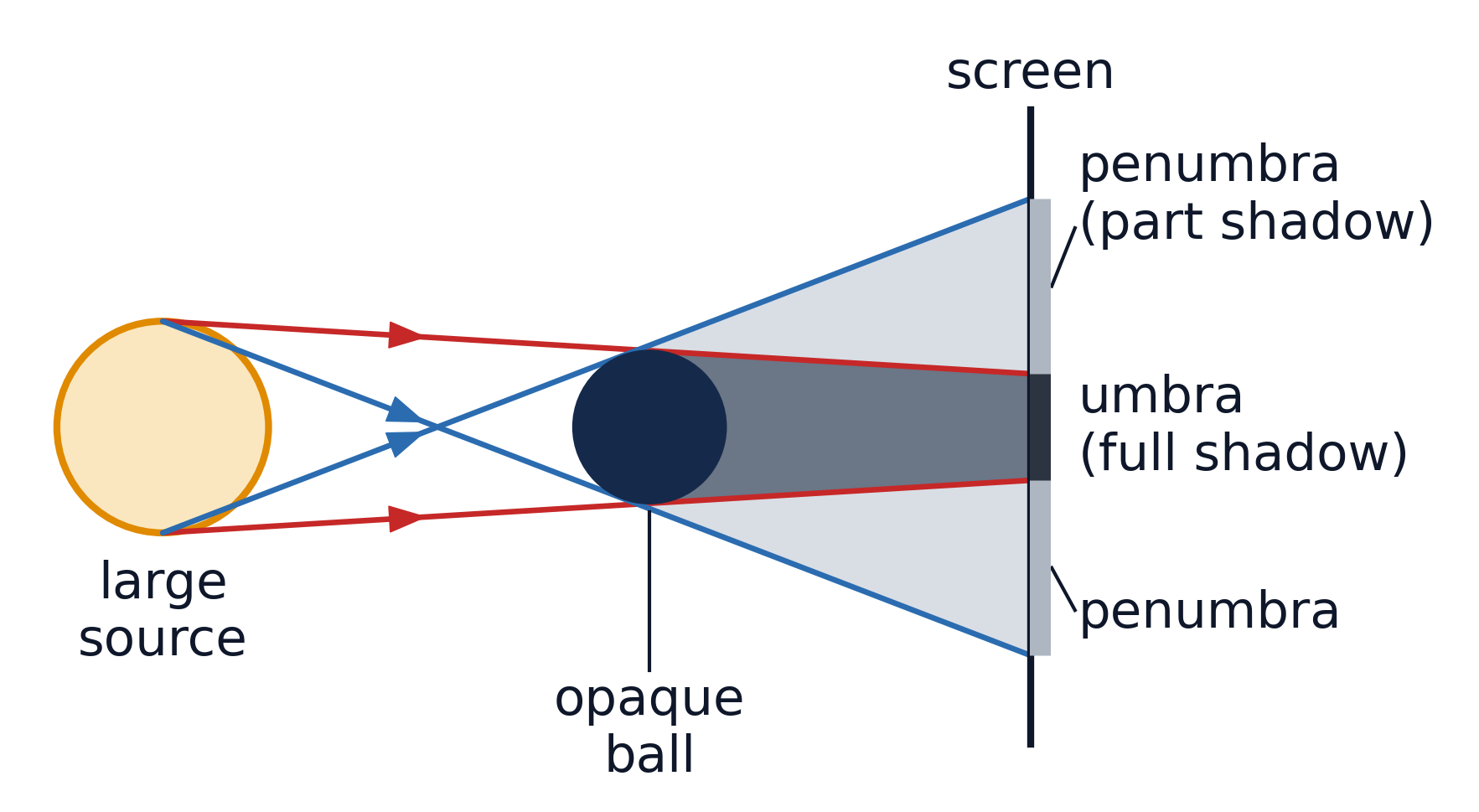
Eclipses. An eclipse is a shadow on a very large scale.
| Eclipse | Order in the line | What happens | Phase of the Moon |
|---|---|---|---|
| Solar eclipse | Sun, Moon, Earth | The Moon's shadow falls on the Earth | New Moon |
| Lunar eclipse | Sun, Earth, Moon | The Earth's shadow falls on the Moon | Full Moon |
The pinhole camera. A closed box with a tiny hole in one side and a screen on the opposite side. Rays from the top of the object pass straight through the hole to the bottom of the screen, and rays from the bottom go to the top. So the image is inverted. It is also real, because it forms on a screen. Moving the screen farther from the hole makes the image larger.
The speed of light. In a vacuum light travels at about 3 \times 10^8 m/s (3 lakh kilometres a second). This is the highest speed possible. In air the speed is almost the same. Sunlight takes about 8 minutes (close to 500 s) to reach the Earth. A light year is the distance light travels in one year: it is a unit of distance, not of time.
2. Reflection and the plane mirror
When light meets a surface and is turned back into the same medium, it is reflected. Draw the normal, a line at right angles to the surface at the point where the ray strikes. The angle of incidence i and the angle of reflection r are both measured from the normal, not from the surface.
The two laws of reflection:
- The angle of incidence equals the angle of reflection: i = r.
- The incident ray, the reflected ray and the normal all lie in one plane.
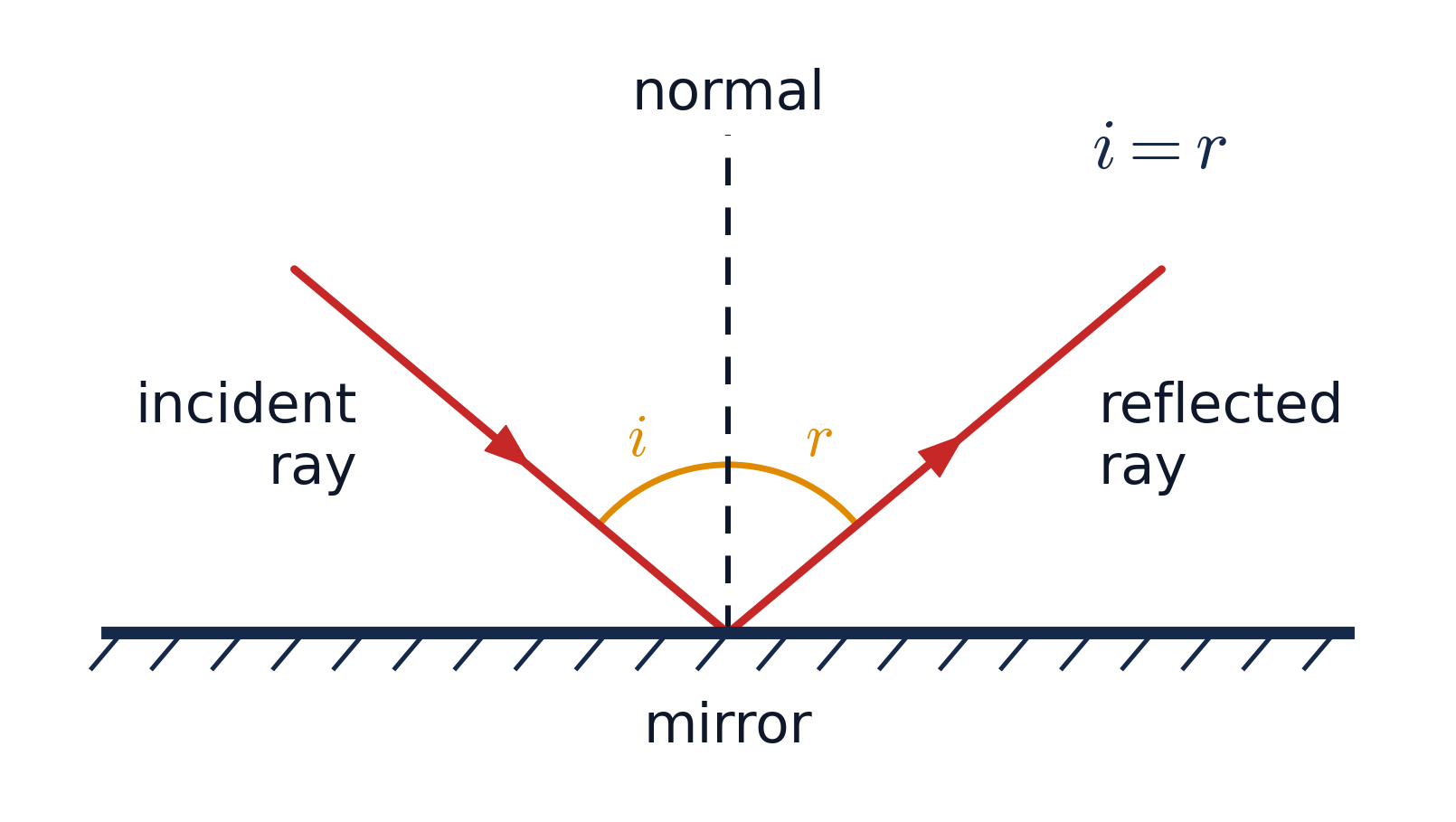
The laws hold for every reflecting surface, flat or curved, smooth or rough. A smooth surface such as a mirror reflects a parallel beam as a parallel beam (regular reflection). A rough surface such as paper or a wall sends the rays in many directions (diffuse reflection), because the normals at different points point different ways. Diffuse reflection is what lets us see ordinary objects from every side.
A ray that strikes a mirror along the normal (i = 0) is reflected straight back along its own path.
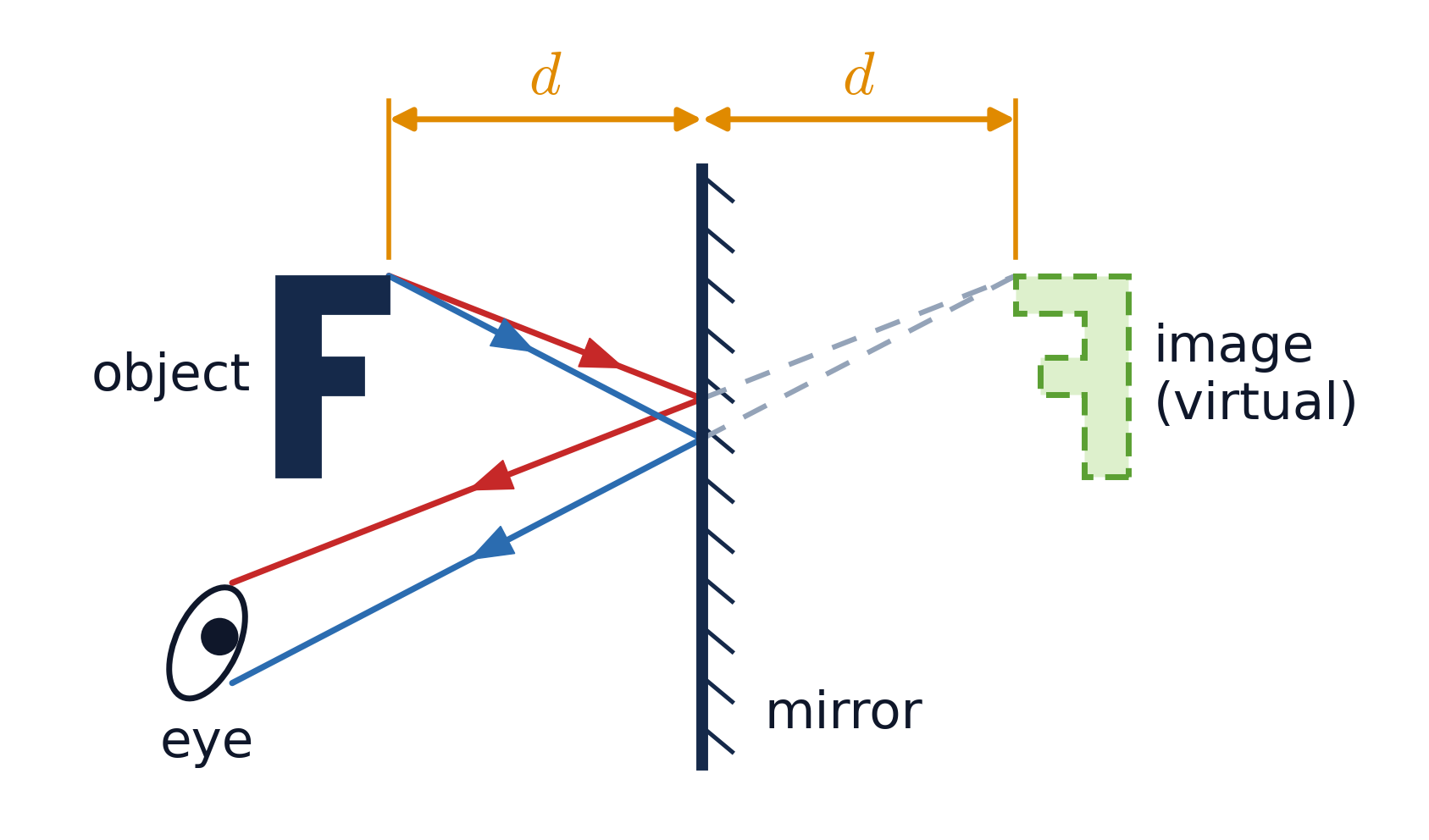
The image in a plane mirror.
| Property | The image in a plane mirror is |
|---|---|
| Nature | virtual: the rays only appear to come from it, and it cannot be caught on a screen |
| Position | as far behind the mirror as the object is in front |
| Size | the same size as the object |
| Way up | erect |
| Sideways | laterally inverted: left and right are exchanged. This is why AMBULANCE is painted reversed on the front of the vehicle, to be read correctly in a driver's mirror |
Three results that examiners use:
- To see your full height in a plane mirror, the mirror needs to be only half your height, whatever your distance from it. A person 1.5 m tall needs a mirror 0.75 m high.
- If you walk towards a plane mirror at 1 m/s, your image also moves towards the mirror at 1 m/s, so it approaches you at 2 m/s.
- If a mirror is turned through an angle \theta, the reflected ray turns through 2\theta.
Two plane mirrors at right angles give three images of an object placed between them. Two parallel mirrors facing each other, as in a barber's shop, give an endless row of images. Two parallel mirrors at 45° to the tube make a simple periscope.
3. Refraction: light bends when its speed changes
Light travels at different speeds in different transparent media. When a ray passes at a slant from one medium into another, the change of speed makes it change direction. This bending is refraction.
The laws of refraction:
- The incident ray, the refracted ray and the normal all lie in one plane.
- For a given pair of media and a given colour, \dfrac{\sin i}{\sin r} is a constant. This is Snell's law, and the constant is the refractive index of the second medium with respect to the first.
Refractive index. The (absolute) refractive index of a medium is
n = \frac{\text{speed of light in vacuum}}{\text{speed of light in the medium}} = \frac{c}{v}
It is a ratio of two speeds, so it has no unit. It is always greater than 1 for a material medium. The larger the refractive index, the slower light travels in the medium. A medium with a larger refractive index is called optically denser; one with a smaller index is optically rarer.
| Medium | Refractive index | Medium | Refractive index |
|---|---|---|---|
| Air | 1.0003 | Crown glass | 1.52 |
| Ice | 1.31 | Carbon disulphide | 1.63 |
| Water | 1.33 | Dense flint glass | 1.65 |
| Kerosene | 1.44 | Sapphire | 1.77 |
| Fused quartz | 1.46 | Diamond | 2.42 |
These are the NCERT Class 10 values. Two warnings come from the table. First, optical density is not mass density: kerosene floats on water, yet it is optically denser than water. Second, diamond has the highest index in the list, so light is slowest in diamond: v = \dfrac{3 \times 10^8}{2.42} \approx 1.24 \times 10^8 m/s.
Which way does the ray bend?
| The ray goes | Speed | The ray bends | Example |
|---|---|---|---|
| from rarer to denser (air to water, air to glass) | falls | towards the normal | a torch beam entering a pond |
| from denser to rarer (water to air, glass to air) | rises | away from the normal | light from a lamp under water coming out into the air |
| along the normal (i = 0), either way | changes | not at all: it goes straight | a ray sent straight down into a pool |
What changes and what does not. On refraction the speed and the wavelength change. The frequency does not change, because it is fixed by the source. So the colour of the light stays the same.
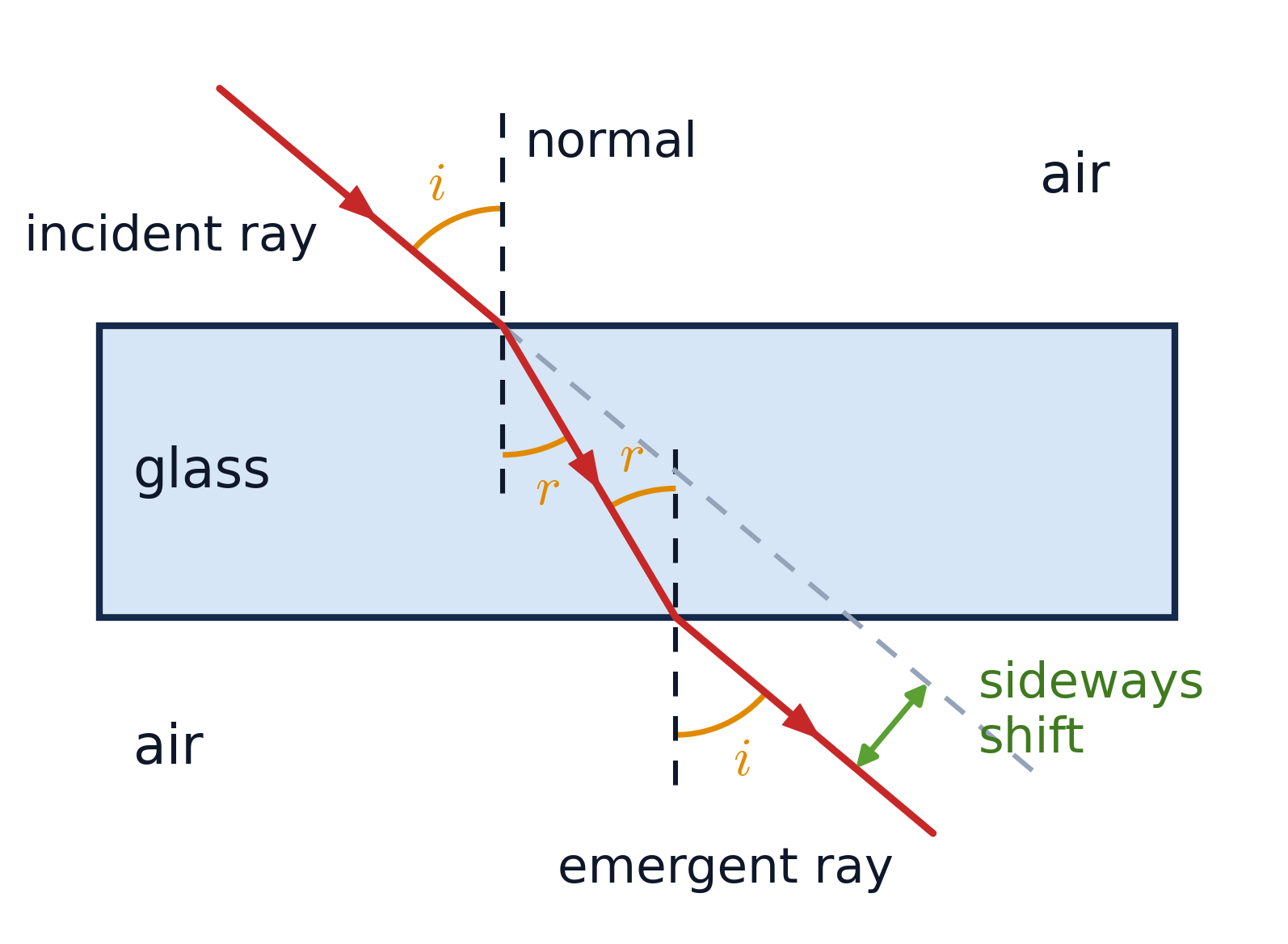
A glass slab. A ray passing through a slab with parallel faces bends towards the normal on entering and away from it on leaving, by the same amount. The emerging ray is parallel to the incident ray but shifted sideways. This is called lateral displacement.
What refraction makes us see.
- A pool, a tank or a bucket of water looks shallower than it is, and a coin at the bottom looks raised. Looking straight down, apparent depth = real depth ÷ refractive index. A pool 2 m deep looks about 2 \div 1.33 \approx 1.5 m deep.
- A pencil dipped at a slant in water looks bent at the surface.
- A lemon in a glass of water looks bigger than it is, seen from the side.
- Stars look a little higher in the sky than they are.
The same rule the other way round. An object in the rarer medium, seen from inside the denser one, looks farther than it is: apparent distance = real distance × refractive index. A bird 3 m above a lake looks, to a fish straight below it, 3 \times 1.33 \approx 4 m up. Both rules are for looking straight along the normal. CDS II 2026 used this second rule inside a lens question (Chapter K1-12).
4. Total internal reflection
Send a ray from a denser medium towards a rarer one, say from water up to the air. It bends away from the normal. Increase the angle of incidence, and the refracted ray leans closer and closer to the surface. At one angle of incidence the refracted ray runs along the surface: the angle of refraction is 90°. This angle of incidence is the critical angle C. For any larger angle no light gets out at all. All of it is reflected back into the denser medium. This is total internal reflection.
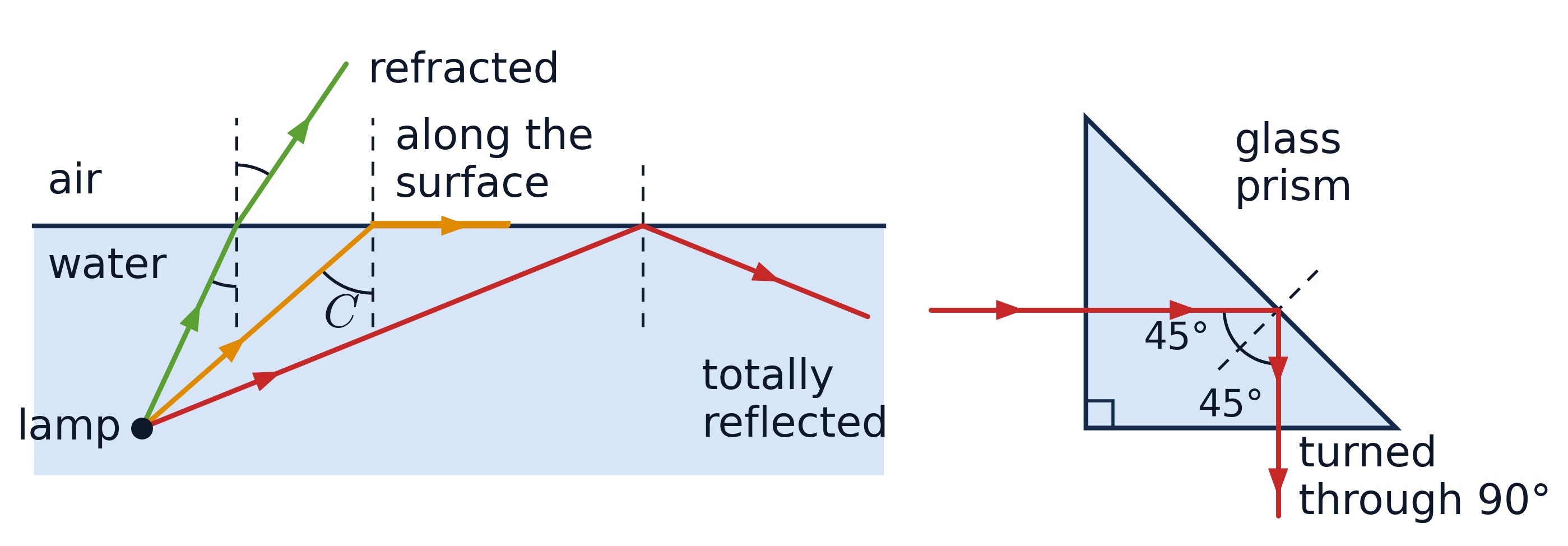
Two conditions, both needed:
- The light must be travelling from an optically denser medium towards a rarer one.
- The angle of incidence must be greater than the critical angle.
For a medium of refractive index n in air, \sin C = \dfrac{1}{n}. A larger refractive index gives a smaller critical angle.
| Medium (to air) | Critical angle, about |
|---|---|
| Water | 49° |
| Crown glass | 41° |
| Diamond | 24° |
Where it is seen and used.
| Example | How total internal reflection acts |
|---|---|
| Optical fibre | Light entering a thin glass fibre strikes its wall at a large angle again and again and is totally reflected each time, so it follows the fibre round bends. Used in telephone and internet cables and in the endoscope, with which a doctor looks inside the body |
| Sparkle of a diamond | The critical angle is only about 24°, so light inside a cut diamond is reflected many times before it leaves |
| Mirage | On a hot road or desert the air near the ground is hotter and optically rarer. Light from the sky bends more and more as it comes down and is at last totally reflected upward. The eye sees an image of the sky on the ground, which looks like water. A mirage needs both refraction and total internal reflection |
| Totally reflecting prism | A right-angled glass prism with angles 45°, 90°, 45° turns a ray through 90° or 180°. The ray meets the long face at 45°, more than the critical angle of 41°. Used in binoculars and in good periscopes |
5. Dispersion: white light is a mixture of colours
When a narrow beam of white light passes through a glass prism it comes out as a band of seven colours: violet, indigo, blue, green, yellow, orange, red (VIBGYOR). The band is a spectrum, and the splitting is dispersion. Isaac Newton was the first to obtain the spectrum of sunlight with a glass prism. He also showed that a second prism placed upside down joins the colours into white light again.
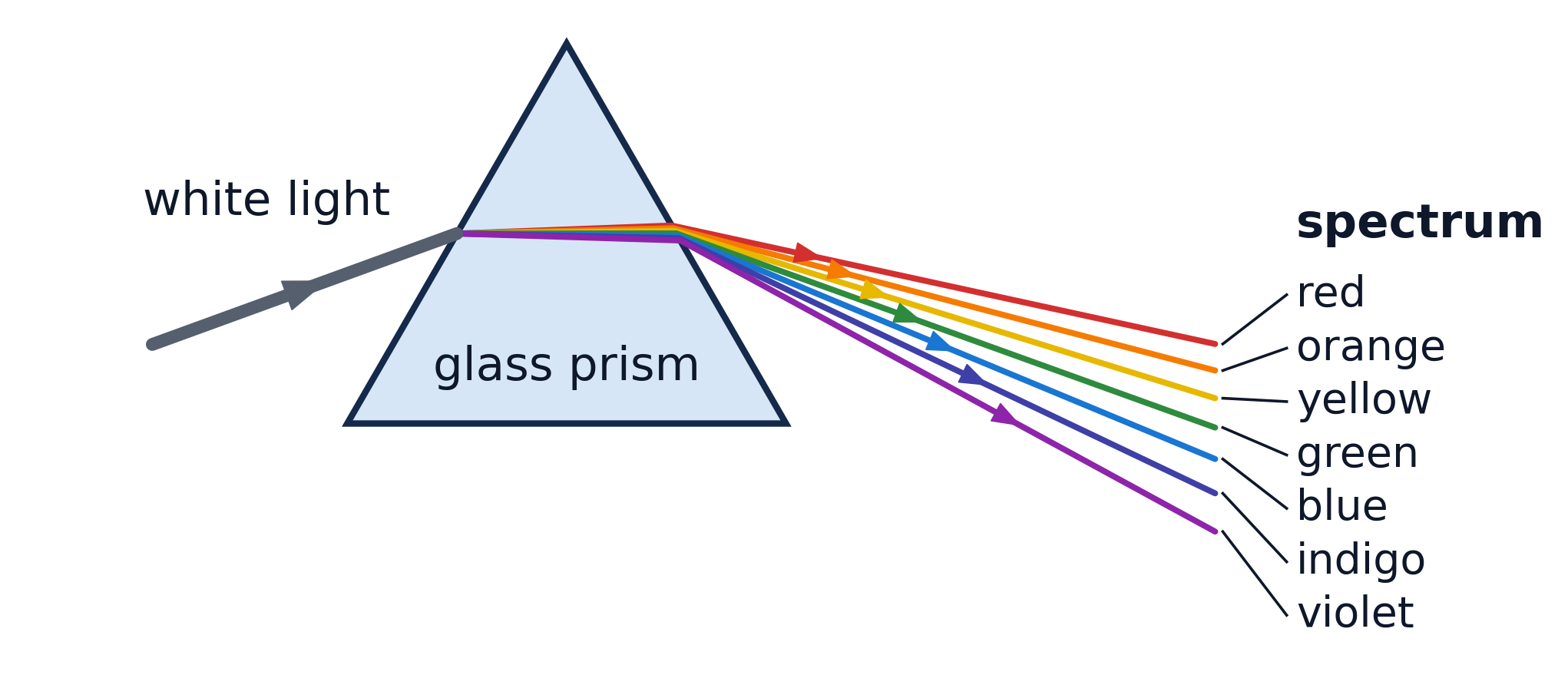
Why does it happen? In a vacuum all colours travel at the same speed. In glass they do not. Violet is slowest, so glass has the greatest refractive index for violet and bends it most. Red is fastest in glass and bends least.
| Red | Violet | |
|---|---|---|
| Wavelength | longest of the visible colours | shortest |
| Speed in glass | greatest | least |
| Refractive index of glass for it | least | greatest |
| Bending (deviation) by a prism | least | most |
A prism bends a ray towards its base, both on entering and on leaving.
The rainbow. A rainbow is a natural spectrum. Raindrops act as tiny prisms. Sunlight is refracted and dispersed on entering a drop, reflected inside the drop, and refracted again on leaving. You see a rainbow only with the Sun behind you. In the common (primary) bow the light is reflected once inside each drop, and red is on the outer edge. A fainter secondary bow, outside the first, comes from two internal reflections, and its colours are in the reverse order.
CDS II 2024 asked what the formation of a rainbow by water droplets involves. The options offered a single refraction, one internal reflection, two internal reflections, and "both refraction and internal reflection". The last is the full answer: neither refraction alone nor reflection alone makes a rainbow.
Colours of light. Red, green and blue are the primary colours of light. Mixed in equal strength they give white. In pairs they give: red + green = yellow, red + blue = magenta, green + blue = cyan.
6. Light in the atmosphere: one table to learn
Atmospheric refraction. The air is denser near the ground and rarer higher up, so light from space bends gradually as it comes down.
Scattering. Very small particles, and the molecules of air themselves, send light out in all directions. They scatter the short wavelengths (blue) far more strongly than the long ones (red).
| What we see | Cause |
|---|---|
| Stars twinkle; planets do not | Atmospheric refraction. The air is never still, so the bending of the thin beam from a star keeps changing. A planet is near enough to act as many points, and the changes average out |
| The Sun is seen about 2 minutes before it actually rises and about 2 minutes after it sets | Atmospheric refraction |
| A pool looks shallow; a stick looks bent | Refraction |
| Rainbow; colours from a prism | Dispersion (with refraction and internal reflection in the drops) |
| Mirage; sparkle of a diamond; optical fibre | Total internal reflection |
| The sky is blue | Scattering: air molecules scatter blue light more than red |
| The Sun is red at sunrise and sunset | Scattering: the light passes through a long path of air, the blue is scattered away, and mostly red reaches the eye |
| Danger signals are red | Red is scattered least, so it is seen from far away even in fog |
| The sky is dark to an astronaut in space | No atmosphere, so no scattering |
| The path of a light beam is seen in a dusty room, in fog or in a colloid such as milk in water | Scattering by the particles: the Tyndall effect |
Four wave words that appear as wrong options. CDS II 2025 asked why a star twinkles and offered interference, refraction, polarisation and diffraction. The answer is refraction (by the moving layers of the atmosphere). Know what the other three mean, so that you can reject them.
| Word | Meaning | Where it is seen |
|---|---|---|
| Interference | Two light waves meet and add up: bright where they help each other, dark where they cancel | The colours of a soap bubble and of a thin film of oil on a wet road |
| Diffraction | Light bends a little round a sharp edge or spreads after a very narrow slit | The coloured bands seen on a compact disc |
| Polarisation | The vibrations of a light wave are limited to one plane | Polaroid sunglasses cut the glare from a road or from water |
| Scattering | Small particles send light out in all directions | Blue sky, red sunset, the Tyndall effect |
Two Class 12 facts complete the picture. In ordinary scattering the frequency of the light does not change. C. V. Raman found that a small part of the light scattered by molecules comes out with a changed frequency. This is the Raman effect, for which he received the Nobel Prize in 1930. And light can be polarised, which is possible only for transverse waves; this is the evidence that light is a transverse wave.
What the papers have asked
These are all the questions on this chapter in the 6 papers from CDS I 2024 to CDS II 2026, in our own words. The answers are our own working.
| Paper | The idea asked | The answer in one line |
|---|---|---|
| CDS II 2024 | What the formation of a rainbow by water droplets involves | Both refraction and internal reflection of sunlight |
| CDS II 2025 | The cause of the twinkling of a star | Refraction of light, by the atmosphere. Not interference, polarisation or diffraction |
| CDS II 2026 (counted in Chapter K1-12) | The curved face of a plano-convex lens is in a liquid of the lens's own refractive index, 8/5. A point source is in air, 40 cm from the lens | The curved face no longer bends light, so only the flat face acts. Seen from inside, the source appears at 40 \times 8/5 = 64 cm |
The third row shows the level the paper can reach: the question gives a focal length that is not needed and expects you to see that a boundary between two media of the same refractive index does nothing. The ideas a paper can pick next are in the table of section 6 and in section 4: blue sky, red sunset, mirage, optical fibre, the critical angle.
Worked examples
Example 1 (a single fact). A ray of light strikes a plane mirror making an angle of 30° with the surface of the mirror. What is the angle of reflection?
(a) 30° (b) 45° (c) 60° (d) 90°
Solution. Angles are measured from the normal. The angle of incidence is 90^\circ - 30^\circ = 60^\circ, and the angle of reflection equals it. Option (a) is the trap: 30° is the angle with the mirror, not with the normal. Answer (c).
Example 2 (a short calculation). The refractive index of a glass is 1.5. What is the speed of light in it? (Speed of light in vacuum = 3 \times 10^8 m/s)
(a) 1.5 \times 10^8 m/s (b) 2 \times 10^8 m/s (c) 3 \times 10^8 m/s (d) 4.5 \times 10^8 m/s
Solution. v = \dfrac{c}{n} = \dfrac{3 \times 10^8}{1.5} = 2 \times 10^8 m/s. Option (d) multiplies instead of dividing and gives a speed greater than that of light in vacuum, which is impossible. Answer (b).
Example 3 (statements). Consider the following statements:
- When light passes from air into glass, its frequency decreases.
- When light passes from air into glass, its wavelength decreases.
Which of the statements given above is/are correct?
(a) 1 only (b) 2 only (c) Both 1 and 2 (d) Neither 1 nor 2
Solution. The frequency is set by the source and does not change on refraction, so statement 1 is wrong. The speed falls in glass. Since speed = frequency × wavelength and the frequency is fixed, the wavelength falls in the same ratio, so statement 2 is correct. Answer (b).
Example 4 (two ideas). A ray of light travelling in air strikes the surface of water at 60° to the normal. Can it be totally internally reflected?
Solution. No, at any angle. Total internal reflection needs the light to start in the denser medium. Here it starts in the rarer medium, air. Part of the light is reflected and the rest is refracted into the water, bending towards the normal. A ray going the other way, from water to air, would be totally reflected at 60°, because 60° is more than the critical angle of water (about 49°).
Example 5 (matching lists). Match each sight with its main cause.
| List I | List II |
|---|---|
| A. Blue colour of the sky | 1. Total internal reflection |
| B. Twinkling of stars | 2. Dispersion |
| C. Spectrum from a prism | 3. Scattering |
| D. Light staying inside an optical fibre | 4. Atmospheric refraction |
(a) A-3, B-4, C-2, D-1 (b) A-4, B-3, C-2, D-1 (c) A-3, B-4, C-1, D-2 (d) A-2, B-4, C-3, D-1
Solution. The sky is blue because air scatters blue light most (3). Stars twinkle because of atmospheric refraction (4). A prism spreads white light into colours by dispersion (2). A fibre holds light by total internal reflection (1). Option (b) exchanges scattering and atmospheric refraction, the most common confusion. Answer (a).
Example 6 (a short calculation). A fish is 1.2 m below the surface of a pond. Seen from directly above, how deep does it appear? (Refractive index of water = 1.33)
Solution. Apparent depth = real depth ÷ refractive index = 1.2 \div 1.33 \approx 0.9 m. The fish looks nearer the surface than it is. Do not multiply: an object in a denser medium always looks nearer, never deeper.
Mistakes that cost marks
- Measuring angles from the surface. The angles of incidence, reflection and refraction are all measured from the normal.
- Mixing up scattering, dispersion and atmospheric refraction. Blue sky and red sunset: scattering. Rainbow and prism colours: dispersion. Twinkling and the early sunrise: atmospheric refraction. Use the table in section 6.
- Saying the frequency changes on refraction. Speed and wavelength change. Frequency does not.
- Forgetting the first condition for total internal reflection. It happens only when light goes from a denser medium towards a rarer one. It can never happen for light going from air into glass or water.
Quick check
Do these without help. Answers are at the end.
- A girl stands 2 m in front of a plane mirror. How far is her image from her?
- Which colour of white light is deviated most by a glass prism, and which least?
- The refractive index of water is 1.33 and that of kerosene is 1.44. In which does light travel faster?
- State the two conditions for total internal reflection.
- Name the phenomenon that makes the sky look blue.
Read and watch more, free
| What | Where | Language |
|---|---|---|
| Textbook, the main chapters | NCERT textbooks, the book menu: Class 10 Science, Chapter 9 Light: Reflection and Refraction, and Chapter 10 The Human Eye and the Colourful World | English, Hindi |
| Textbook, total internal reflection, the prism, the rainbow | NCERT textbooks, the book menu: Class 12 Physics Part II, Chapter 9 Ray Optics and Optical Instruments; Chapter 10 Wave Optics for interference, diffraction and polarisation | English, Hindi |
| Self-study lesson | NIOS Secondary course, Science and Technology (212), Lesson 15 Light Energy, on the NIOS website under online course material | English, Hindi |
| The real papers | UPSC previous question papers (CDS, General Knowledge; the physics block is ten questions) | English, Hindi |
| Video, revision in one class | The Journey Extraordinary: GS Revision Package for the 2026 sittings (the physics class, with six years of past questions; about ten hours, so use the part on this chapter) | Hinglish |
| Video, topic classes | CDS Wallah: CDS Exam Full Playlist, CDS 1 2026 (the physics classes; three to six hours each) | Hinglish |
| Video, past questions | Chandigarh Career Group: CDS General Studies PYQ (the channel also has a list of CDS physics past questions) | Hinglish |
The NCERT and NIOS books are named in words because the book pages move; open the book list and choose the class and subject. The videos were chosen from their titles, length and views; they have not yet been watched by a teacher.
Answers to the quick check
- 4 m. The image is 2 m behind the mirror, and she is 2 m in front of it.
- Violet is deviated most and red least.
- In water. The smaller refractive index means the greater speed.
- The light must travel from a denser medium towards a rarer one, and the angle of incidence must be greater than the critical angle.
- Scattering of sunlight by the molecules of air.
Next chapter: Mirrors, lenses and the eye.