Why this chapter matters. This chapter gave 3 questions in the 6 papers from CDS I 2024 to CDS II 2026: one each in CDS II 2024, CDS II 2025 and CDS I 2026. That is one question in every two papers, worth 0.83 marks. Two of the three were on static charge: why aircraft tyres conduct, and what a Van de Graaff generator produces. The third asked whether the resistivity of a wire changes with its length. Two more questions, counted in Chapter K1-15, could not be done without the rules of this chapter: a bulb used at half its voltage, and three resistors joined so as to give the most heat. So learn three things first: the table "Static charge at work" in section 1, the difference between resistance and resistivity in section 6, and the series and parallel table in section 7.
What you will be able to do
- Say what charge is, state its three basic properties, and tell a conductor from an insulator.
- Use Q = It, V = \dfrac{W}{Q} and V = IR in one-step calculations.
- Find how the resistance of a wire changes with its length and thickness, and say why its resistivity does not change.
- Find the total resistance of resistors in series, in parallel, and in a mixture of the two.
Before you start you should know: work and energy and their unit, the joule (Chapter K1-7), and how to add fractions.
1. Electric charge and static electricity
Rub a plastic comb on dry hair and it picks up small pieces of paper. The comb has become charged. Rubbing does not make charge. It moves electrons from one body to the other. The body that gains electrons becomes negative, and the body that loses them becomes positive by the same amount.
There are two kinds of charge, positive and negative. Like charges repel, unlike charges attract. A glass rod rubbed with silk becomes positive. A plastic rod rubbed with fur or wool becomes negative.
Charge that stays in one place is called static electricity. Charge that flows is current electricity.
| Fact about charge | What to remember |
|---|---|
| SI unit | coulomb (C) |
| Charge of one electron | 1.6 \times 10^{-19} C, negative. A proton has the same amount, positive |
| It adds | Charges add like ordinary numbers with signs: +5 C and -3 C make +2 C |
| It is conserved | The total charge of an isolated system never changes. Charge cannot be created or destroyed, only moved |
| It is quantised | Any charge is a whole number of electron charges: q = ne |
| Force between two charges (Coulomb's law) | F = k\dfrac{q_1 q_2}{r^2}, with k = 9 \times 10^{9} N m²/C². Double the distance and the force becomes one quarter |
Ways to charge a body. By rubbing (friction), by touching it with a charged body (conduction), and by bringing a charged body near without touching (induction).
Lightning is static electricity on a very large scale. Charges separate inside a thundercloud. The base of the cloud usually becomes negative, and it induces positive charge on the ground below. When the charges become large enough, they rush through the air between the parts of the cloud, or between the cloud and the ground. That sudden flow is the flash.
Static charge at work. The CDS papers have asked two of these five in six sittings.
| Where | What happens |
|---|---|
| Aircraft tyres | In flight the body of an aircraft is charged by friction with the air. Its tyres are made of rubber that conducts a little. On landing the charge flows through them to the ground, so no spark jumps. A spark near fuel is the danger |
| Petrol tanker | A moving tanker is charged in the same way, by friction with the air and the road. A metal chain or strap touching the road carries the charge to the earth |
| Lightning conductor | A pointed metal rod above the highest part of a building, joined by a thick metal strip to a plate buried in the ground. It gives the charge of a strike an easy path to the earth, so the current does not pass through the building |
| Shielding | Charge given to a hollow conductor stays on its outer surface, and the electric field inside it is zero. So a person inside a closed metal car or an aircraft is safe in a thunderstorm. The metal body gives the protection, not the rubber tyres |
| Van de Graaff generator | A machine that builds up a very high voltage. A moving belt of insulating material carries charge up to a large hollow metal dome, again and again. The charge moves at once to the outside of the dome, so the dome goes on accepting more. Its potential rises to a few million volts. The current it can give is very small, and it is a direct current. It is used to speed up charged particles such as protons |
2. Conductors and insulators
In a metal, some electrons are not tied to any one atom. These free electrons can drift through the whole piece. A material with many free electrons lets charge flow and is a conductor. A material with almost none is an insulator, also called a non-conductor.
| Kind | Examples | Exam fact |
|---|---|---|
| Conductors | Silver, copper, aluminium, iron, graphite, salt water, the human body | Silver is the best conductor. Copper and aluminium are used for wires because they are cheaper. The current in a metal is carried by free electrons |
| Insulators | Rubber, glass, plastic, dry wood, dry air, pure (distilled) water | Used to cover wires and to make handles of tools |
| Semiconductors | Silicon, germanium | They conduct better when warmer. Used in diodes and chips |
An insulator can still be charged. Charge put on an insulator stays where it is put, which is why a rubbed comb keeps its charge. Charge given to a conductor spreads at once over its outer surface, and if you hold a metal rod in your hand the charge runs through your body to the earth. So a metal rod shows a charge only when it has an insulating handle.
3. Electric current
Current is the rate of flow of charge.
I = \frac{Q}{t}
The unit is the ampere (A). One ampere is one coulomb passing each second. Small currents are given in milliamperes: 1 mA = 10^{-3} A.
Example. A current of 2 A flows for 5 minutes. The time is 300 s, so Q = It = 2 \times 300 = 600 C. Always change minutes to seconds first.
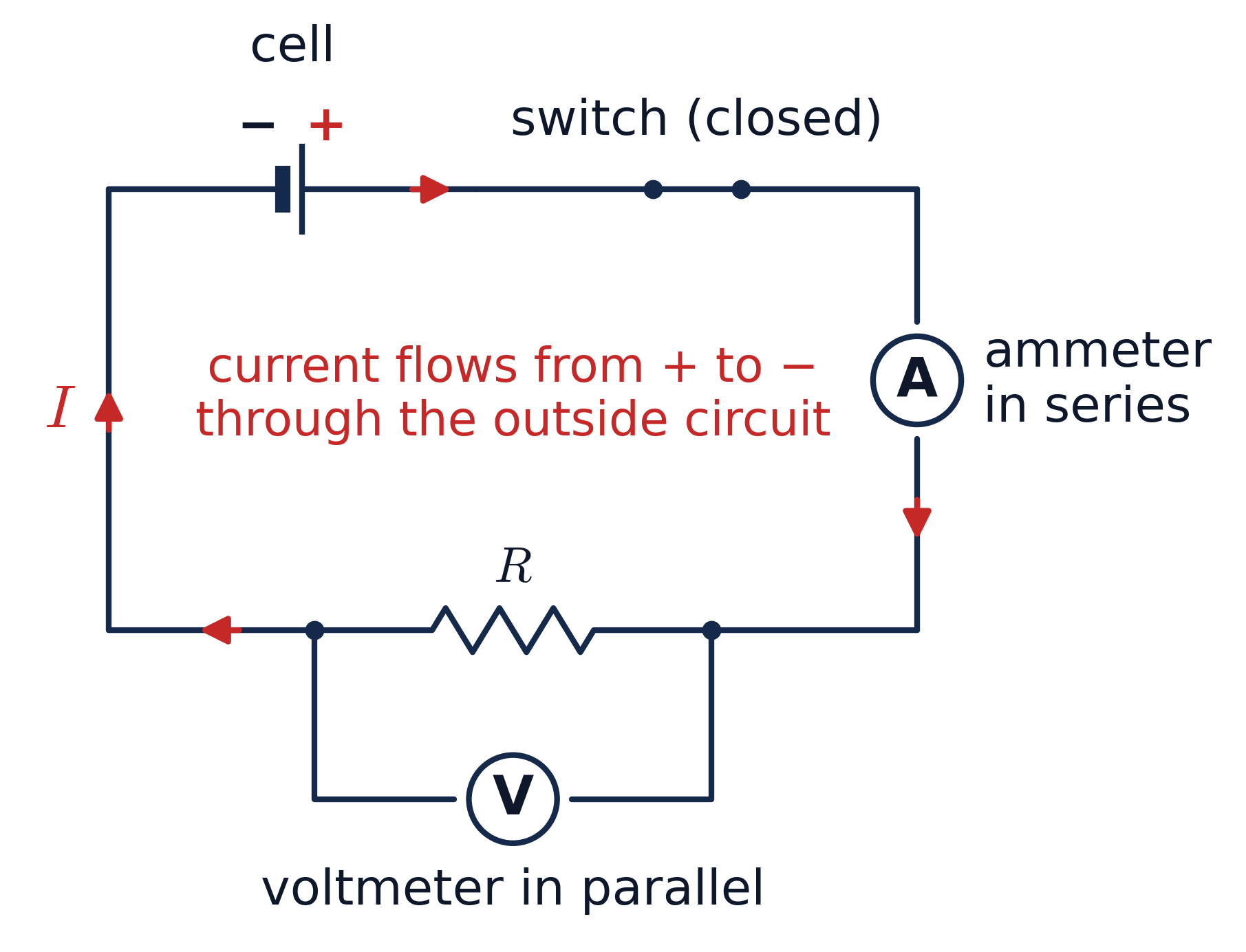
Direction. By agreement, current flows from the positive terminal of a cell to the negative terminal through the outside circuit. The electrons actually drift the other way, from negative to positive. Both statements are correct and both are asked.
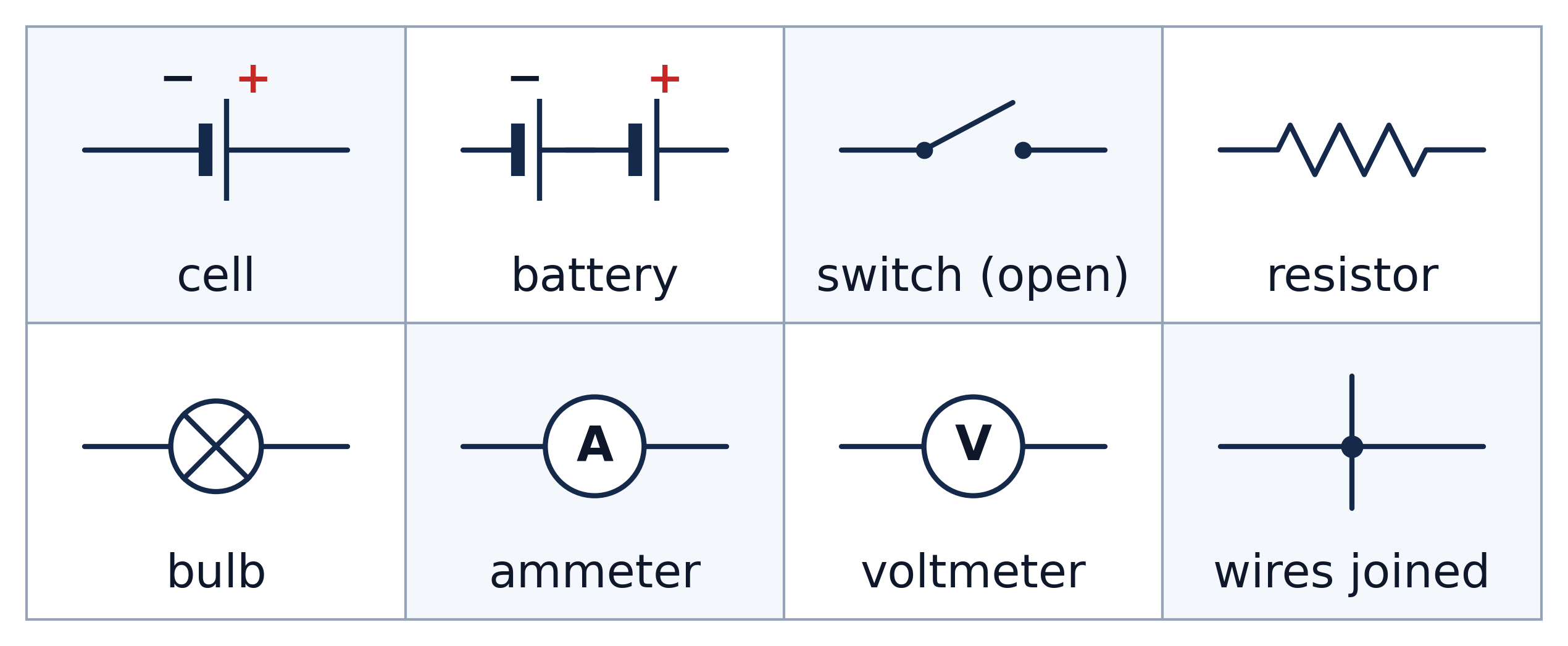
Current is measured with an ammeter. A galvanometer is the sensitive instrument that detects a small current and shows its direction.
4. Potential difference
Water flows in a pipe only when there is a difference of pressure between its ends. Charge flows in a wire only when there is a difference of electrical "pressure" between its ends. This is the potential difference, often called the voltage. A cell or a battery keeps it up.
The potential difference between two points is the work done in moving one coulomb of charge from one point to the other.
V = \frac{W}{Q}
The unit is the volt (V). One volt is one joule per coulomb.
Example. 60 J of work moves 5 C between two points. V = \dfrac{60}{5} = 12 V.
Potential difference is measured with a voltmeter.
| Meter | Measures | How it is connected | Its own resistance |
|---|---|---|---|
| Ammeter | Current | In series, so that the whole current passes through it | Very low, so that it does not reduce the current |
| Voltmeter | Potential difference | In parallel, across the two points | Very high, so that it takes almost no current |
5. Ohm's law
Georg Ohm found that for a metal wire at a steady temperature, the current through it is directly proportional to the potential difference across its ends.
V = IR
R is the resistance of the wire. Its unit is the ohm (\Omega). One ohm is one volt per ampere. Resistance is the opposition a conductor offers to the flow of charge. It arises because the drifting electrons keep colliding with the atoms of the metal.
A graph of V against I for such a wire is a straight line through the origin.
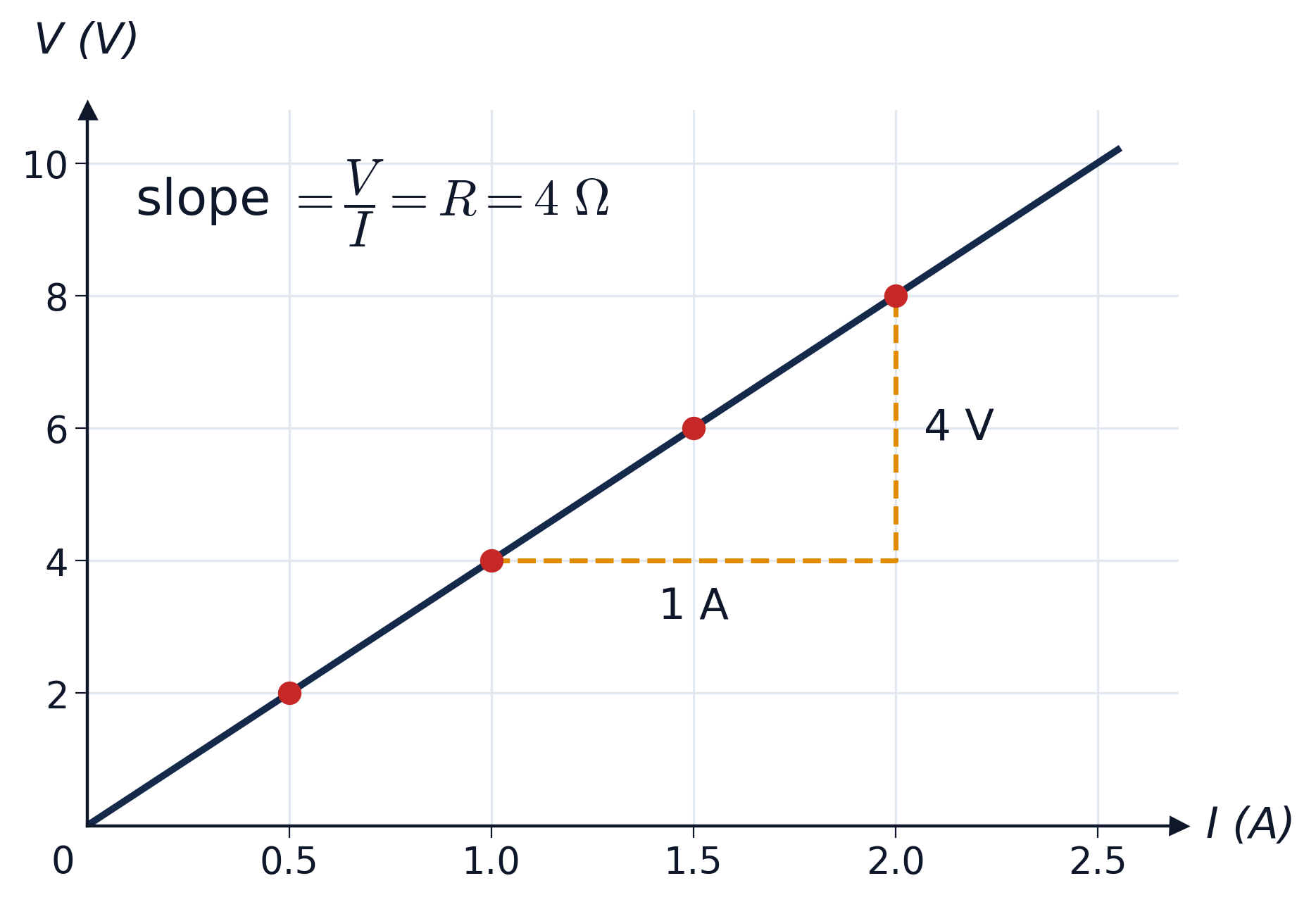
Example. A heater takes 2 A on a 220 V supply. Its resistance is R = \dfrac{220}{2} = 110\ \Omega. On a 110 V supply the same heater takes \dfrac{110}{110} = 1 A. Halving the voltage halves the current, if the resistance stays the same.
Ohm's law is not a law for every material. A conductor obeys it only when its resistance does not depend on the voltage applied or on the direction of the current. A diode and other semiconductor devices do not obey it. The filament of a bulb does not follow a straight line either, because it gets hotter and its resistance rises.
6. Resistance and resistivity
A long road with many obstacles slows traffic more than a short one, and a narrow road more than a wide one. A wire behaves in the same way.
R = \rho\,\frac{L}{A}
Here L is the length, A is the area of cross-section and \rho (rho) is the resistivity of the material. Its unit is the ohm metre (\Omega m).
| Resistance R | Resistivity \rho | |
|---|---|---|
| Belongs to | One particular wire | The material |
| Unit | ohm | ohm metre |
| Length doubled | Doubles | No change |
| Area of cross-section doubled | Halves | No change |
| Radius doubled | Becomes one quarter, because the area is \pi r^2 | No change |
| Temperature raised (a metal) | Rises | Rises |
| Material changed | Changes | Changes |
CDS I 2026 asked what happens to the resistivity of a wire when its length or its thickness is changed. Nothing happens to it. Only the resistance changes.
Five more facts worth knowing:
- The resistivity of a metal rises when it is heated. The resistivity of a semiconductor falls when it is heated.
- An alloy has a higher resistivity than the metals in it. Nichrome, an alloy of nickel and chromium, is used for heating elements. Copper has a very low resistivity and is used for connecting wires.
- If a wire is stretched, its volume stays the same. Stretch it to twice its length and the area becomes half, so the resistance becomes 2 \times 2 = 4 times. In general, a wire stretched to n times its length has n^2 times the resistance.
- Conductivity is the reciprocal of resistivity: \sigma = \dfrac{1}{\rho}. Its unit is the siemens per metre (S/m). A good conductor has a high conductivity and a low resistivity.
- Some materials lose all their resistance when they are cooled below a fixed, very low temperature. They are called superconductors. Mercury becomes one at about 4.2 K.
Example. A wire has resistance R. A second wire of the same metal has half the length and twice the radius. Its area is 4 times as large, so its resistance is R \times \dfrac{1}{2} \times \dfrac{1}{4} = \dfrac{R}{8}.
7. Resistors in series and in parallel
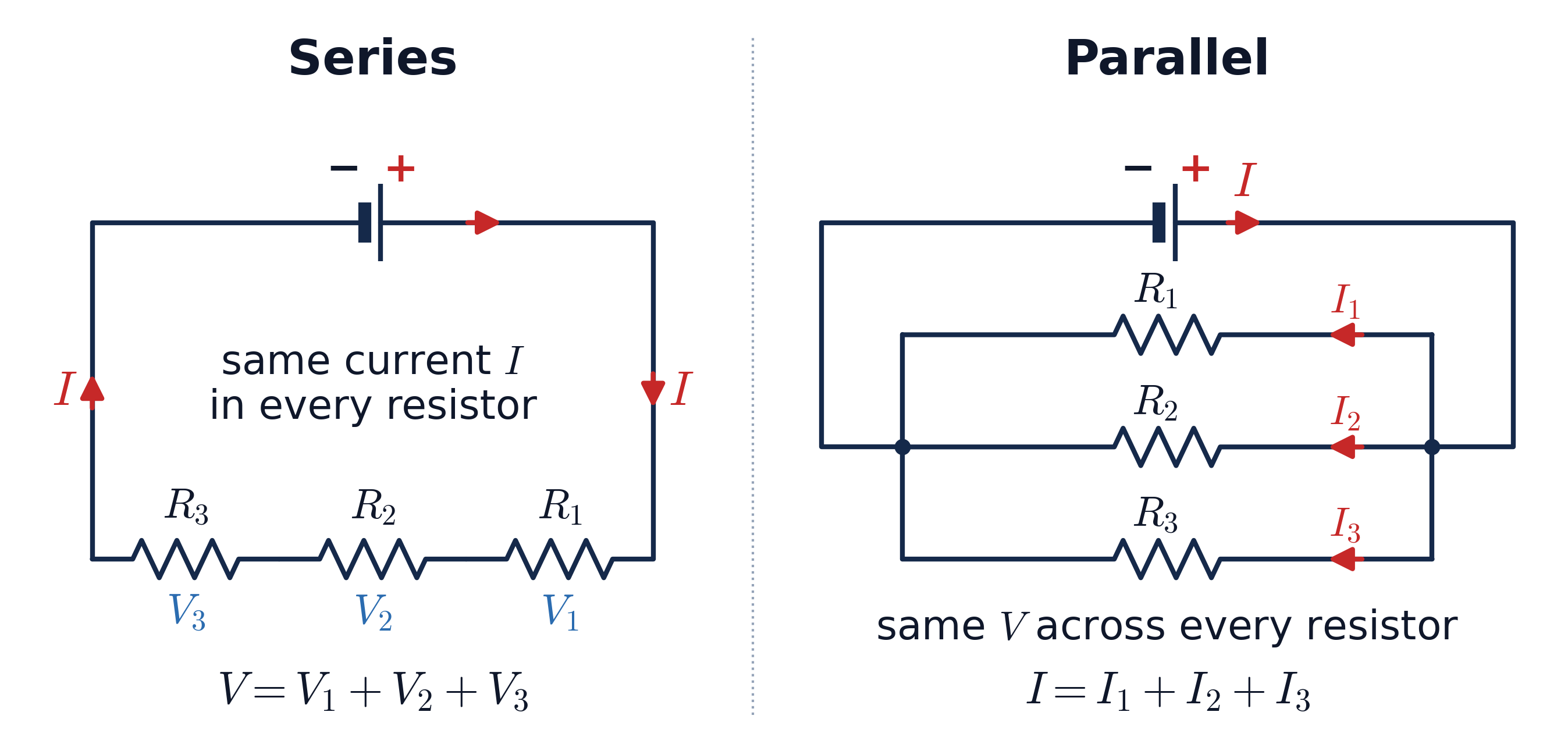
In series the resistors are joined end to end, so there is only one path. In parallel they are joined between the same two points, so the current divides.
| Series | Parallel | |
|---|---|---|
| Total resistance | R = R_1 + R_2 + R_3 | \dfrac{1}{R} = \dfrac{1}{R_1} + \dfrac{1}{R_2} + \dfrac{1}{R_3} |
| Two resistors only | R_1 + R_2 | \dfrac{R_1 R_2}{R_1 + R_2} (product over sum) |
| n equal resistors, each r | nr | \dfrac{r}{n} |
| Current | The same in every resistor | Divides. The smaller resistance takes the larger current |
| Potential difference | Divides. The larger resistance takes the larger share | The same across every resistor |
| The total is | Larger than the largest resistor | Smaller than the smallest resistor |
| If one part fails | Everything stops | The others keep working |
The lamps and fans in a house are connected in parallel. Each one then gets the full supply voltage, and each has its own switch.
Mixed circuits. Work from the inside outwards. Replace each simple group by one resistor, redraw, and repeat.
Example. 4 Ω and 8 Ω are in series, and this pair is in parallel with 6 Ω. The series pair is 12 Ω. Then \dfrac{12 \times 6}{12 + 6} = 4\ \Omega.
Two rules for any circuit (Kirchhoff's rules).
| Rule | What it says | It follows from |
|---|---|---|
| Junction rule | The current flowing into a junction equals the current flowing out | Conservation of charge |
| Loop rule | Round any closed loop, the emfs and the potential differences add up to zero | Conservation of energy |
What the papers have asked
These are all the questions on this chapter in the 6 papers from CDS I 2024 to CDS II 2026, in our own words.
| Paper | The idea asked | The answer in one line |
|---|---|---|
| CDS II 2024 | The most fitting reason why aircraft have conducting tyres | The body gathers charge in flight by friction with the air. The tyres let it pass to the ground on landing |
| CDS II 2025 | What a Van de Graaff generator produces | It is an electrostatic machine that builds up a very high voltage, a few million volts, with a very small direct current. Two of the printed options ("electrostatic charge" and "high voltage, low direct current") both describe it. We have not seen the official key |
| CDS I 2026 | The correct statement about the resistivity of a wire when its length or area of cross-section changes | Resistivity stays the same. It belongs to the material, not to the piece of wire |
| CDS I 2025 (counted in Chapter K1-15) | Power of a bulb used at half its rated voltage | The resistance of the bulb is taken as fixed, so P = \dfrac{V^2}{R} falls to one quarter |
| CDS II 2026 (counted in Chapter K1-15) | How to join three unequal resistors to a battery to get the most heat each second | All three in parallel. That gives the smallest total resistance, and P = \dfrac{V^2}{R} is then largest |
What this shows:
| Point | What to do about it |
|---|---|
| No calculation of charge, voltage or total resistance was set on its own in these six papers | Do not skip sections 3 to 7 for that reason. The power questions of the next chapter use every formula here |
| Static electricity was asked through real machines and vehicles, not through definitions | Learn the "why" in each row of the static table |
| The resistivity question had four long options that differed in one word | Read each option to its end. "Resistance" and "resistivity" are easy to misread at speed |
Worked examples
Example 1 (a short calculation). A 3 Ω resistor and a 6 Ω resistor are joined in parallel. This pair is joined in series with a 4 Ω resistor across a 12 V battery. What is the current in the 3 Ω resistor?
(a) \tfrac{2}{3} A (b) \tfrac{4}{3} A (c) 2 A (d) 4 A
Solution. The parallel pair is \dfrac{3 \times 6}{3 + 6} = 2\ \Omega. The total is 2 + 4 = 6\ \Omega, so the battery gives \dfrac{12}{6} = 2 A. The potential difference across the pair is 2 \times 2 = 4 V, so the 3 Ω resistor carries \dfrac{4}{3} A. Option (c) is the total current, not the current in one branch. Option (a) is the current in the 6 Ω resistor. Answer (b).
Example 2. A uniform wire of resistance 5 Ω is stretched to three times its length. What are its new resistance and its new resistivity?
(a) 15 Ω, three times the old resistivity (b) 15 Ω, the same resistivity (c) 45 Ω, three times the old resistivity (d) 45 Ω, the same resistivity
Solution. The volume is fixed, so the area becomes one third. R is proportional to \dfrac{L}{A}, which becomes 3 \times 3 = 9 times: 9 \times 5 = 45\ \Omega. Resistivity belongs to the material and does not change. Option (b) forgets that the wire also becomes thinner. Answer (d).
Example 3 (statements). Consider the following statements:
- An ammeter is connected in series and should have a very low resistance.
- A voltmeter is connected in parallel and should have a very low resistance.
Which of the statements given above is/are correct?
(a) 1 only (b) 2 only (c) Both 1 and 2 (d) Neither 1 nor 2
Solution. Statement 1 is correct. Statement 2 has the right connection but the wrong resistance. A voltmeter must have a very high resistance, or it would take a large current away from the part it is measuring. Answer (a).
Example 4. A current of 0.5 A flows through a lamp for 4 minutes. How many electrons pass through it? (Charge of an electron = 1.6 \times 10^{-19} C)
(a) 1.25 \times 10^{19} (b) 7.5 \times 10^{20} (c) 1.92 \times 10^{-17} (d) 7.5 \times 10^{21}
Solution. Q = It = 0.5 \times 240 = 120 C. Number of electrons = \dfrac{120}{1.6 \times 10^{-19}} = 7.5 \times 10^{20}. Option (a) comes from using 4 minutes as 4 seconds. Option (c) multiplies by the electron charge where it should divide. Answer (b).
Example 5 (statements). Consider the following statements:
- When a glass rod is rubbed with silk, new charge is created on the rod.
- The charge on any body is a whole-number multiple of the charge of an electron.
- A body can be charged without being touched by a charged body.
Which of the statements given above are correct?
(a) 1 and 2 only (b) 2 and 3 only (c) 1 and 3 only (d) 1, 2 and 3
Solution. Statement 1 is wrong: rubbing only moves electrons from the glass to the silk, and the total charge stays zero. Statement 2 is the quantisation of charge. Statement 3 is charging by induction. Answer (b).
Example 6 (matching). Match the quantity with its SI unit.
| Quantity | Unit |
|---|---|
| A. Charge | 1. ohm metre |
| B. Potential difference | 2. coulomb |
| C. Resistance | 3. volt |
| D. Resistivity | 4. ohm |
(a) A-2, B-3, C-4, D-1 (b) A-2, B-4, C-3, D-1 (c) A-3, B-2, C-1, D-4 (d) A-2, B-3, C-1, D-4
Solution. Charge is in coulombs, potential difference in volts, resistance in ohms, and resistivity in ohm metres. Option (d) swaps the last two. Resistivity is \dfrac{RA}{L}, so its unit is ohm × m² ÷ m, which is ohm metre. Answer (a).
Example 7 (how many are correct). Consider the following statements:
- The body of an aircraft can gather electric charge in flight by friction with the air.
- Charge given to a hollow metal conductor stays on its outer surface.
- A person in a closed metal car is safe from lightning mainly because the rubber tyres insulate the car from the ground.
How many of the above statements are correct?
(a) Only one (b) Only two (c) All three (d) None
Solution. Statement 1 is correct, and it is the reason for conducting tyres. Statement 2 is correct, and it is the reason a Van de Graaff dome can go on taking charge. Statement 3 is wrong. The metal body shields the inside, because the field inside a hollow conductor is zero. A few centimetres of rubber cannot stop a flash that has crossed kilometres of air. Answer (b).
Mistakes that cost marks
- Time left in minutes. In Q = It the time must be in seconds. Ten minutes is 600 s, not 10.
- Changing the resistivity with the shape. Cutting, stretching or folding a wire changes its resistance. Its resistivity changes only if the material or the temperature changes.
- Forgetting to turn the fraction over in parallel. For 3 Ω and 6 Ω in parallel, \dfrac{1}{3} + \dfrac{1}{6} = \dfrac{1}{2}. The answer is 2 Ω, not \dfrac{1}{2}\ \Omega. Check: a parallel total must be smaller than the smallest resistor.
- Doubling the radius is not doubling the area. The area goes as the square of the radius, so twice the radius gives four times the area and one quarter of the resistance.
Quick check
Do these without help. Answers are at the end.
- A current of 3 A flows for 2 minutes. How much charge passes?
- 45 J of work is done in moving 9 C of charge between two points. What is the potential difference?
- Four resistors of 8 Ω each are joined in parallel. What is the total resistance?
- A copper wire is cut into two equal pieces. What happens to the resistance and to the resistivity of each piece, compared with the whole wire?
- A 10 Ω and a 15 Ω resistor are joined in series across a 5 V battery. What is the potential difference across the 15 Ω resistor?
Read and watch more, free
NCERT and NIOS books are free on their own websites. The NIOS lesson is named in words, without a link.
| What | Where | Language |
|---|---|---|
| Textbook, the main chapter | NCERT textbooks, the book menu: Class 10 Science, Chapter 11 "Electricity" | English, Hindi |
| Textbook, a first read on circuits | NCERT textbooks, the book menu: Class 7 Science Curiosity, Chapter 3 "Electricity: Circuits and their Components" | English, Hindi |
| Textbook, full treatment | NCERT textbooks, the book menu: Class 12 Physics Part I, Chapter 1 "Electric Charges and Fields" (charge, Coulomb's law), Chapter 2 "Electrostatic Potential and Capacitance" (shielding) and Chapter 3 "Current Electricity" (resistivity, Kirchhoff's rules) | English, Hindi |
| Self-study lesson | NIOS Secondary course, Science and Technology (212), Lesson 16 "Electrical Energy", on the NIOS website under online course material | English, Hindi |
| The real papers | UPSC previous question papers (General Knowledge booklets of every CDS sitting) | English, Hindi |
| Video, physics in one class | The Journey Extraordinary: CDS GS Revision Package (the physics class with six years of past questions; it is over ten hours long, so find this chapter's part) | Hinglish |
| Video, topic by topic | CDS Wallah: CDS Exam Full Playlist (the physics videos) | Hinglish |
| Video, past questions | Reveal GK: CDS past questions by subject and topic (the physics parts) | Hinglish |
The videos were chosen from their titles, length and views; they have not yet been watched by a teacher.
Answers to the quick check
- Q = It = 3 \times 120 = 360 C.
- V = \dfrac{W}{Q} = \dfrac{45}{9} = 5 V.
- \dfrac{8}{4} = 2\ \Omega.
- The resistance of each piece is half that of the whole wire, because the length is half. The resistivity is unchanged.
- The total resistance is 25 Ω, so the current is \dfrac{5}{25} = 0.2 A. Across the 15 Ω resistor the potential difference is 0.2 \times 15 = 3 V.
Next chapter: Effects of current, electrical power.