Why this chapter matters. This chapter gave 2 questions in the 6 papers from CDS I 2024 to CDS II 2026, both in CDS I 2025. Both were one-line ideas: the name of the force with which the Earth attracts a body, and a "which statement is not correct" question on the law of gravitation, g, mass and weight. Three more questions leaned on this chapter from other chapters: floating on the Moon (CDS II 2026) and two on space, a Lagrange point (CDS II 2024) and the orbit of a space telescope (CDS I 2024), which Chapter K1-17 takes up. So expect statements, not sums. Learn first the law of gravitation and the formula for g in sections 1 and 2, and the table of how g changes in section 4.
What you will be able to do
- State Newton's law of gravitation and use it to compare forces.
- Tell mass from weight, and say how g changes with height, depth and place on the Earth.
- Explain how a satellite stays in orbit and why an astronaut inside it feels weightless.
- Use Kepler's third law and the escape speed formula in ratio questions.
Before you start you should know: Newton's laws of motion and the newton (Chapter K1-4), the equations of motion for a falling body (Chapter K1-3), and mass and weight (Chapter K1-1).
1. Newton's law of gravitation
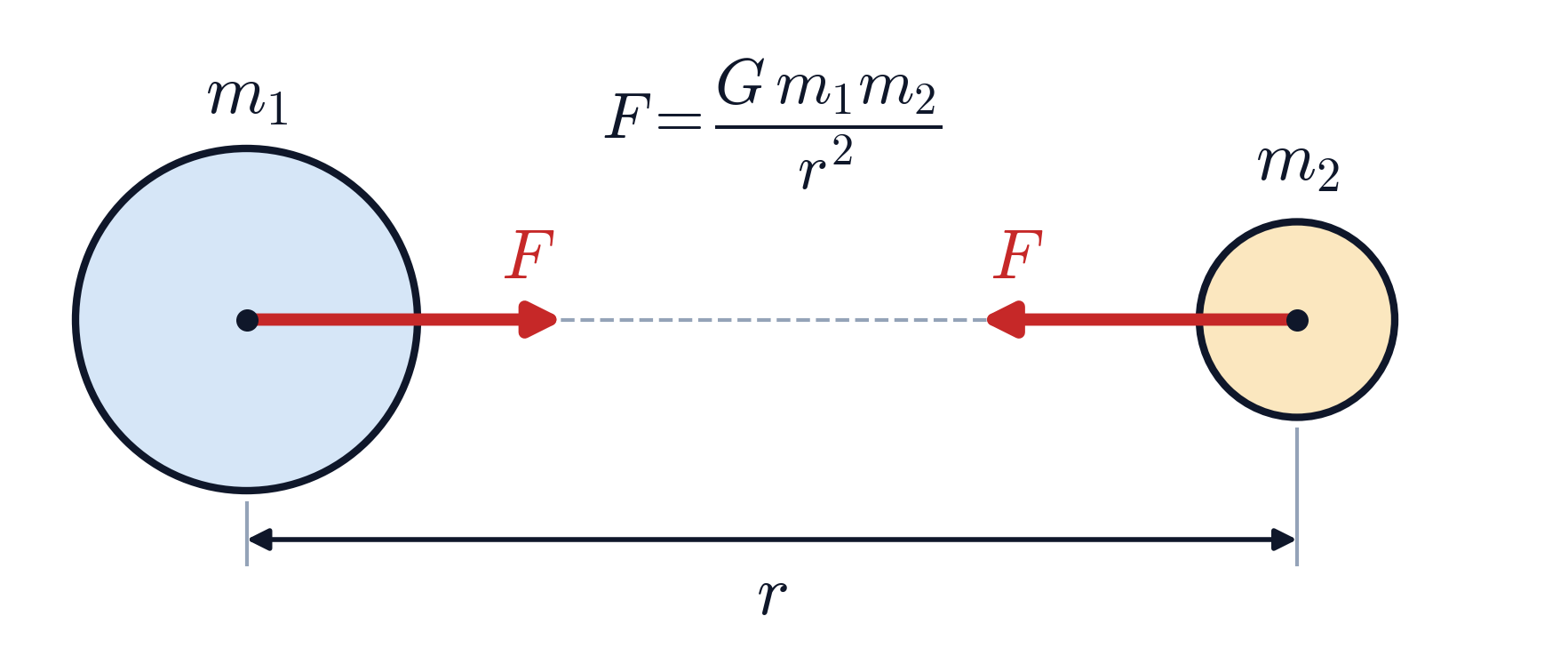
Every body in the universe attracts every other body. The force is larger for larger masses and smaller for larger distances.
F = \frac{G\,m_1 m_2}{r^2}
Here m_1 and m_2 are the two masses and r is the distance between their centres.
| Fact | Value or meaning |
|---|---|
| G, the universal gravitational constant | 6.67 \times 10^{-11} N m² kg⁻² |
| Unit of G | N m² kg⁻² (newton metre squared per kilogram squared) |
| Who gave the law | Isaac Newton |
| Who first measured G in a laboratory | Henry Cavendish |
| Kind of force | Always attractive; acts along the line joining the two bodies |
| "Inverse square law" | Double the distance and the force becomes one-fourth; three times the distance, one-ninth |
Five points that examiners use:
- G is the same everywhere in the universe. Do not confuse it with g, which changes from place to place.
- The two bodies pull each other with equal forces, in opposite directions (Newton's third law). The Earth pulls an apple with a certain force, and the apple pulls the Earth with exactly the same force. The Earth does not seem to move only because its mass is so large.
- Gravitation is the weakest of the fundamental forces, but it acts over the longest distances. It holds the Moon near the Earth and the planets near the Sun.
- Gravity is a conservative force: the work it does depends only on the starting point and the end point, not on the path.
- The law of gravitation is a separate law of nature. It cannot be worked out from the three laws of motion. The laws of motion say how a body moves when a force acts on it. The law of gravitation says how large one particular force is. Newton needed both to explain the planets. CDS I 2025 gave "the law of gravitation follows from the laws of motion" as one of four statements, and it was the incorrect one.
Example. If both masses are doubled, the force becomes 2 \times 2 = 4 times. If the distance is then also doubled, the force is divided by 4 and returns to its first value.
2. Acceleration due to gravity, g
A body of mass m on the Earth's surface is pulled by the Earth (mass M, radius R) with a force GMm/R^2. Dividing by m gives its acceleration:
g = \frac{GM}{R^2} \approx 9.8 \text{ m/s}^2
The mass m of the falling body has cancelled. So all bodies fall with the same acceleration, whatever their mass. In air, a feather falls slowly only because of air resistance. In a vacuum, a coin and a feather dropped together reach the bottom together. Two stones of unequal mass dropped from a tower have, at every instant, the same acceleration and the same velocity. Their momentum, kinetic energy and weight are different, because these depend on mass.
Writing the Earth's mass as density times volume, M = \rho \times \tfrac{4}{3}\pi R^3, gives a second form:
g = \tfrac{4}{3}\pi G \rho R
So for planets of the same density, g is proportional to the radius: the bigger planet has the larger g.
3. Mass and weight
| Mass | Weight | |
|---|---|---|
| What it is | The amount of matter in a body | The force of gravity on the body, W = mg |
| SI unit | kilogram (kg) | newton (N) |
| Kind of quantity | Scalar | Vector (points towards the centre of the Earth) |
| Does it change from place to place? | No | Yes, because g changes |
| Measured with | A beam balance | A spring balance |
The force with which the Earth attracts a body is, by definition, the weight of the body. CDS I 2025 asked this in one line, with mass and density among the options. Mass and weight are also measured in different units: mass in kilograms, weight in newtons. The older unit kilogram-force (also written kilogram-weight) is the weight of 1 kg, which is 9.8 N.
On the Moon, g is about one-sixth of its value on the Earth. A soldier of mass 60 kg weighs 60 \times 9.8 = 588 N on the Earth and about 98 N on the Moon. His mass is 60 kg in both places.
4. How g changes
| Change | What happens to g | Formula (for those who want it) |
|---|---|---|
| Going up to a height h | Decreases | g_h = g\,\dfrac{R^2}{(R+h)^2} |
| Going down to a depth d | Decreases | g_d = g\left(1 - \dfrac{d}{R}\right) |
| At the centre of the Earth | Zero | Put d = R |
| From the equator to the poles | Increases; least at the equator, greatest at the poles |
There are two reasons for the last row. The Earth is slightly flattened, so the poles are nearer to the centre than the equator is. And the Earth's rotation reduces the effective g most at the equator and not at all at the poles.
So g is greatest on the surface at the poles. It becomes smaller if you climb a mountain and also if you go down a mine. At a height equal to the Earth's radius (h = R), the distance from the centre is 2R and g falls to one-fourth.
5. Satellites
A satellite is a body that moves round a planet. The Moon is the Earth's natural satellite. Artificial satellites are put into orbit by rockets.
Why a satellite does not fall and needs no fuel. A satellite is always falling towards the Earth, but it is also moving sideways so fast that the ground curves away below it at the same rate. The Earth's gravitational pull supplies the centripetal force that keeps it on its circle. Above the atmosphere there is no air resistance, so once it is in orbit it needs no engine and no fuel to keep going.
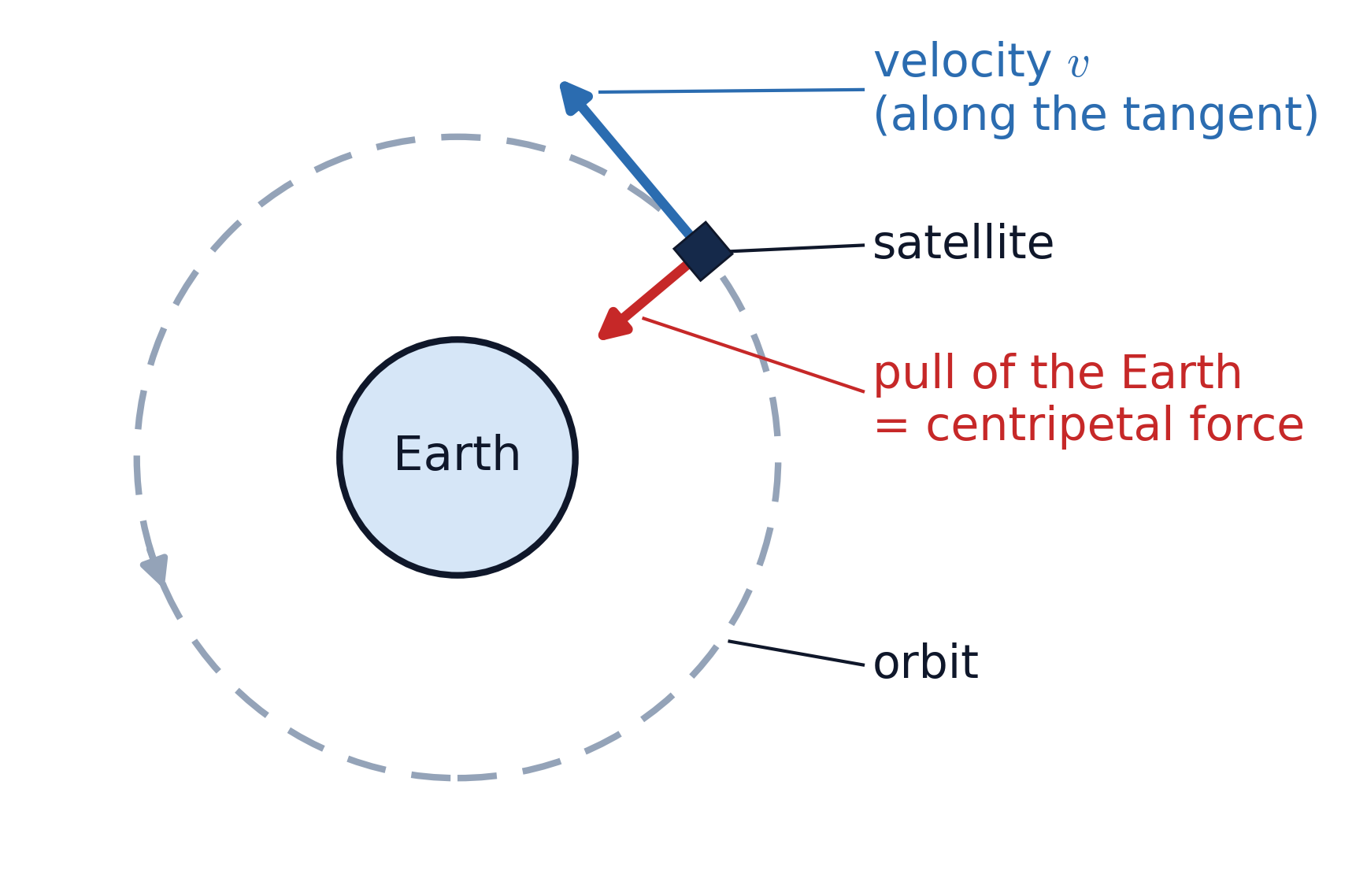
For a circular orbit of radius r (measured from the Earth's centre), setting gravity equal to the centripetal force gives
v = \sqrt{\frac{GM}{r}}
The orbital speed does not depend on the mass of the satellite. A higher orbit means a lower speed and a longer period.
| Satellite | Height above the ground | Period | Used for |
|---|---|---|---|
| Very low orbit, close to the surface | Small compared with R | About 84 minutes; speed about 7.9 km/s | (The limiting case used in problems) |
| Polar satellite | About 500 to 800 km; passes over the poles | About 100 minutes | Remote sensing, weather, surveying, spying |
| Geostationary satellite | About 35,800 km (often rounded to 36,000 km), above the equator | 24 hours | Communication, television, weather watching |
A geostationary satellite moves in the plane of the equator, from west to east, and takes 24 hours for one round, the same as the Earth's rotation. From the ground it seems to stay at one point in the sky, so a dish antenna can point at it all the time.
Weightlessness. Inside the International Space Station gravity is still strong: at that height g is only a little less than on the ground. The astronaut feels weightless because the station and the astronaut are both in free fall with the same acceleration. The floor does not need to push up on the astronaut, so the normal reaction is zero. What we feel as weight is this push of the floor. The gravitational pull is not zero; it is the very force that keeps the station in orbit.
6. Kepler's laws of planetary motion
Johannes Kepler found three laws from careful records of where the planets were seen.
| Law | Statement | What to remember |
|---|---|---|
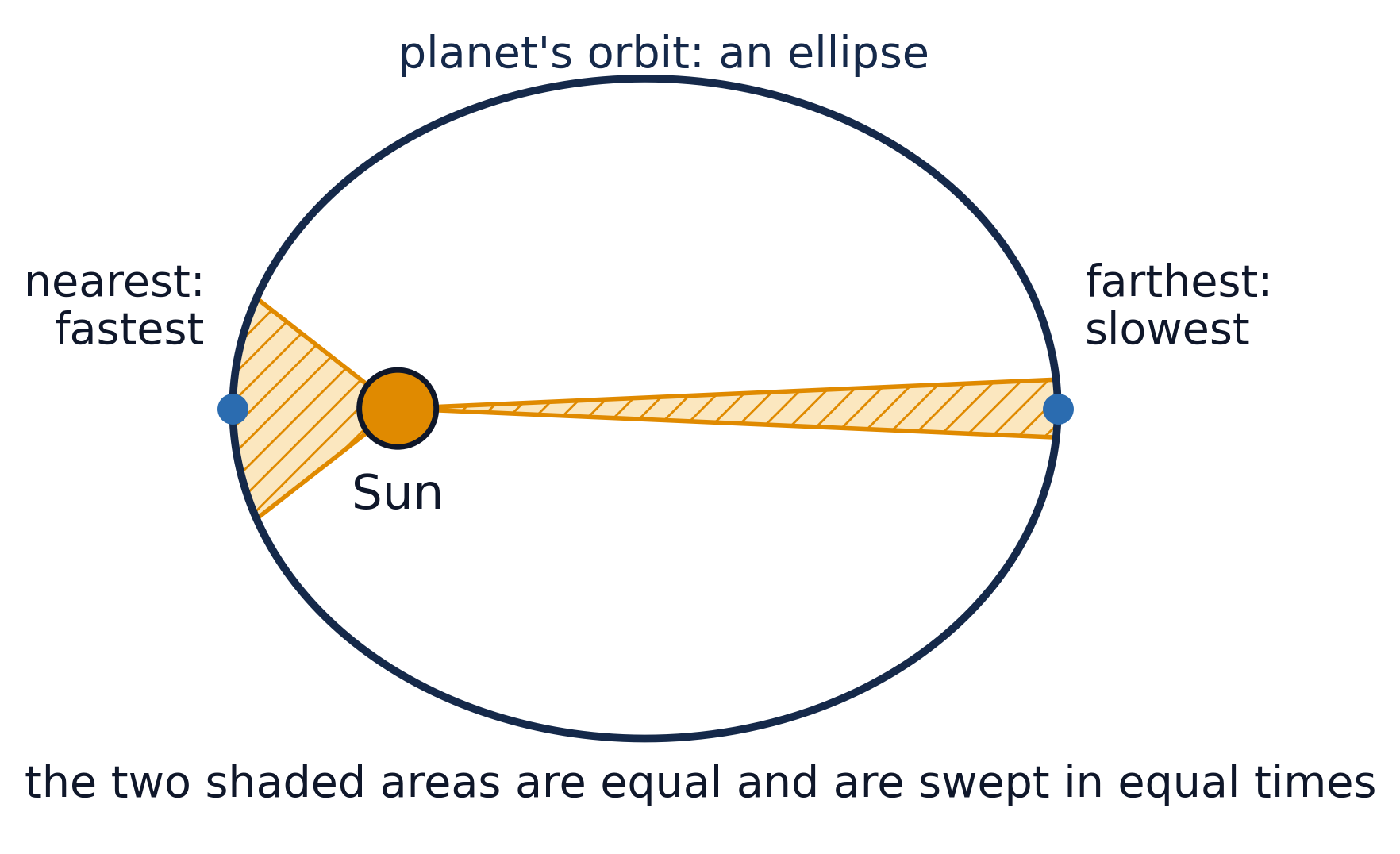
| First (law of orbits) | Every planet moves in an ellipse with the Sun at one focus | The Sun is at a focus, not at the centre |
| Second (law of areas) | The line joining the Sun and a planet sweeps out equal areas in equal times | The planet moves fastest when nearest the Sun and slowest when farthest. It follows from the conservation of angular momentum |
| Third (law of periods) | The square of the period is proportional to the cube of the semi-major axis: T^2 \propto a^3 | A farther planet has a longer year |
The semi-major axis is half the longest diameter of the ellipse. For a circular orbit it is the radius.
Using the third law. If a planet's orbit is 4 times as large as the Earth's, then T^2 is 4^3 = 64 times, so T is 8 times: its year is 8 Earth years. Going the other way, a year of 8 Earth years means a^3 = 8^2 = 64, so the orbit is 4 times as large.
7. Escape speed
Throw a ball up and it comes back. Throw it faster and it rises higher. The escape speed is the least speed with which a body must be thrown from the surface so that it never comes back.
v_e = \sqrt{\frac{2GM}{R}} = \sqrt{2gR}
| Fact | Value |
|---|---|
| Escape speed from the Earth | About 11.2 km/s |
| Escape speed from the Moon | About 2.3 km/s |
| Depends on | The mass and radius of the planet |
| Does not depend on | The mass of the body thrown, or the direction in which it is thrown |
| Compared with the speed of a satellite close to the surface | v_e = \sqrt{2} \times v_{orbit}; for the Earth, 11.2 km/s against 7.9 km/s |
The Moon has almost no atmosphere because its escape speed is low: gas molecules move fast enough to escape.
Writing M as density times volume gives v_e \propto R\sqrt{\rho}. This is the quick way for a planet described by its radius and density.
8. Gravitational potential
Lifting a body of mass m through a small height h near the ground stores potential energy mgh in it (Chapter K1-7). For large distances the potential energy of a mass m at distance r from the Earth's centre is -GMm/r. It is taken as zero very far away and is negative nearer the Earth.
The gravitational potential at a point is the potential energy per unit mass there. The work done by gravity when a body moves between two points is its mass times the difference in potential. So if two points are at the same potential, gravity does no work on a body moved from one to the other, even if the strength of the field is different at the two points. For the same reason gravity does no work on a satellite in a circular orbit.
What the papers have asked
The first two rows are all the questions on this chapter in the 6 papers from CDS I 2024 to CDS II 2026. The last three rows are questions counted in other chapters that use its ideas. All are in our own words.
| Paper | The idea asked | The answer in one line |
|---|---|---|
| CDS I 2025 | Which of four statements on gravitation is not correct? | "The law of gravitation follows from the laws of motion" is the wrong one. The other three were true: all bodies attract one another, g is zero at the centre of the Earth, and mass and weight have different units |
| CDS I 2025 | The name of the force with which the Earth attracts an object | The weight of the object |
| CDS II 2026 (counted in Chapter K1-1) | A body floats on the Moon, where g is one-sixth. Does it float deeper? | No. Weight and upthrust both fall to one-sixth, so the same fraction is under water |
| CDS II 2024 (counted in Chapter K1-17) | The shape formed by the Sun, the Earth and the Lagrange point L4 | An equilateral triangle |
| CDS I 2024 (counted in Chapter K1-17) | Where the James Webb Space Telescope moves | It orbits the Sun, about 15 lakh km from the Earth |
What this shows:
| Point | What to do about it |
|---|---|
| Both direct questions were statements of fact, not calculations | Know sections 1 to 4 as sentences you could mark true or false |
| "Which statement is not correct" needs all four options judged | Three true statements are also three facts to keep: read them as revision |
| No ratio sum on Kepler's law or escape speed in these six papers | Know the formulas and one worked ratio each. Do not drill twenty of them |
| The space questions went to the news: a telescope, a Lagrange point | Sections 5 to 7 here are the base. Chapter K1-17 adds the space facts |
Worked examples
Example 1. The distance between two small bodies is made three times as large. The gravitational force between them becomes
(a) three times (b) one-third (c) one-ninth (d) nine times
Solution. F \propto 1/r^2. With r three times as large, r^2 is nine times as large and the force is one-ninth. One-third is the tempting answer, but the law has the square of the distance. Answer (c).
Example 2. A planet has the same mass as the Earth but twice its radius. What is the acceleration due to gravity on its surface? (Take g on the Earth as 9.8 m/s².)
(a) 2.45 m/s² (b) 4.9 m/s² (c) 9.8 m/s² (d) 19.6 m/s²
Solution. g = GM/R^2. The mass is the same and R^2 is 4 times as large, so g is one-fourth: 9.8 \div 4 = 2.45 m/s². Option (b) divides by 2, forgetting the square. Answer (a).
Example 3. Consider the following statements:
- The mass of a body is the same on the Earth and on the Moon.
- The weight of a body is zero at the centre of the Earth.
Which of the statements given above is/are correct?
(a) 1 only (b) 2 only (c) Both 1 and 2 (d) Neither 1 nor 2
Solution. Mass is the amount of matter and does not change with place, so statement 1 is correct. At the centre of the Earth g = 0, so the weight mg is zero, and statement 2 is correct. Answer (c).
Example 4. The radius of the orbit of planet X is 9 times the radius of the Earth's orbit. How long is one year on planet X?
(a) 3 Earth years (b) 9 Earth years (c) 27 Earth years (d) 81 Earth years
Solution. By Kepler's third law T^2 \propto a^3. Here a^3 = 9^3 = 729, so T = \sqrt{729} = 27 Earth years. Option (b) takes the period as proportional to the radius, and option (d) squares instead of using the power 3/2. Answer (c).
Example 5. Which one of the following statements about a geostationary satellite is NOT correct?
(a) Its period is 24 hours. (b) It moves in the plane of the equator. (c) It moves from east to west. (d) It is about 36,000 km above the Earth's surface.
Solution. To stay above one place the satellite must turn the same way as the Earth, which is from west to east. So (c) is the wrong statement. The other three are the standard facts. Answer (c).
Example 6. A planet has four times the mass of the Earth and the same radius. If the escape speed from the Earth is 11.2 km/s, the escape speed from this planet is
(a) 5.6 km/s (b) 11.2 km/s (c) 22.4 km/s (d) 44.8 km/s
Solution. v_e = \sqrt{2GM/R}. With M four times as large and R the same, v_e is \sqrt{4} = 2 times: 22.4 km/s. Option (d) forgets the square root. Answer (c).
Example 7 (how many of the above). Consider the following statements:
- The force with which the Earth attracts a body is called the mass of the body.
- The value of g is zero at the centre of the Earth.
- Newton's law of gravitation can be derived from his three laws of motion.
How many of the above statements are correct?
(a) Only one (b) Only two (c) All three (d) None
Solution. Statement 1 is wrong: that force is the weight. Mass is the amount of matter. Statement 2 is correct: g falls steadily with depth and is zero at the centre. Statement 3 is wrong: the law of gravitation is a separate law. The laws of motion do not say how large the force of gravity is. Answer (a).
Example 8 (match the lists). Match List-I (quantity) with List-II (value).
List-I: A. Escape speed from the Earth B. Speed of a satellite close to the Earth's surface C. Period of a geostationary satellite D. Acceleration due to gravity on the Moon
List-II: 1. About 7.9 km/s 2. About one-sixth of that on the Earth 3. 24 hours 4. About 11.2 km/s
(a) A-1, B-4, C-3, D-2 (b) A-4, B-1, C-2, D-3 (c) A-4, B-1, C-3, D-2 (d) A-4, B-3, C-1, D-2
Solution. Escape speed from the Earth is about 11.2 km/s (A-4). A satellite close to the surface moves at about 7.9 km/s (B-1), which is the escape speed divided by \sqrt{2}. A geostationary satellite takes 24 hours (C-3). On the Moon g is about one-sixth of the Earth's value (D-2). Option (a) swaps the two speeds: remember that escaping needs more speed than orbiting. Answer (c).
Mistakes that cost marks
- Mixing up G and g. G is a universal constant, 6.67 \times 10^{-11} N m² kg⁻². g is an acceleration, about 9.8 m/s² on the Earth, and it changes with place.
- "There is no gravity in space." Wrong. An astronaut in orbit is weightless because of free fall. Gravity is what holds the satellite in its orbit.
- Thinking g increases as you go down a mine. It decreases with depth as well as with height. It is greatest on the surface, and on the surface it is greatest at the poles.
- Calling the pull of the Earth on a body its mass. The pull is the weight, in newtons. The mass, in kilograms, is the amount of matter.
- Forgetting the square or the power in a ratio. Force goes as 1/r^2, g goes as 1/R^2, the period goes as a^{3/2}, and escape speed goes as the square root of M/R.
Quick check
Do these without help. Answers are at the end.
- Two bodies attract each other with a force of 36 N. What is the force if the distance between them is doubled?
- A body has a mass of 12 kg on the Earth. What are its mass and its weight on the Moon, where g is about one-sixth of 9.8 m/s²?
- Where on the Earth's surface is g the least?
- What supplies the centripetal force on a satellite going round the Earth?
- What is the escape speed from the Earth, and does it depend on the mass of the body thrown?
Read and watch more, free
The present NCERT Class 9 Science book no longer has a chapter on gravitation, so the Class 11 chapter is the main text. NCERT and NIOS books are free on their own websites. The NIOS lessons are named in words, without a link.
| What | Where | Language |
|---|---|---|
| Textbook | NCERT textbooks, the book menu: Class 11 Physics Part I, Chapter 7 "Gravitation" (the law, g and how it changes, satellites, Kepler's laws, escape speed) | English, Hindi |
| Self-study lesson, easier | NIOS Secondary course, Science and Technology (212), Lesson 11 "Gravitation", on the NIOS website under online course material | English, Hindi |
| Self-study lesson, satellites and Kepler's laws | NIOS Senior Secondary course, Physics (312), Lesson 5, on the NIOS website under online course material | English, Hindi |
| The real papers | UPSC previous question papers (General Knowledge booklets of every CDS sitting) | English, Hindi |
| Video, physics in one class | The Journey Extraordinary: CDS GS Revision Package (the physics class with six years of past questions; it is over ten hours long, so find this chapter's part) | Hinglish |
| Video, topic by topic | CDS Wallah: CDS Exam Full Playlist (the physics videos) | Hinglish |
| Video, past questions | Reveal GK: CDS past questions by subject and topic (the physics parts) | Hinglish |
The videos were chosen from their titles, length and views; they have not yet been watched by a teacher.
Answers to the quick check
- One-fourth of 36 N, which is 9 N.
- Mass 12 kg (unchanged). Weight 12 \times 9.8 \div 6 = 19.6 N.
- At the equator.
- The Earth's gravitational pull on the satellite.
- About 11.2 km/s. No, it is the same for every body.
Next chapter: Work, power and energy.