Why this chapter matters. This chapter gave 3 questions in the 6 papers from CDS I 2024 to CDS II 2026: one in CDS I 2025 and two in CDS II 2025. That is one question in every two papers, worth 0.83 marks each time. Two of the three were short power calculations (P = W/t with W = mgh). The third asked for the work done by a string on a stone whirled in a circle, which is zero. So learn section 1 (when work is zero, positive or negative) and section 7 (power) first. The rest of the chapter is the base for those two, and its ideas are also used in the questions on motion, gravitation and electricity.
What you will be able to do
- Say whether the work done by a force is positive, negative or zero, and calculate it.
- Calculate kinetic energy, potential energy and power, with the right units, and compare the powers of two machines.
- Use the conservation of energy to find the speed of a falling body without the equations of motion.
- Tell conservative forces from non-conservative forces, and name the energy change in common devices.
Before you start you should know: force and the newton, momentum (Chapter K1-4), and speed, velocity and acceleration (Chapter K1-3).
1. Work
In physics, work is done only when a force moves the body it acts on. A sentry who stands holding a rifle for an hour gets tired, but he does no work on the rifle, because the rifle does not move.
W = F s \cos\theta
F is the force, s is the displacement and \theta is the angle between the force and the displacement. Work is a scalar. Its SI unit is the joule (J).
One joule is the work done when a force of 1 N moves a body through 1 m in the direction of the force: 1 \text{ J} = 1 \text{ N} \times 1 \text{ m}. The same work is done by 2 N over 0.5 m, or by 4 N over 0.25 m.
| Angle between force and displacement | Work | Example |
|---|---|---|
| 0^\circ (same direction) | Positive, W = Fs | A man pushes a cart forward; gravity acts on a falling stone |
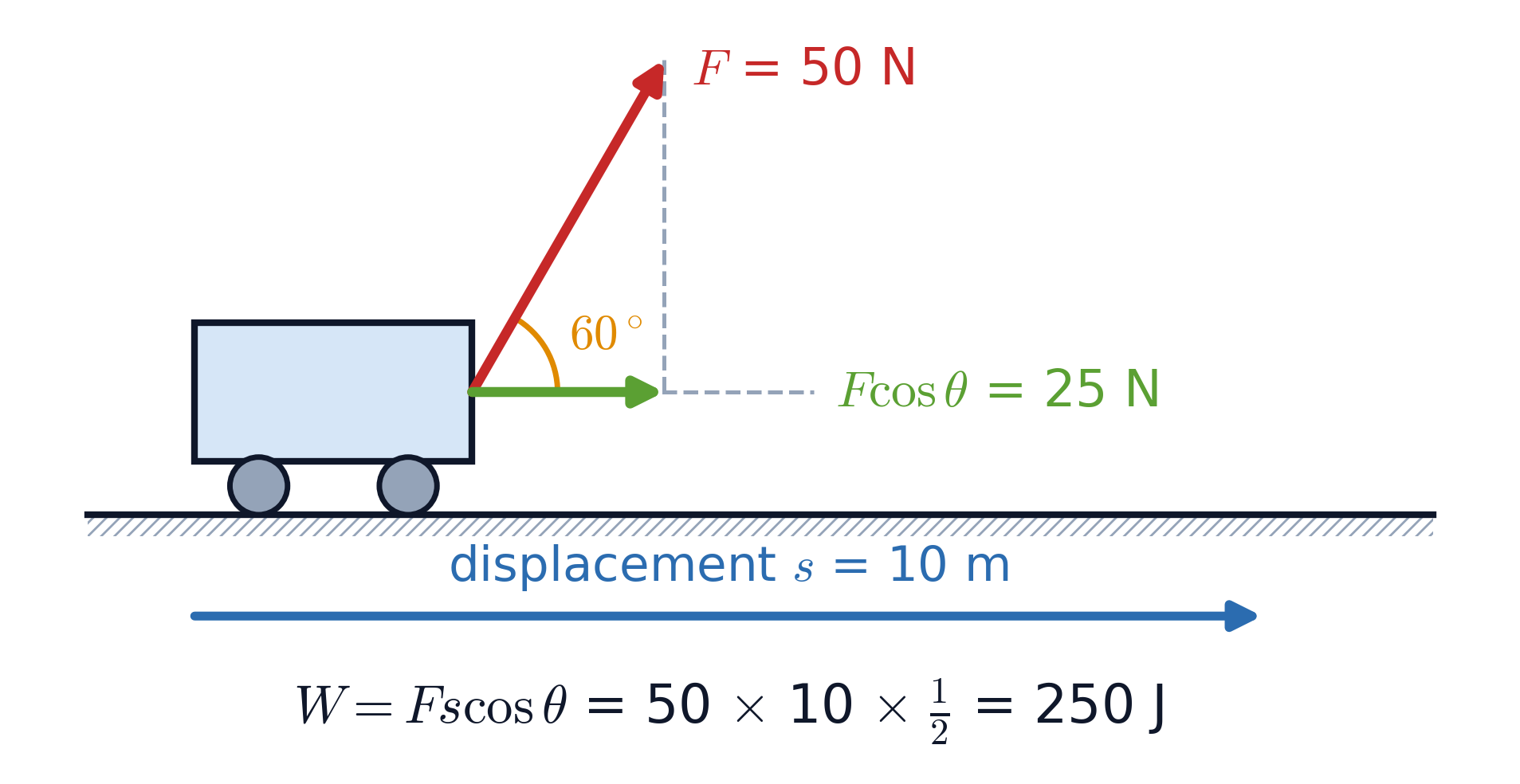
| Between 0^\circ and 90^\circ | Positive, W = Fs\cos\theta | A man pulls a trolley with a rope held at a slant |
| 90^\circ (at right angles) | Zero | A porter walks on a level platform with a load on his head: the upward push on the load is at right angles to the motion. Gravity on a satellite in a circular orbit. The pull of the string on a stone whirled in a circle |
| 180^\circ (opposite, or anti-parallel) | Negative, W = -Fs | Friction on a sliding box; brakes on a jeep; gravity on a stone going up |
Work is also zero when there is no displacement, as when you push hard on a wall that does not move.
Motion in a circle. A stone is tied to a string and whirled in a circle. The string pulls the stone towards the centre. The stone moves along the circle, at right angles to the string, at every instant. So the work done by the string is zero, however fast the stone moves and whatever its mass. This is also why a force towards the centre changes the direction of the velocity but not the speed. CDS II 2025 asked exactly this.
Example. A soldier lifts an ammunition box of mass 20 kg through 1.5 m. Taking g = 10 m/s², the force needed is the weight, 200 N, and the work is 200 \times 1.5 = 300 J.
2. Energy and kinetic energy
Energy is the ability to do work. It has the same unit as work, the joule, and it is also a scalar.
A moving body can do work, so it has energy because of its motion. This is kinetic energy:
KE = \tfrac{1}{2}mv^2
A bullet of mass 10 g moving at 400 m/s has \tfrac{1}{2} \times 0.01 \times 400^2 = 800 J.
Because of the square, speed matters more than mass. Double the mass and the kinetic energy doubles. Double the speed and the kinetic energy becomes four times. Kinetic energy is never negative.
Kinetic energy and momentum. Momentum is p = mv. Putting v = p/m into the formula gives
KE = \frac{p^2}{2m}
So if a heavy body and a light body have the same momentum, the lighter one has more kinetic energy. If they have the same kinetic energy, the heavier one has more momentum.
3. Potential energy
A body can also store energy because of its position or its shape. This is potential energy.
| Kind | Formula | Example |
|---|---|---|
| Gravitational potential energy, at a height h above the ground | PE = mgh | Water stored behind a dam; a stone on a cliff |
| Elastic potential energy of a spring stretched or pressed by x | PE = \tfrac{1}{2}kx^2 | The wound spring of a watch; a stretched bow |
In mgh, the height is measured straight up. The path by which the body reached that height does not matter. Carrying a 10 kg pack up a hill 100 m high stores 10 \times 10 \times 100 = 10{,}000 J in it (with g = 10 m/s²), whether you take the steep path or the long winding one.
Energy stored in the bonds between atoms, as in food, fuel and a cell, is called chemical energy.
4. The work-energy theorem
The total (net) work done on a body by all the forces equals the change in its kinetic energy.
W_{net} = \tfrac{1}{2}mv^2 - \tfrac{1}{2}mu^2
Positive net work speeds a body up. Negative net work slows it down. This is always true, for every kind of force.
Example. A block of mass 2 kg slides at 3 m/s on a rough floor and stops after 3 m. Its kinetic energy, \tfrac{1}{2} \times 2 \times 3^2 = 9 J, is all taken away by friction. So friction force × 3 m = 9 J, and the friction force is 3 N.
5. Conservation of energy
Energy can neither be created nor destroyed. It can only change from one form into another. The total energy of an isolated system, one that exchanges nothing with its surroundings, always stays the same.
The sum of kinetic and potential energy is called mechanical energy. When only gravity acts (no friction, no air resistance), the mechanical energy of a body stays constant.
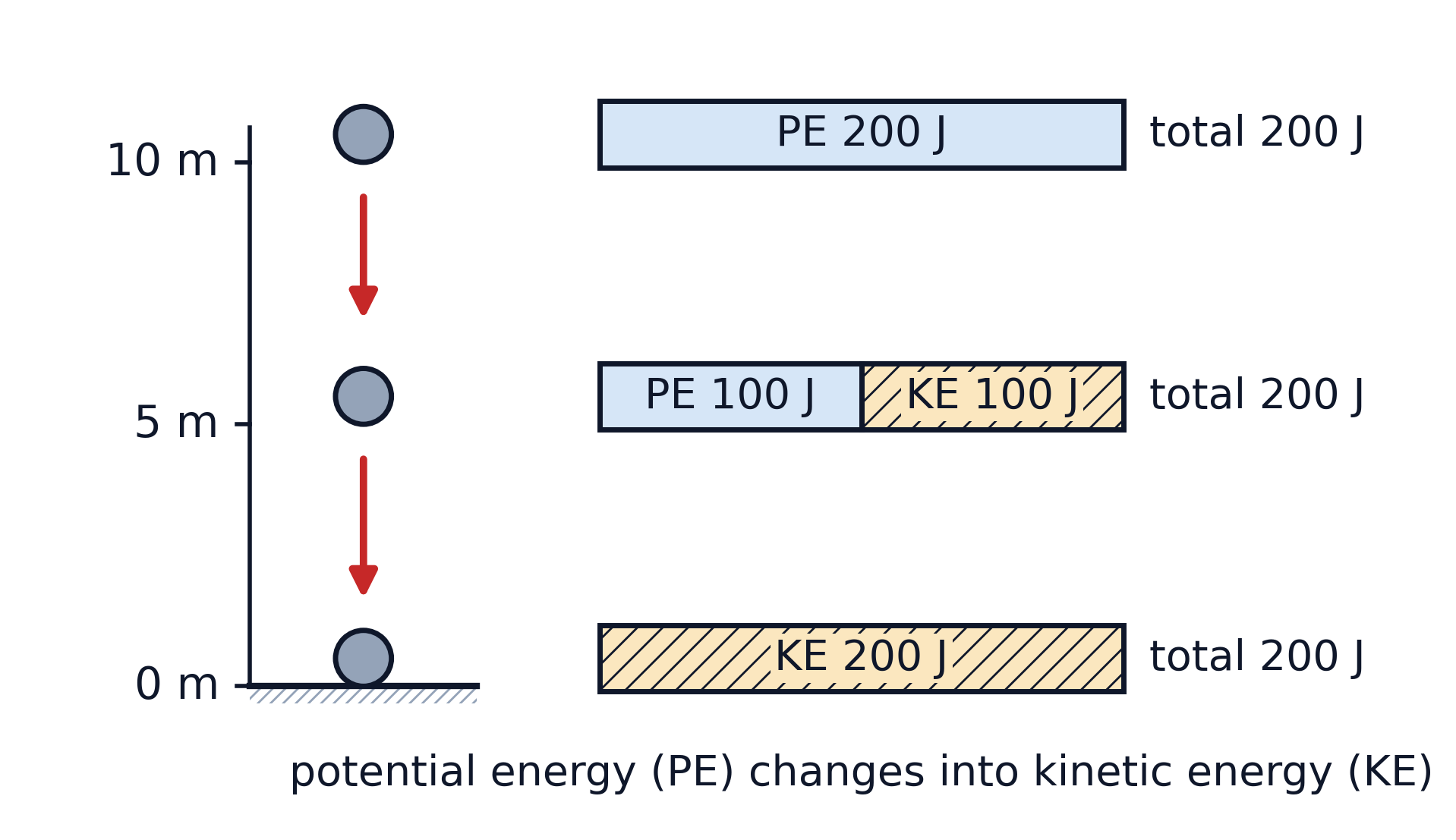
Take a stone of mass 2 kg dropped from a height of 10 m, with g = 10 m/s².
| Position | Potential energy mgh | Kinetic energy | Total |
|---|---|---|---|
| At the top (10 m), at rest | 200 J | 0 | 200 J |
| Halfway (5 m) | 100 J | 100 J | 200 J |
| Just before the ground (0 m) | 0 | 200 J | 200 J |
Three results follow.
- The kinetic energy at the bottom equals the potential energy at the top: \tfrac{1}{2}mv^2 = mgh, so v = \sqrt{2gh}. The mass cancels.
- For a ball thrown straight up, the kinetic energy at the start equals the potential energy at the highest point, where the speed is zero.
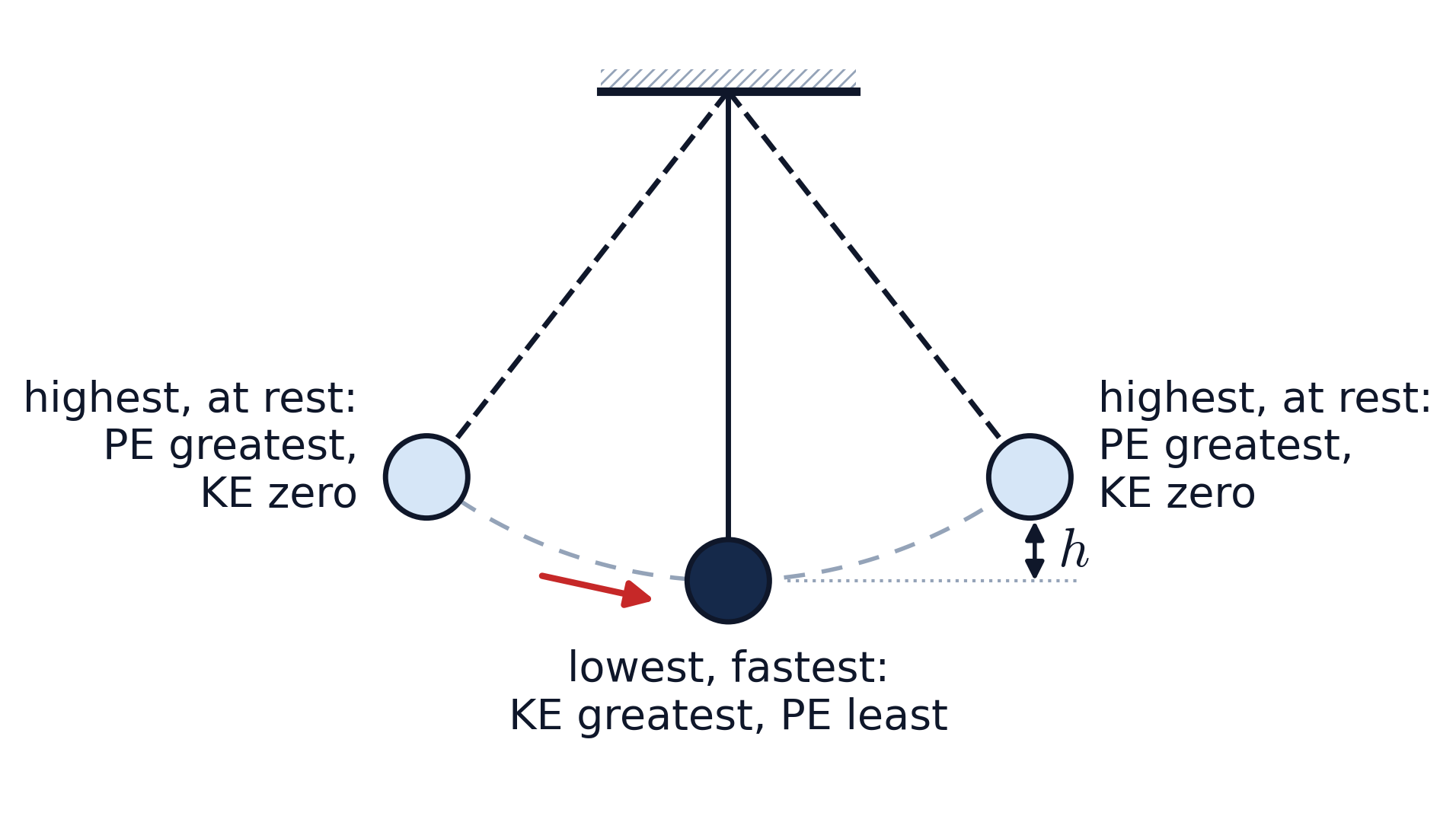
- A pendulum bob has only potential energy at the two ends of its swing and the greatest kinetic energy at the lowest point.
When the stone hits the ground and stops, its energy is not lost. It changes into heat and sound.
6. Conservative and non-conservative forces
| Conservative force | Non-conservative force | |
|---|---|---|
| Work done between two points | Depends only on the two points, not on the path | Depends on the path taken |
| Work done over a closed path (back to the start) | Zero | Not zero |
| Potential energy | Can be defined | Cannot be defined |
| Examples | Gravity, the force of a spring, the electric force between charges | Friction, air resistance |
The work done by gravity on a body depends only on the vertical height between the start and the end. If the body moves horizontally, gravity does no work. Friction always acts against the motion, takes mechanical energy away and turns it into heat.
For a conservative force, the potential energy is found from the work done against the force. In the language of calculus this is written U = -\int F\,dx.
7. Power
Power is the rate of doing work, or the rate at which energy is used.
P = \frac{W}{t} \qquad \text{and, for a body moving at speed } v \text{ under a force } F, \qquad P = Fv
| Quantity | Unit | Equal to |
|---|---|---|
| Work, energy | joule (J) | 1 N m, also 1 kg m² s⁻² |
| Power | watt (W) | 1 J/s |
| Power | kilowatt (kW) | 1000 W |
| Power | horsepower (hp) | About 746 W |
| Energy | kilowatt hour (kWh), the "unit" on an electricity bill | 3.6 \times 10^6 J |
| Energy | calorie (cal) | About 4.2 J |
| Energy | electron volt (eV) | 1.6 \times 10^{-19} J |
| Energy | erg (the CGS unit) | 10^{-7} J |
Take care with two units. The kilowatt hour is a unit of energy, not of power: it is the energy used by a 1 kW machine in one hour. And kg m/s² is the newton, a unit of force, not of energy.
Example. A pump lifts 600 kg of water through 10 m in one minute. Work = mgh = 600 \times 10 \times 10 = 60{,}000 J. Power = 60{,}000 \div 60 = 1000 W, or 1 kW.
"Minimum power" to lift a load. The least force that will lift a load is its weight mg, so the least work is mgh and the least power is mgh/t. Any extra power would go into speeding the load up. CDS I 2025 asked for the least power to lift 50 kg through 8 m in 10 s with g = 10 m/s²: 50 \times 10 \times 8 \div 10 = 400 W.
Comparing two powers. Write each power as work ÷ time in the same unit of time, then use the ratio given. CDS II 2025 gave two workers: the second did 1000 J in 20 minutes, which is 50 J per minute. The first had twice that power, 100 J per minute, and did 500 J. So the first took 500 \div 100 = 5 minutes. There was no need to change minutes into seconds, because both powers were in joules per minute.
A machine of constant power. If a machine supplies energy at a steady rate P to a block that starts from rest on a smooth floor, then after time t the block has kinetic energy Pt. So \tfrac{1}{2}mv^2 = Pt, and the speed grows as the square root of the time: v \propto \sqrt{t}.
8. Energy changes in common devices
| Device or event | Energy change |
|---|---|
| Electric motor, fan | Electrical to mechanical |
| Dynamo, generator | Mechanical to electrical |
| Dry cell, battery (when giving current) | Chemical to electrical |
| Solar cell | Light to electrical |
| Electric bulb | Electrical to light and heat |
| Microphone | Sound to electrical |
| Loudspeaker | Electrical to sound |
| Hydroelectric power station | Potential energy of stored water to kinetic energy to electrical energy |
| Steam engine | Heat to mechanical |
| Burning candle, burning fuel | Chemical to heat and light |
| Photosynthesis in a green leaf | Light to chemical |
9. Collisions, in brief
In every collision the total momentum is conserved (Chapter K1-4).
- In an elastic collision the total kinetic energy is also conserved. If a ball hits an identical ball at rest head-on and elastically, the first ball stops and the second moves off with the first ball's speed. This is why, when a pendulum bob strikes an identical bob at rest, the second bob rises to the height from which the first was released.
- In an inelastic collision some kinetic energy changes into heat, sound and change of shape. If the bodies stick together, the loss is the greatest possible, but momentum is still conserved.
What the papers have asked
These are all the questions on this chapter in the 6 papers from CDS I 2024 to CDS II 2026, in our own words.
| Paper | The idea asked | The answer in one line |
|---|---|---|
| CDS I 2025 | The least power needed to lift a 50 kg mass through 8 m in 10 s (g = 10 m/s²) | P = mgh/t = 50 \times 10 \times 8 \div 10 = 400 W |
| CDS II 2025 | The work done by the string on a stone whirled in a circle | Zero. The pull of the string is at right angles to the motion at every instant |
| CDS II 2025 | One worker does 500 J in an unknown time, another does 1000 J in 20 minutes, and the first has twice the power of the second. Find the unknown time | The second gives 50 J per minute, so the first gives 100 J per minute and takes 5 minutes |
Three questions is a small sample. The same ideas appear inside other chapters' questions: the papers also asked when momentum is conserved (Chapter K1-4) and the power of a bulb (Chapter K1-15). Expect one question in most papers from this list: work zero or negative, kinetic energy when the speed changes, v = \sqrt{2gh}, a power sum, a unit, or an energy change in a device.
Worked examples
Example 1. A man pulls a trolley along a level road with a force of 50 N. The rope makes an angle of 60^\circ with the road. How much work does he do in moving the trolley 10 m?
(a) 0 J (b) 250 J (c) 433 J (d) 500 J
Solution. W = Fs\cos\theta = 50 \times 10 \times \cos 60^\circ = 500 \times \tfrac{1}{2} = 250 J. Option (d) forgets the angle; only the part of the force along the road does work. Option (c) uses \sin 60^\circ. Answer (b).
Example 2. Consider the following statements:
- When a stone is thrown straight up, the work done by gravity on it during the upward journey is negative.
- A man who carries a suitcase along a level road at steady speed does work against gravity.
Which of the statements given above is/are correct?
(a) 1 only (b) 2 only (c) Both 1 and 2 (d) Neither 1 nor 2
Solution. Going up, the displacement is upward and gravity is downward: they are opposite, so the work done by gravity is negative. Statement 1 is correct. On a level road the suitcase does not rise, and the upward force on it is at right angles to the motion, so no work is done against gravity. Statement 2 is wrong. Answer (a).
Example 3. A cricket ball is dropped from the top of a building 20 m high. With what speed does it reach the ground? (Take g = 10 m/s² and neglect air resistance.)
(a) 10 m/s (b) 14 m/s (c) 20 m/s (d) 200 m/s
Solution. Potential energy at the top = kinetic energy at the bottom: mgh = \tfrac{1}{2}mv^2, so v = \sqrt{2gh} = \sqrt{2 \times 10 \times 20} = \sqrt{400} = 20 m/s. The mass is not needed. Option (d) is gh without the 2 and without the square root. Answer (c).
Example 4. A car of mass 1000 kg moves at 20 m/s. If its speed is doubled, its kinetic energy becomes
(a) 200 kJ (b) 400 kJ (c) 800 kJ (d) 1600 kJ
Solution. At 20 m/s, KE = \tfrac{1}{2} \times 1000 \times 20^2 = 200{,}000 J = 200 kJ. At 40 m/s the speed is doubled, so the kinetic energy is four times: 800 kJ. Option (b) doubles it, forgetting that the speed is squared. Answer (c).
Example 5. A boy of mass 60 kg runs up a staircase 3 m high in 6 seconds. What is his power? (Take g = 10 m/s².)
(a) 30 W (b) 180 W (c) 300 W (d) 1800 W
Solution. Work done against gravity = mgh = 60 \times 10 \times 3 = 1800 J. Power = 1800 \div 6 = 300 W. Option (d) is the work, not the power: do not forget to divide by the time. Answer (c).
Example 6. Match List I with List II.
| List I (device) | List II (energy change) |
|---|---|
| A. Dynamo | 1. Sound to electrical |
| B. Microphone | 2. Electrical to mechanical |
| C. Electric motor | 3. Mechanical to electrical |
(a) A-3, B-1, C-2 (b) A-2, B-1, C-3 (c) A-3, B-2, C-1 (d) A-1, B-3, C-2
Solution. A dynamo is turned and gives current (A-3). A microphone turns sound into an electrical signal (B-1). A motor takes current and turns (C-2). Option (b) swaps the dynamo and the motor, which are opposites of each other. Answer (a).
Mistakes that cost marks
- "Effort" is not work. If the body does not move, or moves at right angles to the force, the work is zero. Holding a load still, or carrying it on a level road, does no work against gravity.
- Doubling the speed does not double the kinetic energy. It makes it four times, because of v^2.
- Treating the kilowatt hour as a unit of power. It is a unit of energy: 1 kWh = 3.6 \times 10^6 J. The watt, kilowatt and horsepower are units of power.
- Saying energy is "lost" in friction or in a collision. Mechanical energy is lost; total energy is not. It has become heat and sound.
Quick check
Do these without help. Answers are at the end.
- A force of 20 N moves a box 5 m in the direction of the force. How much work is done?
- What is the kinetic energy of a 4 kg body moving at 5 m/s?
- A 2 kg stone is on a cliff 30 m high. What is its potential energy? (Take g = 10 m/s².)
- A motor does 6000 J of work in 2 minutes. What is its power?
- Name the energy change in (a) a solar cell, (b) a loudspeaker.
Read and watch more, free
| What | Where | Language |
|---|---|---|
| Textbook | NCERT textbooks, the book menu: Class 9 Science Exploration, Chapter 7 Work, Energy and Simple Machines | English, Hindi |
| Textbook, graduate-entry level | NCERT textbooks, the book menu: Class 11 Physics Part I, Chapter 5 Work, Energy and Power (conservative forces, collisions, power) | English, Hindi |
| Self-study lesson | NIOS Secondary course, Science and Technology (212), Lesson 13 Work and Energy, on the NIOS website under online course material | English, Hindi |
| The real papers | UPSC previous question papers (CDS, General Knowledge; the physics block is ten questions) | English, Hindi |
| Video, revision in one class | The Journey Extraordinary: GS Revision Package for the 2026 sittings (the physics class, with six years of past questions; about ten hours, so use the part on this chapter) | Hinglish |
| Video, topic classes | CDS Wallah: CDS Exam Full Playlist, CDS 1 2026 (the physics classes; three to six hours each) | Hinglish |
| Video, past questions | Chandigarh Career Group: CDS General Studies PYQ (the channel also has a list of CDS physics past questions) | Hinglish |
The NCERT and NIOS books are named in words because the book pages move; open the book list and choose the class and subject. The videos were chosen from their titles, length and views; they have not yet been watched by a teacher.
Answers to the quick check
- 20 \times 5 = 100 J.
- \tfrac{1}{2} \times 4 \times 5^2 = 50 J.
- 2 \times 10 \times 30 = 600 J.
- 6000 \div 120 = 50 W (2 minutes is 120 seconds).
- (a) Light to electrical. (b) Electrical to sound.
Next chapter: Heat and temperature.