Why this chapter matters. This chapter gave 3 questions in the 6 papers from CDS I 2024 to CDS II 2026: one each in CDS II 2024, CDS II 2025 and CDS I 2026. That is one question in every two papers. Two of the three were one-line calculations that turn on the meaning of frequency, time period and wavelength: count the waves, then use f = 1/T and v = f\lambda. The third was a set of statements on longitudinal and transverse waves. So learn sections 1 and 2 first. The facts in sections 3 to 6 (speed in different media, pitch and loudness, ultrasound, echo and SONAR) are the usual material for "which statement is correct" questions and take one reading.
What you will be able to do
- Say what kind of wave sound is, and why it cannot cross a vacuum.
- Count waves correctly, and use f = 1/T, v = f\lambda and the echo rule in the short calculations the exam sets.
- Match pitch, loudness and quality to frequency, amplitude and wave shape.
- Tell echo from reverberation, and audible sound from infrasound and ultrasound, with the uses of each.
- Say what vibrates in a sitar, a flute and a tabla, and what raises the pitch of each.
Before you start you should know: speed = distance ÷ time (Chapter K1-3), and that density is mass per unit volume (Chapter K1-1).
1. What sound is
Every sound starts with something that vibrates: a guitar string, the skin of a drum, the vocal cords in your throat. The vibrating body pushes the air next to it, that air pushes the air beyond it, and the disturbance travels outwards. The air itself does not travel from the drum to your ear. Only the disturbance does. A disturbance that carries energy in this way is a wave.
Three facts follow.
Sound is a mechanical wave. It needs a material medium: a solid, a liquid or a gas. It cannot travel through a vacuum. In the classroom experiment an electric bell rings inside a glass jar; as the air is pumped out, the sound fades, though you can still see the hammer strike. Astronauts on the Moon cannot talk to each other directly and must use radio. Light, radio waves, microwaves and X-rays are different: they are electromagnetic waves and need no medium. In a list of waves, sound is the odd one out for this reason.
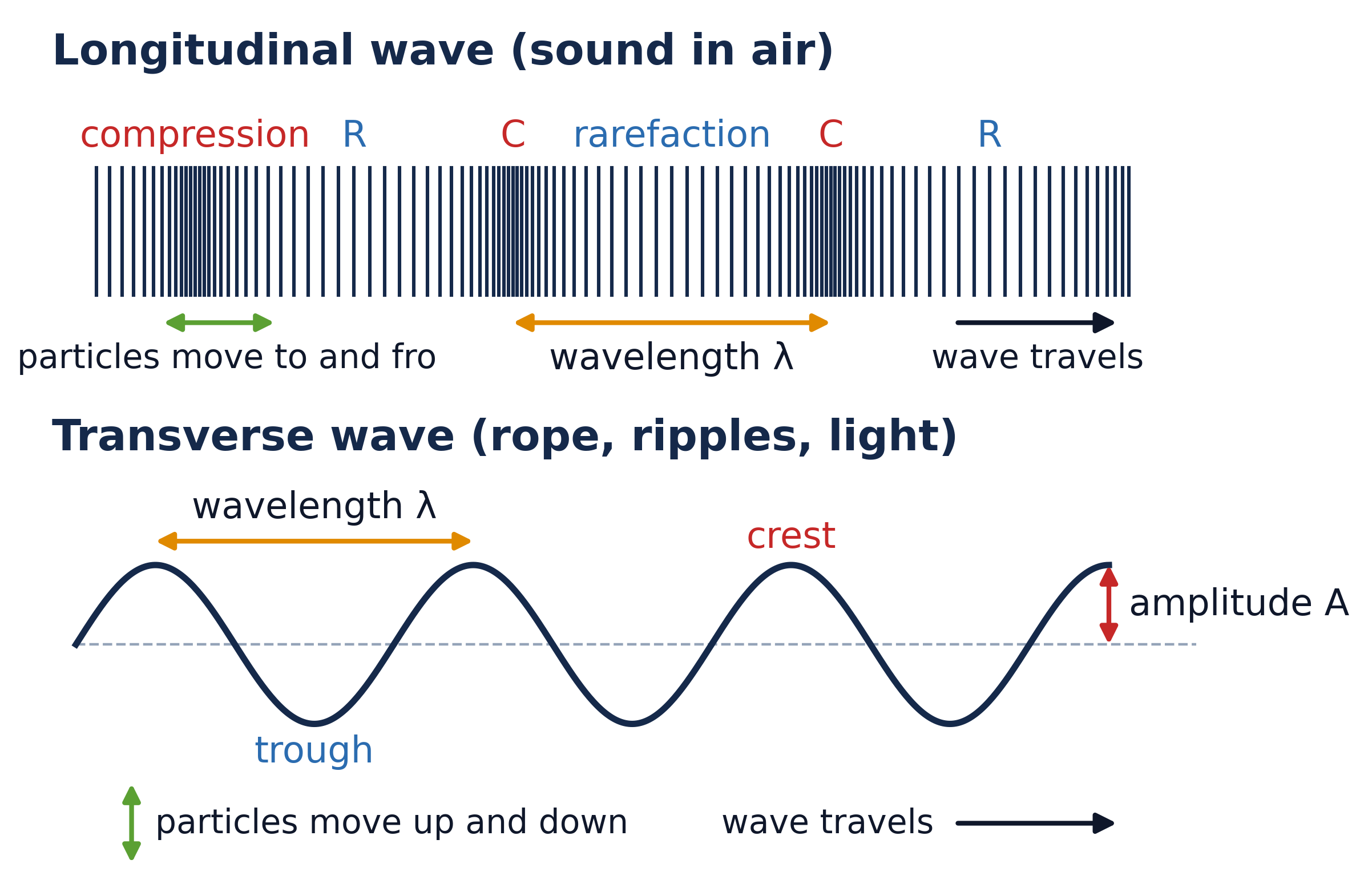
Sound in air is a longitudinal wave. The particles of air move to and fro along the line in which the wave travels. Where the particles are crowded together there is a compression (higher pressure and density). Where they are spread out there is a rarefaction (lower pressure and density). A sound wave in air is a train of compressions and rarefactions.
A transverse wave is the other kind. In a transverse wave the particles move at right angles to the direction of travel, making crests and troughs. Ripples on a pond and the wave on a shaken rope are transverse. Light is also transverse. Sound in a gas or a liquid is never transverse.
Shape and density. A transverse wave bends the medium sideways, so it changes the shape of the medium. Only a medium that resists a change of shape can carry it: a solid, a stretched string, or the surface of a liquid. A longitudinal wave squeezes and stretches the medium, so it changes the density (and the pressure) from place to place. Every medium resists being squeezed, so longitudinal waves travel in solids, liquids and gases. CDS I 2026 set these ideas as three statements, and all three were correct.
| Longitudinal wave | Transverse wave | |
|---|---|---|
| Particles move | along the direction of the wave | at right angles to the direction of the wave |
| The wave is made of | compressions and rarefactions | crests and troughs |
| What changes in the medium | its density and pressure | its shape |
| Can travel in | solids, liquids and gases | solids and stretched strings; the surface of a liquid |
| Examples | sound in air, in water, in a steel rail | a wave on a rope, ripples on water, light |
2. The words that describe a wave
| Quantity | Meaning | Symbol | SI unit |
|---|---|---|---|
| Wavelength | distance between two neighbouring compressions (or two neighbouring rarefactions) | \lambda | metre (m) |
| Frequency | number of complete vibrations in one second | f (NCERT also writes \nu) | hertz (Hz); 1 Hz = 1 vibration per second |
| Time period | time for one complete vibration | T | second (s) |
| Amplitude | the greatest disturbance from the rest position | A | for a displacement, metre |
| Wave speed | distance the wave travels in one second | v | metre per second (m/s) |
Two relations connect them:
T = \frac{1}{f} \qquad\qquad v = f\lambda
In one time period the wave moves forward by one wavelength, so speed = wavelength ÷ time period, which is f\lambda.
A small example. A tuning fork gives a note of 440 Hz in air where sound travels at 344 m/s. Its wavelength is \lambda = \dfrac{v}{f} = \dfrac{344}{440} \approx 0.78 m.
Counting waves. Both CDS questions on this section were about counting.
- One complete wave is one crest and one trough together (in sound, one compression and one rarefaction). A source that sends out 20 crests and 20 troughs has sent out 20 waves, not 40.
- If N complete waves are produced in a time t, the frequency is f = N/t. Twenty waves in 0.1 s is 200 Hz. CDS II 2025 gave these numbers with a speed of 330 m/s, so \lambda = 330 \div 200 = 1.65 m.
- A wave moves forward one wavelength in one time period. So a distance of N wavelengths takes N time periods: t = N \times T = N/f. The speed is not needed. CDS II 2024 asked how long a 300 Hz wave takes to travel 150 wavelengths in a medium whose wave speed was not given: 150 \div 300 = 0.5 s.
One more fact to hold on to. The frequency is fixed by the source. When a sound passes from air into water its frequency stays the same; its speed and wavelength change.
3. How fast sound travels
The speed of sound depends on the medium and on its temperature. It does not depend on how loud the sound is or on its frequency.
| Medium | Speed of sound (about) |
|---|---|
| Air at 0 °C | 331 m/s |
| Air at room temperature (22 to 25 °C) | 344 to 346 m/s |
| Water at 25 °C | 1,500 m/s |
| Steel | 6,000 m/s |
The figures are those of the NCERT table, rounded. Remember the order: sound is in general fastest in solids, slower in liquids, slowest in gases. A soldier who puts his ear to a railway line hears the train through the steel before he hears it through the air. In water at 20 °C the speed is close to 1,480 m/s, which is usually rounded to 1,500 m/s.
What changes the speed in air.
| Change | Effect on the speed of sound in air |
|---|---|
| Temperature rises | Speed rises (roughly 0.6 m/s for each degree Celsius) |
| Air becomes moist | Speed rises a little: moist air is less dense than dry air |
| Pressure changes, temperature kept the same | No change |
| Sound is louder, or of higher pitch | No change |
The pressure result surprises students. For a gas, Class 11 gives v = \sqrt{\dfrac{\gamma P}{\rho}}, where P is the pressure, \rho the density and \gamma a constant of the gas. If the pressure is doubled at the same temperature, the density doubles too. The ratio P/\rho does not change, so the speed does not change.
Sound is very slow beside light. Light travels at about 3 \times 10^8 m/s, close to a million times faster than sound in air. That is why you see the flash of lightning, or of a distant gun, before you hear it. If the thunder comes 5 s after the flash, the strike was about 340 \times 5 = 1700 m away.
An aircraft flying faster than sound is called supersonic. It produces a shock wave, heard on the ground as a sonic boom.
4. Pitch, loudness and quality
These are the three things the ear notices about a sound. Each one goes with one property of the wave.
| What we hear | Property of the wave | Example |
|---|---|---|
| Pitch (how shrill or how deep) | Frequency. Higher frequency, higher pitch | A whistle has a higher pitch than a drum. A child's voice has a higher pitch than a man's |
| Loudness | Amplitude. Larger amplitude, louder sound. Loudness is compared in decibels (dB) | Hit a tabla harder: the amplitude is larger and the sound louder, but the pitch is the same |
| Quality or timbre | The shape of the wave (the mix of frequencies in it) | A sitar and a flute playing the same note at the same loudness still sound different |
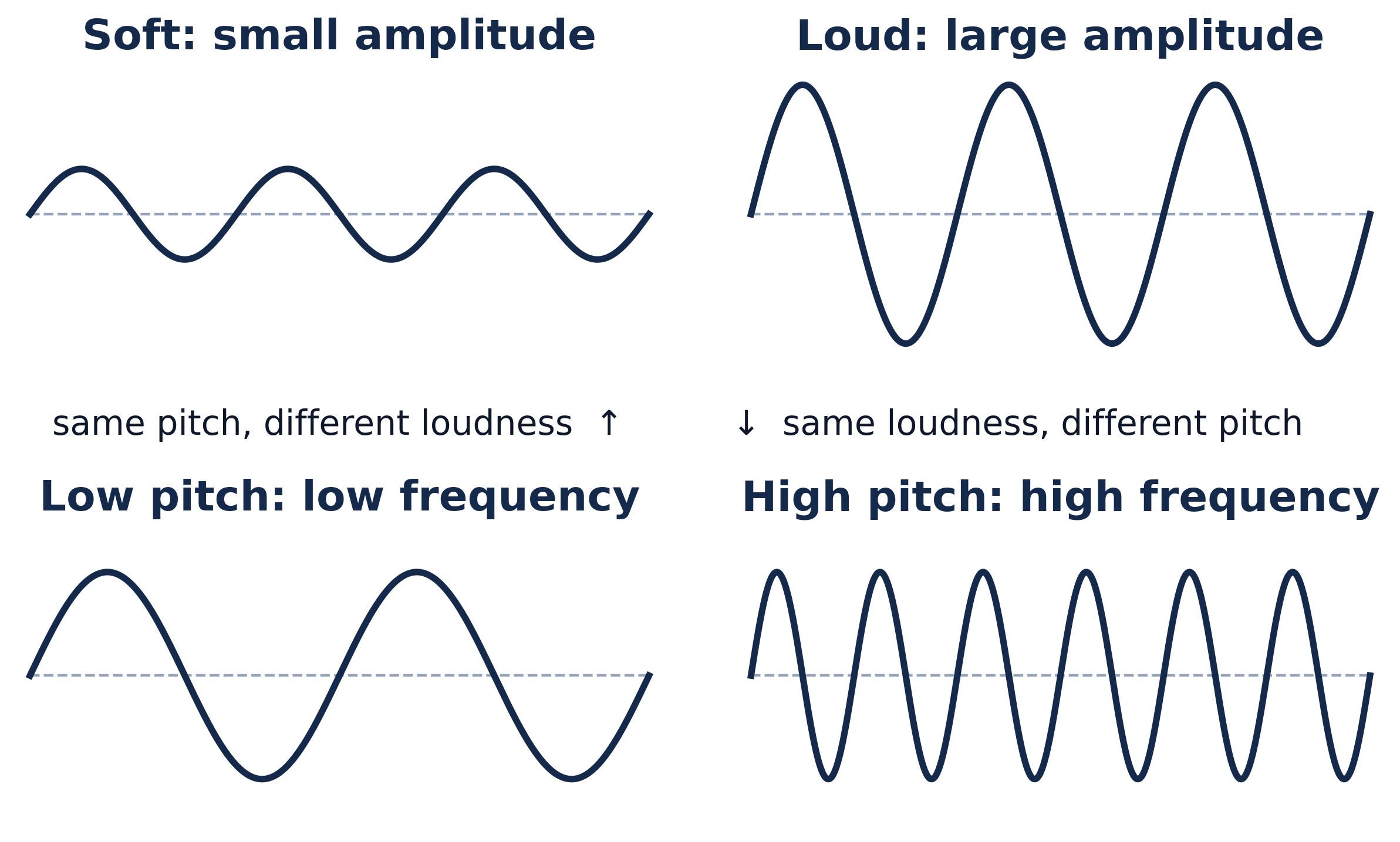
Loudness also falls as you move away from the source, because the same energy is spread over a larger area.
A sound of one single frequency is a tone. A pleasant mixture of frequencies is a note. An unpleasant, irregular sound is noise.
Beats. When two notes of nearly equal frequency sound together, the loudness rises and falls regularly. Each rise is a beat. The number of beats in one second is the difference of the two frequencies. Notes of 256 Hz and 260 Hz together give 4 beats a second. Musicians use beats to tune two strings to each other.
The Doppler effect. When a source of sound and a listener move towards each other, the listener hears a pitch higher than the true one. When they move apart, the pitch heard is lower. The whistle of a train seems to drop in pitch as the engine passes you on the platform. The source has not changed its frequency; the motion has changed the number of waves reaching the ear each second. Light and radio waves show the same effect, and a radar speed gun uses it.
5. The range of hearing: infrasound and ultrasound
| Name | Frequency | Who makes or hears it | Uses |
|---|---|---|---|
| Infrasound | below 20 Hz | whales, elephants and rhinoceroses; earthquakes produce it before the main shock | warning of earthquakes |
| Audible sound | 20 Hz to 20,000 Hz (20 kHz) | the human ear (children hear a little above 20 kHz; the upper limit falls with age) | speech, music |
| Ultrasound | above 20 kHz | bats, dolphins and porpoises make it; dogs can hear part of it | see below |
Ultrasound is ordinary sound of very high frequency. It still needs a medium. It travels at the same speed as audible sound in the same medium, so its wavelength is shorter. It can be reflected, refracted and absorbed like any other sound. "It travels faster" and "it cannot be reflected" are the usual false statements about ultrasound.
Because its wavelength is short, ultrasound travels in a narrow beam and is reflected by small objects. Its uses:
- Bats send out ultrasonic squeaks and judge the distance and direction of an obstacle or an insect from the reflected sound.
- Cleaning small or oddly shaped parts, such as watch parts and spiral tubes, in a liquid bath.
- Finding cracks and flaws inside metal blocks: the flaw reflects the ultrasound back.
- Medicine: ultrasonography (pictures of organs and of the unborn child), echocardiography (pictures of the heart), and breaking small kidney stones into fine grains.
- SONAR.
6. Reflection of sound: echo, reverberation, SONAR
Sound is reflected by a hard surface in the same way as light: the angle of incidence equals the angle of reflection.
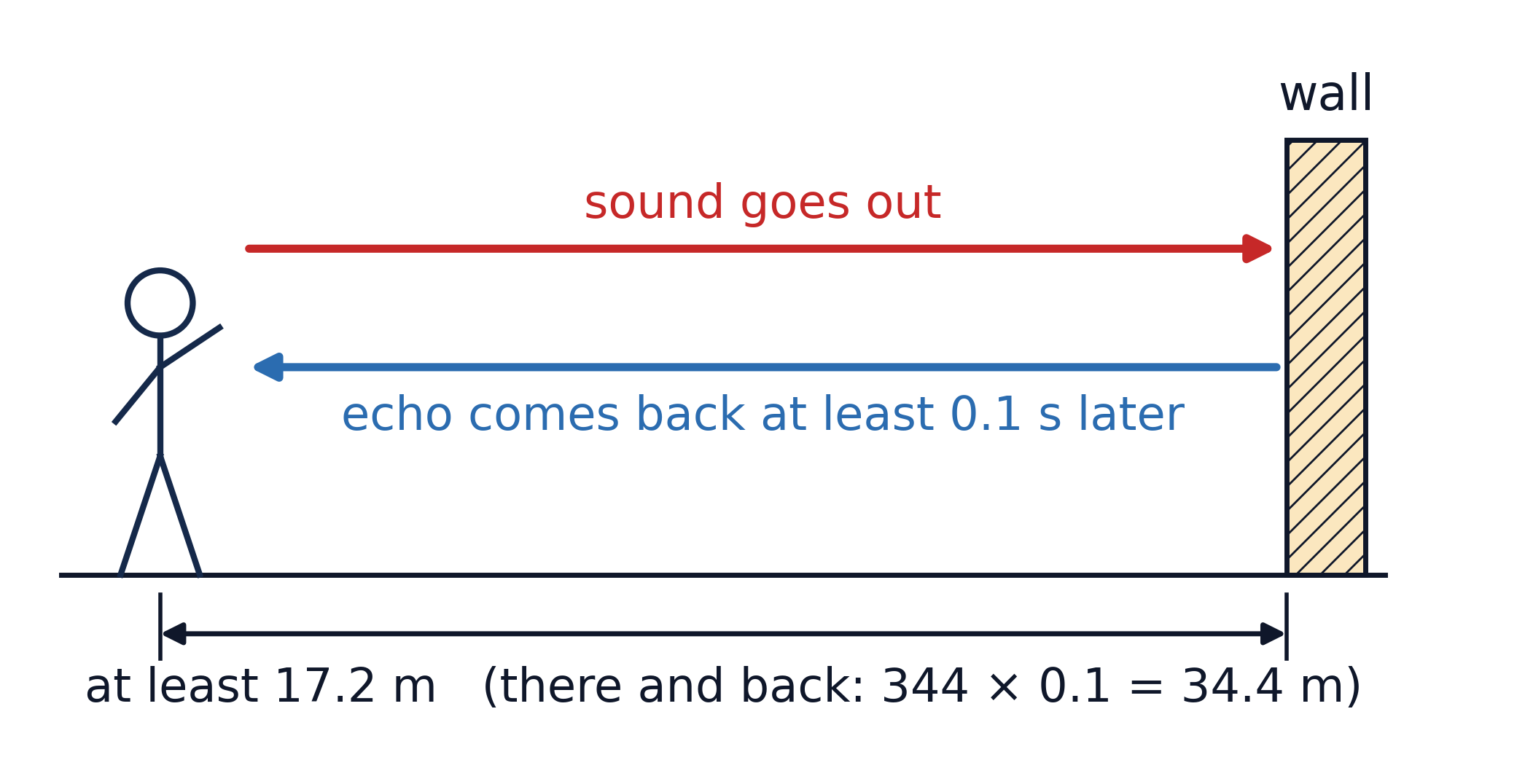
Echo. An echo is a reflected sound heard separately from the original. The sensation of a sound stays in the brain for about 0.1 s. So the reflected sound must arrive at least 0.1 s after the original. Taking the speed of sound as 344 m/s, the sound travels 344 \times 0.1 = 34.4 m in that time, there and back. The reflecting wall must therefore be at least half of that, 17.2 m, away.
For any echo, if d is the distance to the reflector and t the time for the sound to go and return:
2d = v \times t
Reverberation. In a big hall the sound is reflected again and again from the walls, ceiling and floor, and so it persists after the source has stopped. This is reverberation: many reflections running into one another, not one clear echo. Too much of it makes speech unclear. It is reduced with materials that absorb sound: heavy curtains, carpets, fibreboard, rough plaster, and the audience itself.
Many reflections put to use. A megaphone, a horn and a shehnai have a conical tube that sends the sound forward by repeated reflection. A doctor's stethoscope carries the sound of the heart to the ears by repeated reflection inside its tube. Curved ceilings in halls spread sound evenly.
SONAR stands for Sound Navigation and Ranging. A ship or submarine sends a pulse of ultrasound into the sea and times the echo.
- A transmitter under the ship sends out a pulse of ultrasound.
- The pulse is reflected by the sea bed, a shoal of fish, a wreck or a submarine.
- A detector receives the echo and measures the time t.
- The distance is d = \dfrac{v \times t}{2}, with v the speed of sound in sea water.
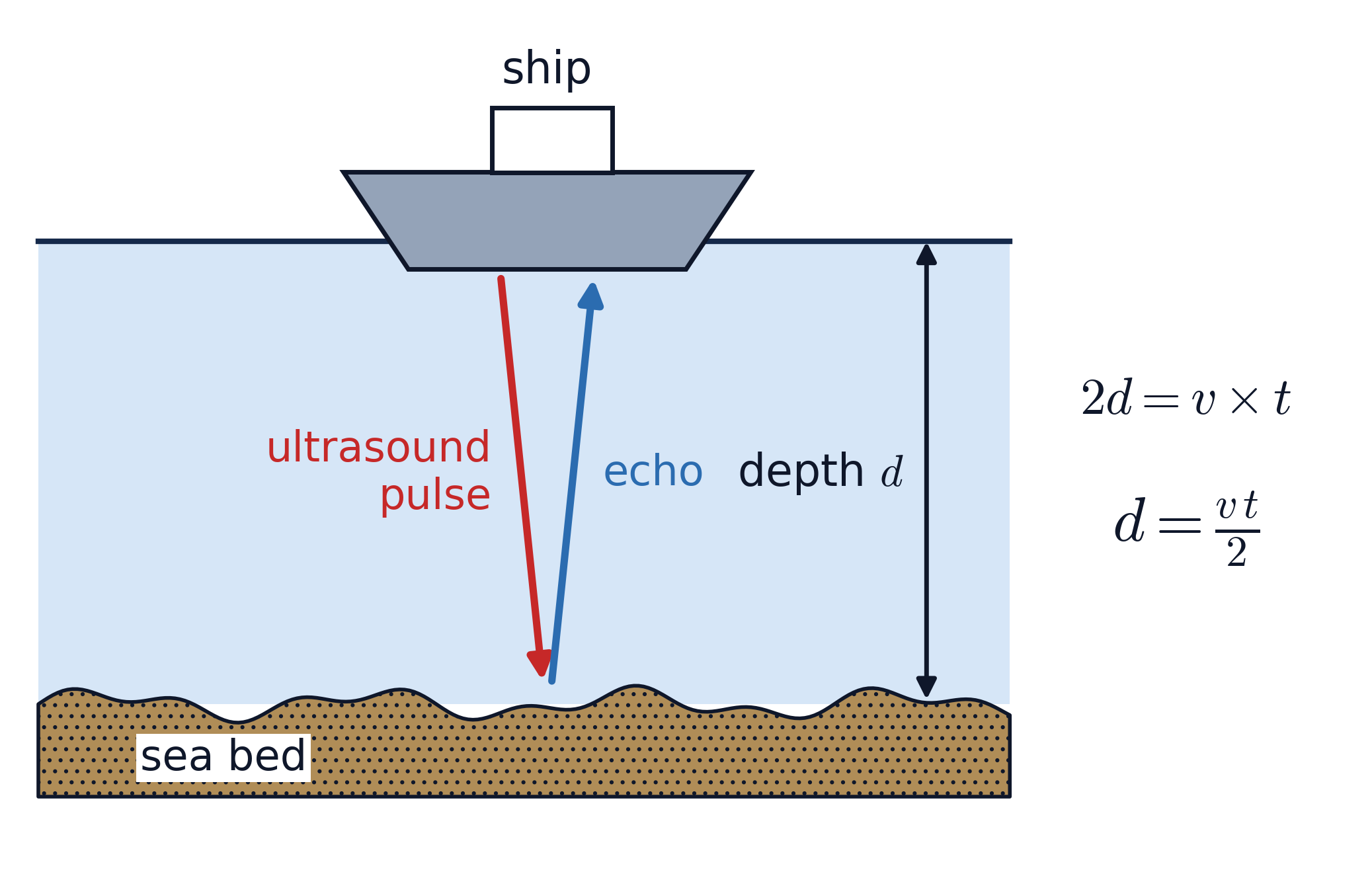
Finding distance in this way is called echo-ranging. Notice the difference from radar: radar uses radio waves, SONAR uses sound.
7. Musical instruments, in brief
No question on instruments came in the six papers, so one reading of this section is enough. Every instrument has something that vibrates. Learn only the simple idea: what vibrates, and how the player changes the pitch.
| Family | What vibrates | Examples | How the pitch is raised |
|---|---|---|---|
| Stringed instruments | a stretched string | sitar, veena, violin, guitar, ektara, santoor | a shorter, tighter or thinner string |
| Wind instruments | the column of air inside | flute (bansuri), shehnai, nadaswaram, trumpet, harmonium (air drives its reeds) | a shorter air column: opening a hole in a flute shortens the column |
| Membrane instruments (drums) | a stretched skin | tabla, mridangam, dholak, drum | a tighter or smaller skin |
| Solid instruments | the body itself | manjira (cymbals), ghatam, jal tarang, bell | a smaller or stiffer body |
For a stretched string, Class 11 gives the lowest frequency as f = \dfrac{1}{2L}\sqrt{\dfrac{T}{\mu}}, where L is the vibrating length, T the tension and \mu the mass of one metre of string. You do not need the formula for calculation here. Read from it three facts: the frequency is higher when the string is shorter, when it is tighter and when it is lighter. A sitar player presses the string on a fret to shorten it. A tabla player hammers the wedges to tighten the skin.
The hollow box of a guitar or a veena does not make the note. It makes the sound louder: the box and the air inside it are set vibrating by the string and push much more air than a thin string can.
What the papers have asked
These are all the questions on this chapter in the 6 papers from CDS I 2024 to CDS II 2026, in our own words. The answers are our own working.
| Paper | The idea asked | The answer in one line |
|---|---|---|
| CDS II 2024 | A sound wave of frequency 300 Hz travels in a medium that is not named. How long does it take to cover 150 wavelengths? | One wavelength takes one time period, 1/300 s. So 150 \div 300 = 0.5 s. The speed is not needed |
| CDS II 2025 | A sound wave moving at 330 m/s produces 20 crests and 20 troughs in 0.1 s. Find its wavelength | 20 complete waves in 0.1 s is 200 Hz. \lambda = 330 \div 200 = 1.65 m. Counting 40 waves gives the wrong option |
| CDS I 2026 | Three statements: particles moving along the wave make it longitudinal; particles moving at right angles make it transverse; transverse waves change the shape of the medium and longitudinal waves its density | All three are correct |
Both calculations were built to catch one slip: counting a crest and a trough as two waves, or hunting for a speed that is not needed. The facts a paper can pick next are in sections 3 to 6: the order of speeds in solids, liquids and gases, pitch against loudness, the range of hearing, ultrasound and its uses, echo, reverberation and SONAR.
Worked examples
Example 1 (a single fact). Two astronauts stand a few metres apart on the surface of the Moon. Why can they not hear each other without radio?
(a) Sound is absorbed by their helmets (b) There is no medium to carry sound (c) The Moon's gravity is too weak (d) Sound is too slow there
Solution. Sound is a mechanical wave. It travels by passing a disturbance from particle to particle, and the Moon has no atmosphere to do this. Gravity has nothing to do with it, so (c) is the tempting wrong option. Radio waves are electromagnetic and cross the vacuum. Answer (b).
Example 2 (statements). Consider the following statements:
- Sound waves in air are longitudinal.
- Ultrasound travels faster in air than audible sound does.
- A louder sound has a larger amplitude.
Which of the statements given above are correct?
(a) 1 and 2 only (b) 2 and 3 only (c) 1 and 3 only (d) 1, 2 and 3
Solution. Statement 1 is correct: the air particles move along the direction of travel. Statement 3 is correct: loudness goes with amplitude. Statement 2 is wrong. Ultrasound has a higher frequency, but in the same medium at the same temperature every frequency travels at the same speed. The higher frequency means a shorter wavelength, not a higher speed. Answer (c).
Example 3 (a short calculation). A man fires a rifle in front of a cliff and hears the echo 3 s later. The speed of sound is 340 m/s. How far away is the cliff?
(a) 113 m (b) 510 m (c) 1020 m (d) 2040 m
Solution. In 3 s the sound travels 340 \times 3 = 1020 m. This is the path to the cliff and back, so the cliff is 1020 \div 2 = 510 m away. Option (c) forgets to halve. Answer (b).
Example 4 (a short calculation). The ear hears sounds from 20 Hz to 20 kHz. In air where the speed of sound is 344 m/s, what are the longest and shortest wavelengths of audible sound?
Solution. Use \lambda = v/f. The lowest frequency gives the longest wavelength: 344 \div 20 = 17.2 m. The highest frequency gives the shortest: 344 \div 20000 = 0.0172 m, which is 1.72 cm. So audible sound in air has wavelengths from about 1.7 cm to about 17 m.
Example 5 (matching lists). Match each instrument with the part that vibrates to make its sound.
| List I | List II |
|---|---|
| A. Veena | 1. Air column |
| B. Bansuri | 2. Stretched membrane |
| C. Mridangam | 3. Stretched string |
| D. Manjira | 4. The metal body itself |
(a) A-3, B-1, C-2, D-4 (b) A-1, B-3, C-2, D-4 (c) A-3, B-1, C-4, D-2 (d) A-2, B-1, C-3, D-4
Solution. The veena is a stringed instrument (3). The bansuri is a flute, so its air column vibrates (1). The mridangam is a drum with a stretched skin (2). The manjira is a pair of small cymbals, and the metal itself vibrates (4). Answer (a).
Example 6 (two ideas). A SONAR pulse sent straight down from a ship returns after 4 s. The speed of sound in sea water is 1500 m/s. A sailor says the sea is 6000 m deep. Is he right?
Solution. No. The pulse travels down and up, so 2d = 1500 \times 4 = 6000 m and the depth is d = 3000 m. The sailor has given the whole path.
Mistakes that cost marks
- Counting a crest and a trough as two waves. One crest and one trough make one wave. Twenty crests and twenty troughs are twenty waves.
- Forgetting to halve in an echo or SONAR question. The time given is for the journey there and back. Write 2d = vt before you put in any number.
- Mixing up pitch and loudness. Pitch goes with frequency. Loudness goes with amplitude. Hitting a drum harder makes it louder, not higher.
- Thinking ultrasound is faster. "Ultra" refers to frequency. In the same medium the speed is the same for all frequencies. Likewise "supersonic" is about the speed of an object and "ultrasonic" is about the frequency of a sound.
- Calling sound transverse, or an electromagnetic wave. Sound in air is longitudinal and mechanical. It needs a medium. Light is transverse and electromagnetic. It needs none.
Quick check
Do these without help. Answers are at the end.
- A sound wave has a frequency of 500 Hz and a wavelength of 0.68 m. What is its speed?
- Which property of a sound wave decides its pitch?
- What is the least distance of a wall for a clear echo, if the speed of sound is 344 m/s?
- Name the range of frequencies the human ear can hear, and the name for sound above this range.
- In which of these does sound travel fastest: air, water, steel?
Read and watch more, free
| What | Where | Language |
|---|---|---|
| Textbook | NCERT textbooks, the book menu: Class 9 Science Exploration, Chapter 10 Sound Waves | English, Hindi |
| Textbook, for transverse and longitudinal waves, speed of sound in a gas, beats and strings | NCERT textbooks, the book menu: Class 11 Physics Part II, Chapter 14 Waves | English, Hindi |
| Self-study lesson | NIOS Secondary course, Science and Technology (212), Lesson 18 Sound and Communication, on the NIOS website under online course material | English, Hindi |
| The real papers | UPSC previous question papers (CDS, General Knowledge; the physics block is ten questions) | English, Hindi |
| Video, revision in one class | The Journey Extraordinary: GS Revision Package for the 2026 sittings (the physics class, with six years of past questions; about ten hours, so use the part on this chapter) | Hinglish |
| Video, topic classes | CDS Wallah: CDS Exam Full Playlist, CDS 1 2026 (the physics classes; three to six hours each) | Hinglish |
| Video, past questions | Chandigarh Career Group: CDS General Studies PYQ (the channel also has a list of CDS physics past questions) | Hinglish |
The NCERT and NIOS books are named in words because the book pages move; open the book list and choose the class and subject. The videos were chosen from their titles, length and views; they have not yet been watched by a teacher.
Answers to the quick check
- v = f\lambda = 500 \times 0.68 = 340 m/s.
- Its frequency. A higher frequency gives a higher pitch.
- 17.2 m. The echo must come at least 0.1 s later, so the sound must travel 344 \times 0.1 = 34.4 m there and back.
- 20 Hz to 20,000 Hz. Sound above 20,000 Hz is ultrasound.
- Steel. Sound is fastest in solids and slowest in gases.
Next chapter: Light: reflection and refraction.